




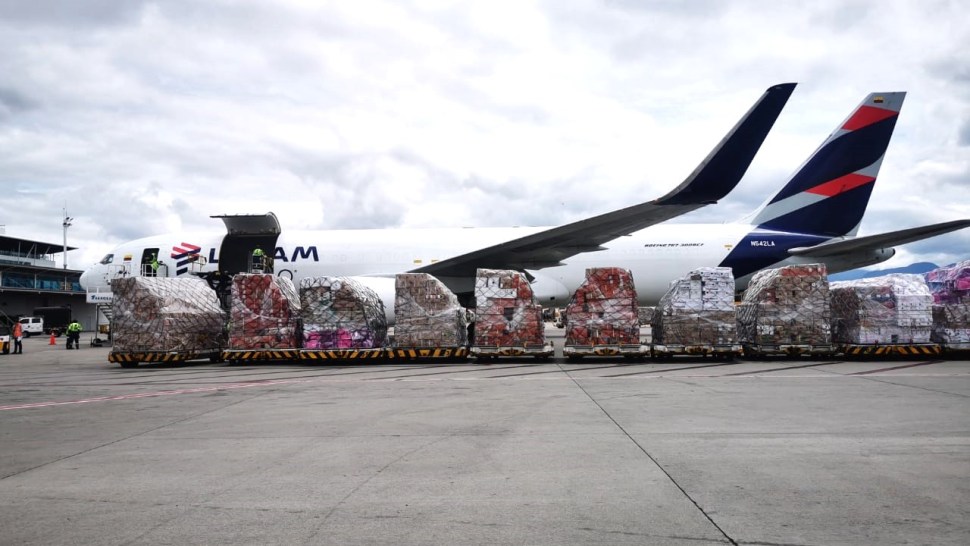
Latam Airlines Group announced Wednesday it will build and finance a new cargo terminal at El Dorado International Airport in Bogotá, Colombia, tripling its existing work space and enabling faster processing of import and export shipments.
The expansion project is part of a new plan to upgrade cargo handling infrastructure at its primary operating hubs.
The 46,400-square foot El Dorado facility will also allow Latam’s cargo division to expand cold storage capacity by about 20% to support the growth of the flower export market, where Latam says it already holds a 35% market share.
Latam Cargo also said it plans to expand its domestic cargo facilities in Bogotá and establish a new space dedicated to handling the growing inflow of imported cargo.
“This investment is essential to leverage the airline’s future growth plans in the Colombian market and represents a renewed vote of confidence by LATAM Group in the country,” said Santiago Álvarez, chief commercial officer of Latam Cargo, in a news release.
Why It Matters: Latam is the largest airline in South America and its freighter division operates 19 Boeing 767-300 converted cargo jets.
Latam has also made improvements at three regional airports in Colombia to more efficiently transfer cargo carried on passenger flights. The enhancements inluce expanding warehouse space, upgrading X-ray screening equipment and implement new counter technologies to expedite cargo acceptance and drop-off.
More broadly, Latam is striving to digitize end-to-end data exchange with industry stakeholders and customs authorities to improve service and efficiency.
The physical expansion is coupled with a digital transformation strategy. In Colombia specifically, it has deployed artificial intelligence and RFID-based tracking tools for flower shipments, complemented by the CargoLink platform for advance cargo acceptance.
Virtual reality warehouse training
Last month, Latam Cargo revealed the deployment of virtual reality technology for training warehouse personnel at its Miami hub. The initiative strengthens operational safety by allowing teams to practice, manage, and respond to real-time scenarios within a controlled digital environment.
In its initial phase, the custom-designed program will cover about 550 employees, including 250 forklift operators. Unlike conventional training methods, the immersive platform captures precise behavioral metrics, including contingency response times as well as the immediate identification and mitigation of hazards.
To ensure complete operational realism, the simulators — co-developed with LATAM Group’s internal training arm, Academia LATAM — feature scenarios across six warehouse pedestrian zones and three specialized modules for forklift drivers. During training, personnel navigate high-risk procedures such as dangerous goods segregation, cargo handling, pedestrian traffic flow, and machinery separation protocol, boosting their overall situational awareness.
Following an initial rollout for onboarding training at the Fast Air warehouse in Santiago, Chile, the Miami launch marks a major scale-up, adding broader operational scenarios.
Latam said it is currently assessing the expansion of this VR training system to other strategic hubs, including in Brazil.
Click here for more FreightWaves/American Shipper stories by Eric Kulisch.
Write to Eric Kulisch at ekulisch@freightwaves.com.
RELATED STORIES:
Latam Airlines dusts off Covid playbook to move cargo in passenger cabin
Latam Cargo airlifts armored vehicles to Peru for Pope Leo visit
