New York–It is increasingly clear that before the end of 2026, the New York City Council will likely pass legislation that will be called the Delivery Protection Act, a law that from the start had Amazon and its Delivery Service Provider (DSP) model in its sights.
What is not known is what will be in it. But it won’t be the same as what was originally introduced.
The Act, which has the the backing of New York Mayor Zohran Mamdani, was considered draconian by Amazon and its DSPs when first introduced in February. They saw in it a threat to the basic Amazon business model where an individually-owned DSP, not the e-commerce giant, delivers the actual packages and employs the workers under a contract with Amazon (NASDAQ: AMZN).
In New York City, there are about 100 individually-owned DSPs under that structure.
But given the bill’s requirement that what it refers to as a “last mile facility operator” would need to be licensed by the city, and that other requirements governing what a last mile facility operator can and can not do (third party subcontracting would be banned), the law if passed as first introduced would effectively require Amazon to buy up all its NYC DSPs.
Who’s your employer?
And then the workers who are now employed by a DSP would become Amazon employees, getting their W-2 tax form from that company.
The hammer in the proposed law that could require Amazon to do a lot of things it might not want to do otherwise is the provision that “any license may be suspended or revoked by the commissioner, upon due notice and hearing, for the failure of a licensee to comply with any applicable provision of law or any rule duly promulgated by the commissioner.”
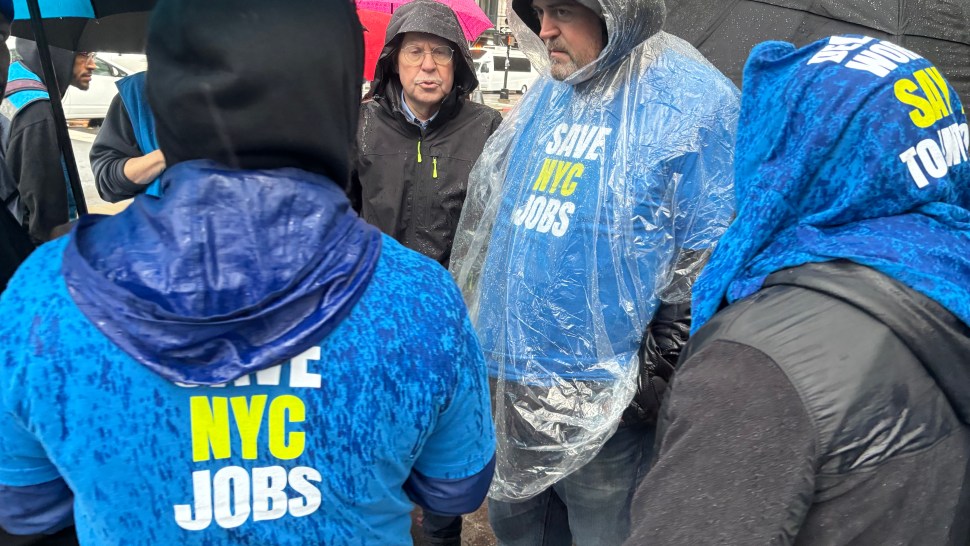
But at a rally Thursday on the steps of New York’s City Hall, in a driving rain with lightning overhead accompanied by cracks of thunder, and in separate discussions, the growing consensus is that whatever comes out of the City Council and signed by the mayor will not be the bill as it is currently written.
What happens with the legislation could have national implications.
The model of the New York Delivery Protection Act is being proposed in Chicago. Although there are not known to be any other cities where the Delivery Protection Act model is being pursued, what is happening in New York has drawn national coverage and might not be limited to New York and Chicago if it passes.
The rally, sponsored by New York Delivers, a coalition that includes Amazon, was not the first gathering on the steps of City Hall by the DPSs. There was a similar rally in April, before the only hearing that has taken place on the bill. Opponents of the bill also made their voices heard at City Hall in February.
The April rally was a dueling showdown of advocates; a large group of Delivery Protection Act backers, organized by the Teamsters, also demonstrated that day. The Teamsters also held a City Hall rally last month.
Not getting public City Council backing
One big difference between the two recent gatherings: there have been City Council members beyond bill sponsor Tiffany Caban at the Teamsters rallies. There have not been City Council members at the New York Delivers events. (Although one City Council member who had backed the bill recently switched sides, generating coverage in The New York Post.)
Business leaders make their stand
What the forces fighting the Delivery Protection Act have are all five of the city’s borough-based Chambers of Commerce, which have focused on the core argument against the Caban bill: the DSPs are locally-owned small businesses, with more than a quarter of them led by people of color. They are in all five boroughs, led by entrepreneurs, employing thousands. Some of them are veterans.
Opponents of the bill also argue there is no guarantee that if the Delivery Protection Act passes as is, the legality of the mandate for a last mile delivery company to hire workers cut loose by the company is questionable and that the enforcement mechanism of denying a re-licensing could still leave workers out of a job while the process plays out.
The other scenario raised by the bill’s opponents would be for Amazon to move some of its warehouse-based activities across borders–into Nassau County from Queens, into Westchester County from the Bronx, for example–and have the DSPs pick up their packages there.
“I think we are at a point where the City Council clearly wants to move something, and there are negotiations happening now about what the final bill is going to look like,” Jessica Walker, president and CEO of the Manhattan Chamber of Commerce, told FreightWaves at the rally. Walker also addressed the crowd standing on the City Hall steps.
She added that the negotiations are not with the outside opponents on one side of the table, arguing against the bill. Rather, Walker said, “all the Council members have to talk to one another and figure out the best route.”
The role of the speaker
Another key player in the process will be Julie Menin, speaker of the City Council.
A recent article in The New York Times cited sources that said Menin “is concerned that the bill might cost the city jobs and lead Amazon to jack up prices.”
But with the bill having enough co-sponsors to pass easily, as long as the speaker allows it to get to the City Council floor, Menin also provided a statement to the Times that was broadly in support of the legislation.
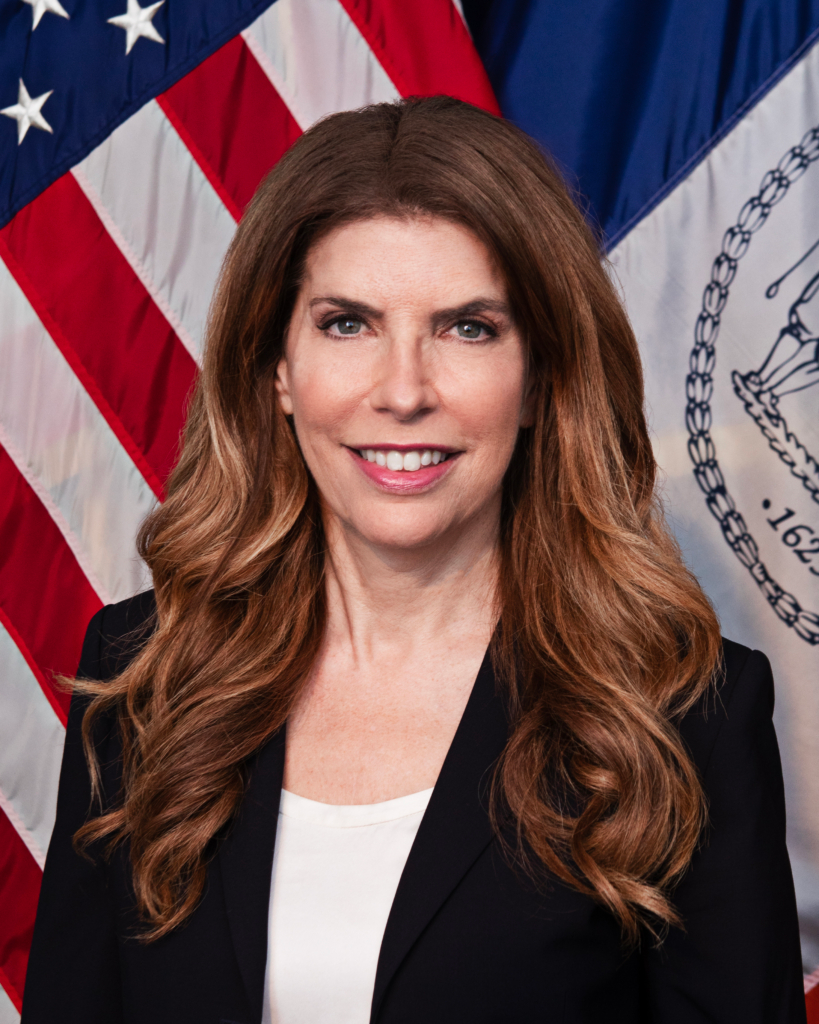
Council speaker Julie Menin
“New York City regulates everything from nail salons to barbershops, yet major online retailers like Amazon have gone unregulated for far too long,” she said, according to the Times. “It’s time for Amazon to adhere to a licensing framework that ensures fair pay, strong worker protections and more responsible delivery practices that don’t leave vehicles idling on our streets for hours.”
Lawyer up!
What is accepted by all sides is that if–when–the bill passes and is signed by the mayor, lengthy litigation will commence. Given that, backers of the bill reportedly are looking for compromise legislation that would take certain issues out of any subsequent litigation and more easily get to some form of regulation.
To do that, the final bill may fall short of the nuclear option that would effectively require Amazon to purchase the DSPs.
Walker said of the negotiations going on within the Council that “what we want to do is get a solid bill that is going to address the concerns that we all have about street safety and worker protection.The problem is the bill as draft doesn’t do that.”
Some of the issues raised by the backers of the bill that seem ripe for compromise might target delivery quotas at DSPs, with the idea that drivers under mandates for delivering a large number of packages in a period of time that seems like a herculean task could also be contributing to traffic safety issues.
“Studies show the big problem is around street safety, especially around the warehouses,” Walker said. She added that there already are multiple city agencies that deal with worker safety, as well as federal involvement. “So to the extent that they are not protecting workers, then we need to ramp up their enforcement activities,” Walker said.
“We’re putting forward other solutions that we think would actually do more, while again not eliminating 100 small businesses in the five boroughs,” Walker said.
Why isn’t it good for us?
Randy Peers, the president and CEO of the Brooklyn Chamber of Commerce, addressed the City Hall rally with a fiery short speech that contained a few expletives. Peers was probably the most vociferous opponent at a panel of the Chamber of Commerce executives at the April hearing.
Citing the number 1,137, Peers said “that’s the amount of subcontractors just the (city’s Department of Transportation) uses. Eighty five of those subcontractors are under the category of courier trucking or logistics. They spend $458 million in subcontracted work. Same model, same city, different rules. Why is that? If it’s good enough for the city and the city agencies, why is it not good enough for these workers here?”
Role of FedEx
One question being raised by the opponents of the bill is why has FedEx (NYSE: FDX) not been as obviously active in the fight, unlike Amazon.
The FedEx model is similar to how Amazon is structured, though their individual contractors are called Independent Service Providers (ISPs). They are not owned by FedEx, and for some of them, their owners could be individuals that also own one or multiple Amazon DSPs.
FedEx is a member of the New York Delivers coalition. But it’s also notable that at rallies pushing back against the bill, Amazon DSP owners are highlighted, and many of the workers attending the gatherings wear their Amazon-branded garb. FedEx is barely mentioned.
But the backers of the bill, at their rallies, barely mention FedEx either.
An email sent to FedEx had not been responded to by publication time.
More articles by John Kingston
Teamsters say they’ve organized Amazon employees in Indiana; company demurs
Transportation committee in House set for overhaul post-election
New cyber thief gang targets transports; Hunt, Ryder and Echo hit