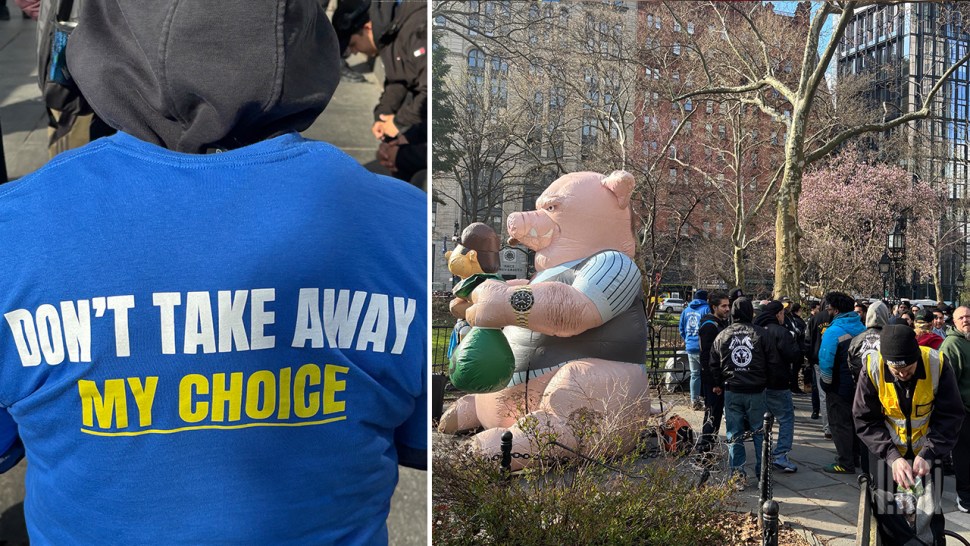
New York–The proposed legislation before the New York City Council that would, among other things, likely force the closure of Amazon’s direct service providers (DSPs) in the city with their activities absorbed into Amazon itself was on center stage Thursday at Gotham’s City Hall, the day kicking off with loud demonstrations outside by supporters and opponents.
But inside the city council chambers, a hearing before the Committee on Worker and Consumer Protection, while exhibiting its own fair amount of bombast, could be seen in one 45-minute presentation as moving toward a possible compromise on a bill that can realistically be described as “draconian.”
Testimony kicked off at 10 a.m. It closed around 5 p.m.
But it was the panel discussion midmorning with three borough chamber of commerce presidents–Brooklyn, the Bronx and Manhattan–that turned the conversation from a litany of complaints and accusations about Amazon to a more practical topic: what happens to the workers if the DSPs disappear and their activities are directly performed by the e-commerce giant? (Zach Miller, the vice president of government affairs at the Trucking Association of New York, also was on the panel).
The stakes in New York City can’t be overstated for Amazon (NASDAQ: AMZN). The fundamental business model for Amazon and other companies that make local deliveries, like FedEX (NYSE: FDX), is that much of that task (or in the case of Amazon, all of it), are made by separate, independently-owned companies operating under a contract with the larger entity. The workers are employees of the smaller delivery company, like an Amazon DSP.
The Delivery Protection Act, as it is called, currently has just over 30 co-sponsors in a chamber of 51. The original bill introduced near the end of the session that ended December 31, 2025, had more than 40 co-sponsors. That bill died when the calendar on the year ran out and a new Council was seated, when it was reintroduced.
There are several key provisions in the act that could be the most disruptive to current economic models.
Big changes projected by the law
One is a requirement that delivery companies be licensed by the city, with the license regulated by the city’s Department of Consumer and Worker Protection (DCWP). That department would have the ability to deny or revoke a license to a company based on various standards of conduct, and the law’s backers and their recitation of various Amazon practices make clear that many Amazon policies might put the company in DCWP’s crosshairs.
Another is that the delivery companies, which are defined as those that also operate warehouse facilities, can not contract out their work to a third party. The warehouse is key; a retail store that makes a delivery out of its bricks and mortar operations would not fall under the law.
The entire Amazon DSP model rests on that subcontracting.
Teamsters and sponsor have been out demonstrating already
Most of the discussion on the bill so far has been driven by its supporters. Its sponsor is Council member Tiffany Caban, and the Teamsters is a major backer.
A rally in February on City Hall’s steps was attended by well over 100 Teamsters and DSP workers, as well as Caban. A protest against the closure of some DSPs in Queens in September featured an address by Caban, who discussed her legislation that was introduced soon after.
A similar Teamsters-driven rally was held at a small park in front of City Hall Thursday prior to the hearing. Separately, DSP workers opposing the bill lined up on either side of the park to get into their own rally on the steps of the building, but faced a limitation on attendance at the event that a long-term observer of New York City governance told FreightWaves was rare.
In the chamber itself, the anti-legislation attendance in the audience looked like it had surpassed the number of pro-legislation workers in the room. At the Teamsters rally, their speakers had an explanation for that: the DSP workers were bribed or scared, but no evidence of that was presented.
When the chamber of commerce presidents began their presentation, the subject matter shifted away from anti-Amazon criticism and to a larger question: what happens to the DSPs and their workers if Amazon needs to bring them under its roof in New York City?
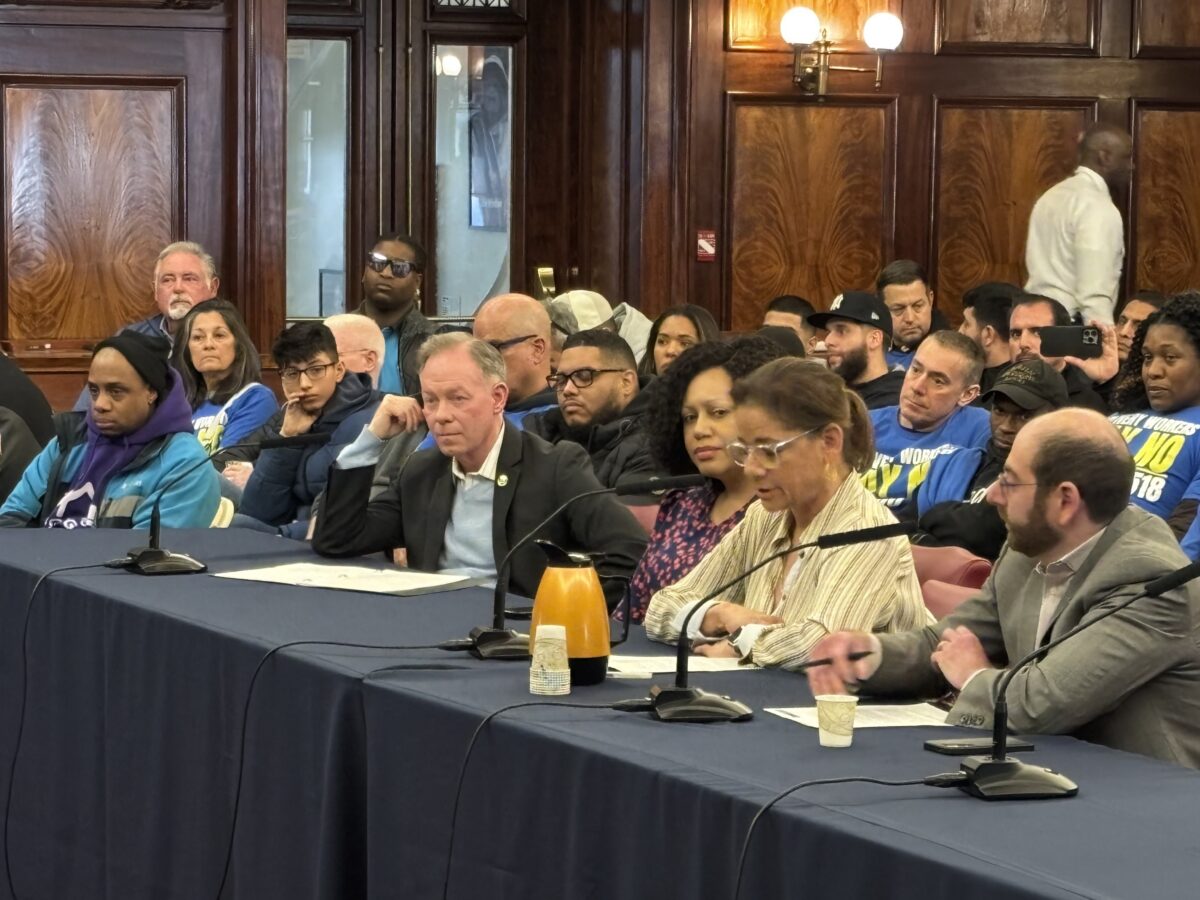
(From left to right at the table: Randy Peers, Brooklyn Chamber of Commerce; Jessica Walker, Manhattan Chamber
of Commerce; Lisa Soren, Bronx Chamber of Commerce; Zach Miller, Trucking Association of New York).
Randy Peers, the president of the Brooklyn Chamber of Commerce, didn’t speak first, but his words were the most stark.
“The licensing requirement is a red herring,” Peers said. “This is not about the proliferation of these facilities in our communities, because you can address that through capping them or through proximity laws, like we do with liquor licenses.”
The proposed law, he said, is “all about the direct hire mandate. At the end of the day, this direct hire mandate puts a whole sub sector of our economy out of business. This is a fact.”
Would the rehiring provision stand up in court?
According to the Delivery Protection Act, if a facility operator needs to terminate a subcontractor because of the death of the third-party model, “the facility operator shall offer to rehire those terminated workers as employees, to perform the same work they had previously performed, before offering to hire any other workers as employees. Offers to rehire such terminated workers shall include a preservation of rights, privileges, and benefits under existing collective bargaining or other agreements and terms no lesser than those in effect at the time of the termination.”
Peere said “no court in the United States is going to force a company to hire a particular classification of workers, so I don’t think that holds water.”
“The reality is we’re cutting a full subsector of our economy, of small businesses,” Peers said. “We’re shutting them down.”
It was that point that seemed to get the attention of the Council committee members, most of whom had spoken positively of the legislation earlier.
Council member Chris Bass, who in earlier comments had roundly criticized Amazon, softened his tone during question and answers with the chamber of commerce representatives.
Banks said he wanted to “get to the middle.” “I don’t want to completely annihilate small business owners who I know very well, who have stabilized some of our local communities or local hiring,” Banks said. “At the same time there is a need for worker protection, and I think that’s the middle where we come to. So can you give or suggest some improvements to the bill where we can get to a middle point?”
Peers said the elimination of the direct hire requirement was “first and foremost.” (However, the bill’s backers might argue that move would thoroughly undermine their goal.)
Babies and bathwater
Council member Shirley Aldebol said she didn’t want to “throw away the baby with the bath water,” and asked whether there were less drastic steps that could be taken to promote various other goals like worker safety.
Aldebol conceded that a closing of a DSP in the South Bronx, with 100 to 125 employees, means “you’re losing a huge amount of people.”
Committee chair Harvey Epstein noted, however, that closing the DSPs does not eliminate the need to deliver the packages.
There was discussion of other steps that the city could take to benefit delivery drivers. For example, a city-wide training regime was mentioned.
Jessica Walker, president of the Manhattan Chamber of Commerce, fired off several suggestions including regulating worker quotas, as protesters at pro-legislation rallies have often cited the number of deliveries a DSP worker must make in a given shift as being unrealistic. (The specter of a driver being required to urinate into a plastic jug was brought up, an activity that long-distance truck drivers know all too well.)
“None of these would require decimating the business,” Walker said.
The human aspect of the bill extends beyond the drivers, as some testimony made clear.
Owner’s view is heard
Mark Facchin is a DSP owner who testified before the Council. “Owning and running a logistics company requires a lot of up front capital and access to lines of credit to make sure we keep our fleet of trucks current, safe and mechanically sound,” he said in his testimony.
Facchin said he and other DSP owners are largely in the same financial situation. “A lot of us have personal guarantees to the Small Business Administration for loans we took to start our businesses and Economic Injury Disaster Loan (EIDL) loans we took during COVID to keep our businesses afloat, bank loans and lines of credit and credit card balances to make sure our operating bills are paid,” he said. “What the City Council is proposing is to make a draconian law that will force my legal entity to be shut down.”
And where was Amazon in the hearing?
The day before the event, it released testimony it submitted to the committee.
It touched on several issues, but one key area was its response to suggestions–amplified by testimony at the hearing by representatives from the city’s comptroller office–that Amazon’s operations were a safety risk.
The Amazon statement said that was a “misconception.”
“The safety of our employees, partners, and the communities we operate in is our top priority,” the Amazon testimony said. “Since 2019, we’ve demonstrated consistent and significant safety improvement at our facilities, with our Recordable Incident Rate improving by 43% and our Lost Time Incident Rate improving by 70% across our global operations.”
The testimony also put an estimate that Amazon “supports more than 25,000 full- and part-time employees in New York City, more than 2,000 of whom work at our local delivery facilities that operate in all five boroughs.”
More articles by John Kingston
3 carriers and Kroger blocked hiring of ex-Quickway drivers: lawsuit
Two solid ‘yes’ votes for Echo Global’s acquisition: Moody’s and S&P
Will the end of DEF sensors mean a reduction in its consumption?
Brokerage Compliance Symposium
The day before F3. Every compliance issue you face - fraud exposure, carrier liability, FMCSA rules, cargo theft, insurance gaps - navigated by attorneys and operators defining best practices in a changing industry.
F3 Awards Dinner
The night before F3. FreightTech100 companies honored. FreightTech 25 and Shipper of Choice winners revealed live. Cocktail reception into dinner and live music - 300 industry leaders in one purpose-built room.
F3: Future of Freight Festival
Industry-defining keynotes, rapid-fire technology demos, and industry leaders networking in experiences across Chattanooga - plus the inaugural F3 Awards Dinner featuring the FreightTech and Shipper of Choice reveals.
The day before F3. Every compliance issue you face - fraud exposure, carrier liability, FMCSA rules, cargo theft, insurance gaps - navigated by attorneys and operators defining best practices in a changing industry.
The Signal at Chattanooga Choo Choo • Chattanooga, TN Register NowThe night before F3. FreightTech100 companies honored. FreightTech 25 and Shipper of Choice winners revealed live. Cocktail reception into dinner and live music - 300 industry leaders in one purpose-built room.
The Signal at Chattanooga Choo Choo • Chattanooga, TN Register NowIndustry-defining keynotes, rapid-fire technology demos, and industry leaders networking in experiences across Chattanooga - plus the inaugural F3 Awards Dinner featuring the FreightTech and Shipper of Choice reveals.
The Signal at Chattanooga Choo Choo • Chattanooga, TN Register Now