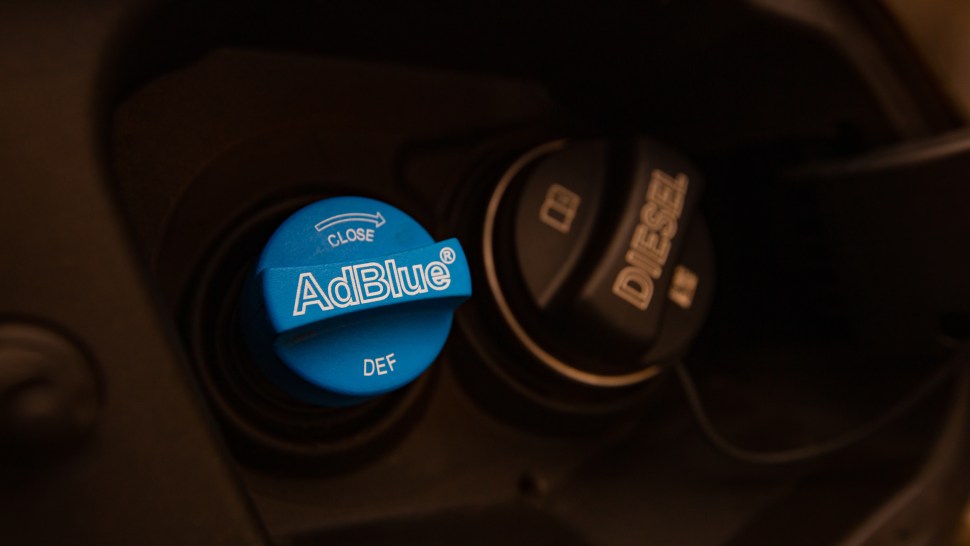
If a truck driver wants to save a few bucks by running some of its miles without diesel exhaust fluid (DEF), it’s now going to be possible for that to occur without the prospect of regulatory “enforcement” provided by a DEF sensor slowing down the vehicle.
But what are the other consequences if that money-saving route of reducing DEF consumption is chosen?
The Environmental Protection Agency (EPA) is allowing trucks and other diesel-fueled equipment like agricultural products to deactivate their DEF sensors, following a late March announcement by the agency. DEF sensors have sort of a built-in enforcement mechanism to ensure that trucks were using a proper amount of DEF, in that after first notifying the drivers of issues with the DEF mix via a warning light, they would start to slow the truck’s speed after a certain number of miles are driven in that condition.
The rule on the sensors does not change the requirement to use DEF for engines post-2010 model year. It also doesn’t change the fact that failing to use DEF can threaten a truck’s warranty.
Can a driver go without it?
With the EPA permitting DEF sensors to be deactivated, driven primarily by concerns about wayward devices leaving drivers stuck on the side of the road (or out in the field for agricultural equipment), it raises the question: what if a driver just decides to drive without DEF, knowing that the sort of invisible enforcement capabilities of the DEF sensor no longer can impact them through what is known as a “derating,” the forced reduction in a truck’s speed?
Allan Schaeffer, who studies diesel engines and their efficiency as head of the Engine Technology Forum, said that such a decision, even if there was no immediate impact beyond saving a few dollars, could have negative consequences later.
“If you don’t put DEF in a system that’s designed for Selective Catalytic Reduction (SCR), you’re going to risk long-term damage to the vehicle,” Schaeffer told FreightWaves in a phone interview.
The ETF has scheduled an April 20 online webinar to discuss the impacts of the recent EPA decision.
DEF is a water-urea mixture designed to reduce nitrogen oxide (NOx) emissions. The mixture splits the NOx molecules coming off an engine into atmospheric nitrogen and oxygen. It is generally about 32.5% urea, which has wider use as a fertilizer.
Trucks also have a separate NOx sensor, which without DEF sensors will now be more on the front lines of notifying a driver that their vehicle is possibly in violation of NOx standards.
A software fix, not hardware
The DEF sensor can be deactivated through a software fix, with the EPA specifically noting that software adjustments that might have been illegal previously are now permitted. It does not require the extraction of any equipment.
If there is evidence that a truck operated for any significant period of time without using DEF, “you’re going to have problems with any warranty claims you might present,” Schaeffer said. “You’re going to have problems with the trade-in. And ultimately, the engine is not going to be a happy engine because DEF and SCR systems are not just something that’s bolted on.”
Rather, Schaeffer said, they are “fully integrated into the entire engine.” “If you believe that what EPA has done gives you the ability to skirt this requirement, you’re going to be a lot unhappier in the long run,” Schaeffer said.
What if it’s just a little bit?
But a theoretical economics model could envision DEF consumption declining as a result of the change, at least on the margin.
The current average is that for every 100 gallons of diesel fuel consumed in a truck, the vehicle will use 2 to 3 gallons of DEF.
That is a ratio that since the SCR/DEF combination first came into existence for most new trucks with the 2010 model year. A driver feeling the need to stick close to that ratio would have always had as a factor in that decision the prospect of an engine derating for either not using DEF or using DEF of poor quality.
But that possibility disappears once the DEF sensor is shut down.
Schaeffer did not dismiss that prospect out of hand. “I kind of believe in the good in everybody,” he said. “But I also know for a fact that times are tough. People are hurting. Fuel costs are sky high and people are trying to do things on the very edge there.”
Jeff Seger, a long-time executive with engine builder Cummins (NYSE: CMI) who now works with the North American Council for Freight Efficiency, told FreightWaves that not only were DEF sensors “problematic” in their shutdowns, whether they were reacting to a lack of adequate DEF supplies or just going haywire, they were also “redundant” to the NOx sensor in seeking to ensure the engine meets emission requirements.
“So there’s just a lot of computing going on,” he said, as the truck’s onboard diagnostics would perform a NOx efficiency test. “If there are DEF quality issues, the NOx efficiency test will detect this and take appropriate action.”
Seger noted that the SCR system is efficient enough in cleaning up NOx emissions that the engine itself can be built to be dirtier than it would have been had it needed to meet NOx standards without DEF. “Some engine manufacturers have chosen a path to make the engine as efficient as possible and then rely on the SCR system to properly clean the exhaust,” Seger said.
Several other people told FreightWaves something similar: that the DEF system cleans up the NOx emissions so well that more of them can come off the engine than would be allowed if no DEF system is in place. As a result, fuel mileage is improved.
Financial penalties haven’t changed
Fines for violations are still in place. In its announcement of the end to the DEF sensor mandate, the EPA stressed that NOx rules are not changing. “Today’s announcement does not weaken or remove emissions standards,” it said. Violations of the standards carry a penalty that starts at $45,268 per violation.
While there are no roadside inspections to determine if a truck is in compliance with NOx standards, failing to use DEF beyond the damage to the engine can yield the fact of a failure to comply that can catch up to the truck owner in other ways, Schaeffer said.
He said this could particularly be an issue when a truck is attempting to be sold, or the owner is changing insurance carriers. “The insurance company doesn’t want to get burned if your truck is an accident of some kind, and they find out that you were tampering with the emissions control system and that caused it to overheat and catch fire,” Schaeffer said as an example. In a regular non-roadside state inspection, that could result in the finding of a noncompliance violation, he said.
More articles by John Kingston
3 carriers and Kroger blocked hiring of ex-Quickway drivers: lawsuit
Indiana’s new CDL rule pushes ahead on English proficiency
Two solid ‘yes’ votes for Echo Global’s acquisition: Moody’s and S&P
Brokerage Compliance Symposium
The day before F3. Every compliance issue you face - fraud exposure, carrier liability, FMCSA rules, cargo theft, insurance gaps - navigated by attorneys and operators defining best practices in a changing industry.
F3 Awards Dinner
The night before F3. FreightTech100 companies honored. FreightTech 25 and Shipper of Choice winners revealed live. Cocktail reception into dinner and live music - 300 industry leaders in one purpose-built room.
F3: Future of Freight Festival
Industry-defining keynotes, rapid-fire technology demos, and industry leaders networking in experiences across Chattanooga - plus the inaugural F3 Awards Dinner featuring the FreightTech and Shipper of Choice reveals.
The day before F3. Every compliance issue you face - fraud exposure, carrier liability, FMCSA rules, cargo theft, insurance gaps - navigated by attorneys and operators defining best practices in a changing industry.
The Signal at Chattanooga Choo Choo • Chattanooga, TN Register NowThe night before F3. FreightTech100 companies honored. FreightTech 25 and Shipper of Choice winners revealed live. Cocktail reception into dinner and live music - 300 industry leaders in one purpose-built room.
The Signal at Chattanooga Choo Choo • Chattanooga, TN Register NowIndustry-defining keynotes, rapid-fire technology demos, and industry leaders networking in experiences across Chattanooga - plus the inaugural F3 Awards Dinner featuring the FreightTech and Shipper of Choice reveals.
The Signal at Chattanooga Choo Choo • Chattanooga, TN Register Now