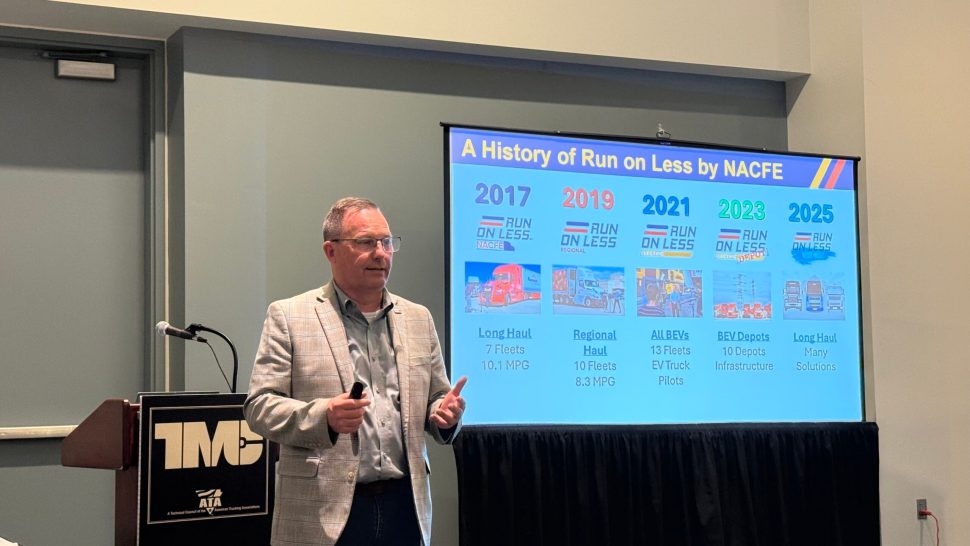
NASHVILLE, Tenn. — Diesel trucks reached 11.5 miles per gallon and a Tesla Semi ran 460 miles on a single charge during NACFE’s 18-day “Run on Less – Messy Middle” demonstration, the most detailed real-world powertrain study yet released at TMC 2026.
The North American Council for Freight Efficiency’s 277-page operations report analyzed 14 Class 8 tractors across diesel, compressed natural gas, battery-electric and hydrogen fuel-cell powertrains. The test generated 2.2 million lines of data from 73,000 miles of actual freight hauling and challenges long-held assumptions about which technologies are truly ready for the road.
“This is a significant analysis of duty-cycle fit for these solutions,” NACFE Executive Director Mike Roeth said during a news conference. “Where are fleets picking battery-electric, hydrogen, natural gas, biodiesel, renewable diesel, and how are they going to work in their operations?”
The report is the second installment in NACFE’s “Run on Less – Messy Middle” series. It includes 28 “boots-on-the-ground” quotes from drivers, fleet managers and infrastructure personnel.
Methodology: Deep Data from 73,000 Miles
NACFE collected data every 10 seconds during the September demonstration. The organization then brought 26 groups to Boulder, Colorado, for a two-day review, with a “judges panel” of major fleets — Amazon, Penske, J.B. Hunt, Covenant and Pitt Ohio — evaluating the results.
“When you have 2 million data points and you have 14 different trucks and 13 different fleets and 14 different appointments, there’s lots of ways you can analyze the data,” NACFE Director of Programs Dean Bushey said.
The 14 trucks covered the full spectrum of Class 8 duty cycles: long-haul irregular routes with sleeper cabs, return-to-base regional hauls, and city delivery runs as short as 100 miles a day.
“What I found really interesting is that we were either lucky or by picking these powertrains it happened, but we covered the classic market really well for freight movement with these 14 trucks,” Roeth said. “This group that we had in the run actually mimics the industry really well.” The trucks represent the roughly 1.8 million to 2 million Class 8 heavy tractors hauling dry vans, reefers and flatbeds nationwide.
The test included four diesel trucks, three natural gas trucks, five battery-electric vehicles and two hydrogen fuel-cell units. At Saia’s Stockton, California, terminal, the fleet added two Tesla Semis — one for pickup-and-delivery, the other slip-seated between long-distance less-than-truckload runs and local delivery on a second shift.
Diesel Performance Shatters Expectations
Two of the four diesel trucks hit 11.5 mpg; the other two reached 9.5 mpg. That far exceeds the national average of 7 mpg, which itself has climbed from 6 mpg over the past 15 years.
“I stood up in Atlanta and yelled 10 mile per gallon,” Roeth recalled of the 2017 Run on Less. “Spoiler alert: we had two trucks in this run that did 11.5. And those of us that have been around for a while would have thought that was complete bullshit, not possible. Maybe if you were going downhill empty, but they hauled real freight at those kinds of numbers.”
Roeth’s takeaway: “My first big thing is on diesel trucks, we have a lot of fuel economy we can still get out, work with drivers, adopt more of the technologies.”
Diesel also benefits from more than 7,500 fueling stations and unmatched operational flexibility.
Natural Gas Demonstrates Heavy-Haul Capability
The three natural gas trucks featured the Cummins X15N 15-liter engine. Wegmans ran 130,000-pound loads daily across Northern New York — one of the toughest duty cycles in the test.
Roeth highlighted three drivers of renewed interest: the purpose-built 15-liter engine, widespread renewable natural gas availability, and improved fueling infrastructure.
“If you can capture — I mean, we’re basically doing methane capture like carbon capture when you grab methane that’s leaving landfills, dairy farms, etc., and use that in the trucks. That’s a really good thing,” he said.
The natural gas trucks posted 4.5 to 6.7 mpg equivalent. Bushey cautioned that direct comparisons with diesel are misleading: the UPS units pulled doubles and triples, moving significantly more freight weight.
Roughly 1,385 public CNG stations operate nationwide, concentrated in California, Texas and major freight corridors.
Battery-Electric Vehicles Show Rapid Technology Advancement
Tesla Semi and Windrose trucks clearly outperformed Freightliner and Volvo battery-electric units on charging speed and range.
One Saia Tesla Semi covered 460 miles in a day shift on a single charge, then continued deliveries on a second shift with another driver.
“That was at 750 kilowatt, and they’re launching the semi at 1.2 megawatt,” Roeth said. “They’re getting the Tesla Semi, which is just a prediction of where battery-electric is going, can completely charge for 400 or 500 miles in 20 to 30 minutes now. A lot of people don’t think that’s real. We’re here to show it and tell it is real.”
Both battery-electric and hydrogen trucks used only 63% of available range on average, a reflection of today’s charging and hydrogen infrastructure rather than vehicle limits.
Hydrogen Faces Demonstration-Scale Limitations
The two Hyundai XCIENT fuel-cell trucks ran efficiently but were limited by fueling availability. Penske and Pilot operated the tractors in Texas and California.
“The promise of hydrogen, I would say, eludes us a good deal,” Roeth said.
NACFE had to scramble after Nikola’s bankruptcy and Hyzon’s struggles; only two fleets with Hyundai trucks stepped forward.
Practical Takeaways for Fleets
Terrain sensitivity mattered: battery-electric vehicles lost more efficiency on climbs than diesels, though they still beat diesel on flat ground. Driver behavior was another big variable — the 11.5-mpg diesels came partly from skilled drivers, and battery-electric efficiency varied with how precisely drivers held speed on grades.
“The drivers have to know how to drive the trucks,” Bushey said. “Culture matters. I think the fleet owners and the fleet service people really need to incentivize their people out there.”
The report concludes most fleets will run mixed powertrains in the near term. Operators should weigh maturity, total cost of ownership, duty cycle, infrastructure, regulations, residual value and service networks.
The Bullish Case for Battery-Electric
Despite today’s hurdles, NACFE is unequivocal about the long-term winner.
“We believe strongly that battery electric trucks are our future,” Roeth said. “It’s so simple. It’s efficient, it’s batteries, electronics, electric motors. My 40-year career, the aftertreatment cost more than the engine. And it’s damn near as big as the engine was 40 years ago. These diesel trucks are unbelievable, but they come with huge complexity and huge cost and that’s only going to get worse.”
Bushey added that rapid battery innovation — new chemistries, lighter packs, potential solid-state cells and faster charging — supports that optimism.
“Battery electric trucks are a program management and supply chain challenge, not an engineering and technology challenge,” Roeth said. “And batteries are getting better and better and better.”
NACFE will release the emissions report April 15, the cost analysis May 1 ahead of ACT Expo, and final findings in June.
Brokerage Compliance Symposium
The day before F3. Every compliance issue you face - fraud exposure, carrier liability, FMCSA rules, cargo theft, insurance gaps - navigated by attorneys and operators defining best practices in a changing industry.
F3 Awards Dinner
The night before F3. FreightTech100 companies honored. FreightTech 25 and Shipper of Choice winners revealed live. Cocktail reception into dinner and live music - 300 industry leaders in one purpose-built room.
F3: Future of Freight Festival
Industry-defining keynotes, rapid-fire technology demos, and industry leaders networking in experiences across Chattanooga - plus the inaugural F3 Awards Dinner featuring the FreightTech and Shipper of Choice reveals.
The day before F3. Every compliance issue you face - fraud exposure, carrier liability, FMCSA rules, cargo theft, insurance gaps - navigated by attorneys and operators defining best practices in a changing industry.
The Signal at Chattanooga Choo Choo • Chattanooga, TN Register NowThe night before F3. FreightTech100 companies honored. FreightTech 25 and Shipper of Choice winners revealed live. Cocktail reception into dinner and live music - 300 industry leaders in one purpose-built room.
The Signal at Chattanooga Choo Choo • Chattanooga, TN Register NowIndustry-defining keynotes, rapid-fire technology demos, and industry leaders networking in experiences across Chattanooga - plus the inaugural F3 Awards Dinner featuring the FreightTech and Shipper of Choice reveals.
The Signal at Chattanooga Choo Choo • Chattanooga, TN Register Now