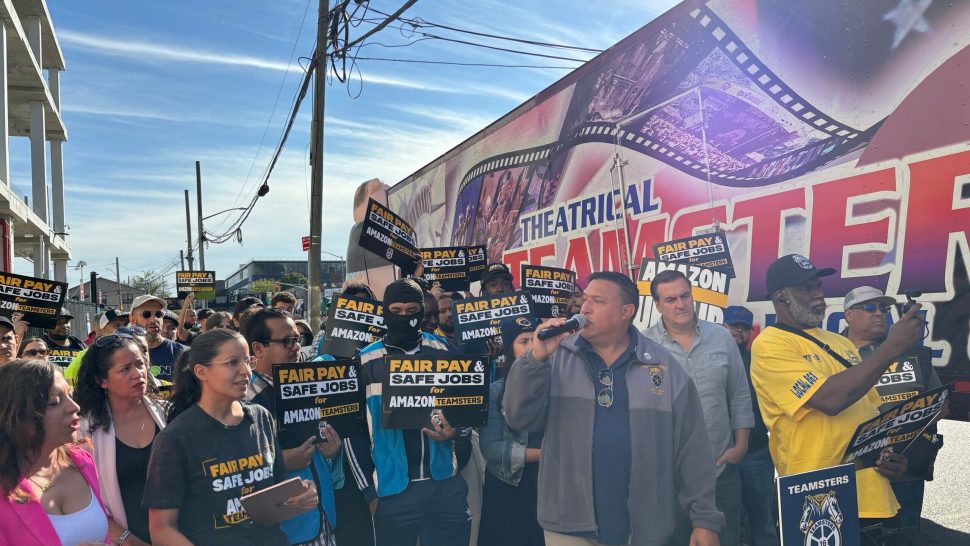
Maspeth, New York–A fiery crowd of as many as 150 workers and supporters rallied outside Amazon’s giant DBK4 warehouse in this industrial part of New York City Monday, carefully standing on the sidewalk so as not to step on Amazon property, while truck drivers from the neighborhood of nearby warehouses blasted their horns in solidarity as they drove by.
But despite the emotion and energy, backed by several local politician officials in attendance, the reality is that the Teamsters’ drive to unionize both Amazon (NASDAQ: AMZN) employees and drivers who work for their Direct Service Providers (DSPs) may have stalled. Regulatory victories from 2023 and 2024 look likely to crash up on the rocks of a Trump administration National Labor Relations Board (NLRB) that already has established some policies that could prove to be a big hurdle for the union’s efforts.
DBK4 might be seen as ground zero for the fight over unionizing DSPs. The workers like to describe themselves as “Amazon Teamsters.”
But for the employees at eight DSPs operating out of DBK4 last year who signed a majority of documents embracing the Teamsters as their representative–a process known in some quarters as “card check” but which the union refers to as signing an authorization card–the reality is the W-2 tax forms those workers receive every year come from the DSPs, not Amazon.
The only group of actual Amazon employees who have voted in favor of unionization anywhere in the U.S. are in Staten Island, another one of New York City’s five boroughs (Maspeth is in Queens). Other votes have failed, such as a closely-watched vote in Bessemer, Alabama several years ago.
The Staten Island representation drive was headed by an independent grass roots union that won an actual election–not card check–in 2022. The union came under the Teamsters umbrella last year.
But attempts to win a contract with Amazon have gone nowhere, according to several Staten Island Teamsters representatives at the Maspeth rally.
What triggered the scheduled demonstration Tuesday was what happened to Cornucopia Logistics, a DSP operating out of DBK4.
It no longer performs that function. Speakers at the rally said Amazon ended the contract because of the card check effort, leaving 105 men and women out of work with no notice.
Latrice Johnson, one of the employees of Cornocupia, said she “did not see it coming.” Notices of the layoff have only started arriving at her home in recent days, well after the actual dismissal.
In remarks to the crowd, Johnson said she often delivered 300 packages a day, “giving my everything to this job.”
“But what did we get in return?” she said. “Dirty and unsafe vans with barely any room to store packages. Every day we were asked to do more with less in conditions that made our jobs harder than it should. Still, we got the job done. And then three weeks ago, over 100 jobs were laid off with no notice whatsoever.”

(Left, Antonio Rosario; right, Latrice Johnson)
The widely-held view among the protesters is that Cornucopia is the latest DSP at DBK4 to have its contract revoked by Amazon. They see it as a straight line: the card check/authorization card effort which came in overwhelmingly a majority of the workers at the eight DSPs; the one-week strike by many DSP drivers at DBK4 just before Christmas; and the elimination of some DSPs from the site for what pro-union workers said was retaliation for both those developments.
There were various estimates at the protest of just how many DSPs had lost their contract with Amazon at DBK4 and when; three or four seemed to be the consensus.
But an spokeswoman for Amazon, Eileen Hards, said Cornucopia’s absence from DBK4 was not a rejection from the company as an Amazon DSP. Instead, it was because all the company’s operations were transferred to another Amazon facility in Queens.
It is part of a broader effort, Hards said, to have DSPs deliver from only one site, “to allow them to be more hands on with drivers, allow them to better work with their business partners, different things like that. So (Cornucupia) is still delivering.”
(Ironically, the section on Cornucopia’s website about employment opportunities still lists jobs at Maspeth).
Ultimately, underneath the cheering and solidarity in Queens was the realization that the unionization effort at Amazon and their DSPs increasingly appears to be stuck in the mud.
As noted, probably the biggest success–the Staten Island victory–is going nowhere so far.
Big role for the NLRB
The push for unionization at DSPs did score significant victories last year when two separate regional National Labor Relations Board regional directors–one near Atlanta and the other in Southern Callifornia–published opinions that Amazon was a “joint employer” along with the DSPs.
To demonstrate how far apart the union and the company are on some issues, a Teamsters spokesman, in an email to FreightWaves, said “The NLRB has ruled twice now that Amazon is a joint employer.” The response from Amazon: “The NLRB has not ruled that.”
The difference presumably can be explained by the fact that while there have been preliminary actions in favor of the argument that Amazon is a joint employer with the DSPs–the two decisions–it happened on a regional level and the process is not complete.
If those earlier NLRB opinions were to be upheld, it could undercut the Amazon argument that workers at the DSPs are not Amazon employees. In turn, the union response to that denial goes deeply into the issue of defining an independent contractor, including the degree of control Amazon has over the DSPs and by extension its workers.
The next hearing in the NLRB process is set for later this month.
Where the change in administrations is likely to have its biggest impact on the Teamsters’ efforts is the diminished impact that the NLRB’s Cemex decision will have in aiding unions trying to organize a workplace through card check.
The August 2023 decision in the Cemex case was referred to by the law firm of Littler Mendelson, in the headline of a blog post, as “Not Exactly Card Check, but Awfully Close.”
“The Cemex decision does two key things: one, institutes a new modified…doctrine that facilitates card check recognition; and two, lowers the threshold for when the Board will issue a bargaining order without holding an election,,” the law firm said in the post.
The Teamsters spokesman said the union has had successful card check actions at more than 20 DSPs
But in February, NLRB Acting General Counsel William B. Cowen issued a memo withdrawing earlier guidance on several earlier legal opinions, including the Cemex decision. That would seem to shut off the NLRB–which currently does not have a quorum but is awaiting Senate confirmation of two White House nominees–from approving a card check filing as a means to gain union recognition by Amazon or any employer…unless a full Republican-majority NLRB rules Amazon is a joint employer with the DSPs.
The odds on that would be considered slim by all sides.
‘Pushing a rock uphill’
Antonio Rosario, a Teamsters organizer who led the speeches at the rally, conceded in an interview with FreightWaves after the gathering that the union’s effort was like “pushing a rock uphill.”
“The only thing we can do is continue to talk to workers, explain to them what their rights are, let them know, even though they’ve been a little diminished because of everything happening, that we’re bringing people together,” he said.
He said unionization efforts at DSPs are continuing. “We’re going to go into more buildings, and sooner or later, Amazon’s going to have to say they’re spending too much money to stop this,” Rosario said. “They’re better off just giving these workers a contract.”
But the challenges facing the union could also be heard in the comments by Brendan Radtke, who had been a driver with Cornucopia and lost his job with the end of that company’s contract at BPK4.
He noted in an address to the rally that not all 105 Cornucopia workers who were axed in recent weeks were in attendance. Many of them, he said, might be contemplating further employment with another DSP in the Amazon system.
Radtke said those workers who stayed away from a demonstration called specifically to support them might be concerned about getting a question from a potential new employer: “Were you part of the union? If you were, we will know.”
More articles by John Kingston
Louisiana scheme to obtain class A CDLs without passing tests snags six in sweeping indictment
PAMT wound up in violation of a debt covenant at the end of 2Q: SEC filing
F3: Future of Freight Festival
Industry-defining keynotes, rapid-fire technology demos, and industry leaders networking in experiences across Chattanooga - plus the inaugural F3 Awards Dinner featuring the FreightTech and Shipper of Choice reveals.
Industry-defining keynotes, rapid-fire technology demos, and industry leaders networking in experiences across Chattanooga - plus the inaugural F3 Awards Dinner featuring the FreightTech and Shipper of Choice reveals.
The Signal at Chattanooga Choo Choo • Chattanooga, TN Register Now