




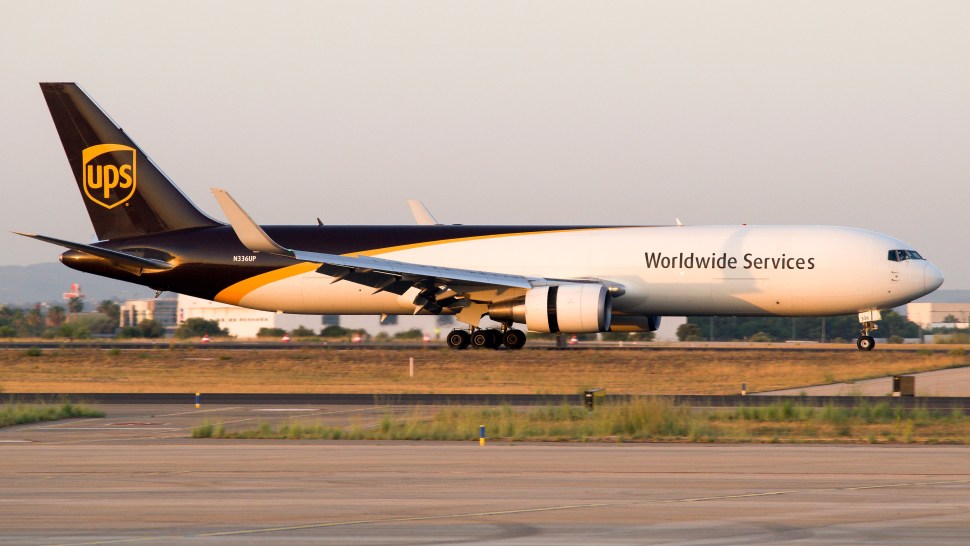
United Parcel Service has to temporarily replace a Boeing 767-300 freighter aircraft after sustaining damage when it was struck by the wing tip of a passenger plane during taxiing at Miami International Airport, complicating planning and operations with the peak season underway and volumes surging.
A UPS (NYSE: UPS) spokesperson declined to provide details about how UPS Airline operations will be impacted or how long the cargo jet will be out of service during a crucial period when every asset is needed to keep up with demand.
Integrated logistics companies like UPS typically have spare aircraft in reserve that can be substituted when a plane has a maintenance or other problem that prevents it from flying. A more likely scenario at this time of year would be for UPS to engage a third-party capacity provider to provide dedicated airlift until the 767 freighter can be repaired, or demand calms down.
The accident is expected to create operational headaches for UPS airline and logistics specialists, but likely won’t cause any delays for packages and freight.
The UPS cargo jet was involved in a low-speed ground collision at Miami Airport on Saturday night when Copa Airlines Flight 427, a Boeing 737-800 with 166 passengers that just touched down from Panama City, clipped the nose of the UPS aircraft with its left wing as it was taxiing to its gate and the UPS plane was preparing to depart for Bogotá, Colombia, according to the Federal Aviation Administration.
Air traffic control audio suggests the accident involved distracted driving. The FAA said air traffic controllers had instructed the UPS crew to give way to the Copa Airlines aircraft.
Copa pilot: “427, somebody hit us.”
ATC: “427, roger. UPS, you’re supposed to give way to the 73 there.”
UPS pilot: “Roger, we running checklist, runway change.”
ATC: “UPS 358, did you hit that aircraft?”
UPS pilot: “Yeah, we went too far, and then he clipped us with the wing.”
Photos of the UPS plane taken by passengers on the Copa jet and posted on social media show the nose crumpled, with a large hole in the panels.
Experts say it is challenging for pilots to judge clearance from the wingtips.
“From the seat, you can’t see your own wingtips. On a 737 they’re well behind you, and on a 767 or 777 they’re out of sight altogether. At night you judge another jet’s position by its lights, not its shape. Ground controllers sequence traffic but don’t guarantee wingtip separation. Clearance comes from airport design and the crew’s eyes, so a few feet of misjudgment at walking pace is enough,” said Helen Askew, a former 767 and 747 freighter captain and senior author, aviation at Travel Statistics Bureau (12,000+ flight hours, former airline Head of Flight Safety, who has flown both 767s and 747 freighters), explains how this can happen at walking pace.
The National Transportation Safety Administration has opened an investigation into the accident, which came two months after an Amazon 767 freighter operated by 21 Air overshot the runway at Miami and struck two vehicles, killing five people.
“We are aware of an incident involving one of our aircraft on the ground in Miami. Our crew is safe, and we are committed to working with authorities to determine what happened. The safety of our employees and the public is our highest priority,” UPS Airlines said in a statement posted on X.
The accident in Miami also occurred days after the one-year anniversary of the deadly crash of a UPS MD-11 freighter that suffered an engine detachment during takeoff.
Click here for more FreightWaves/American Shipper stories by Eric Kulisch.
Write to Eric Kulisch at ekulisch@freightwaves.com.
