




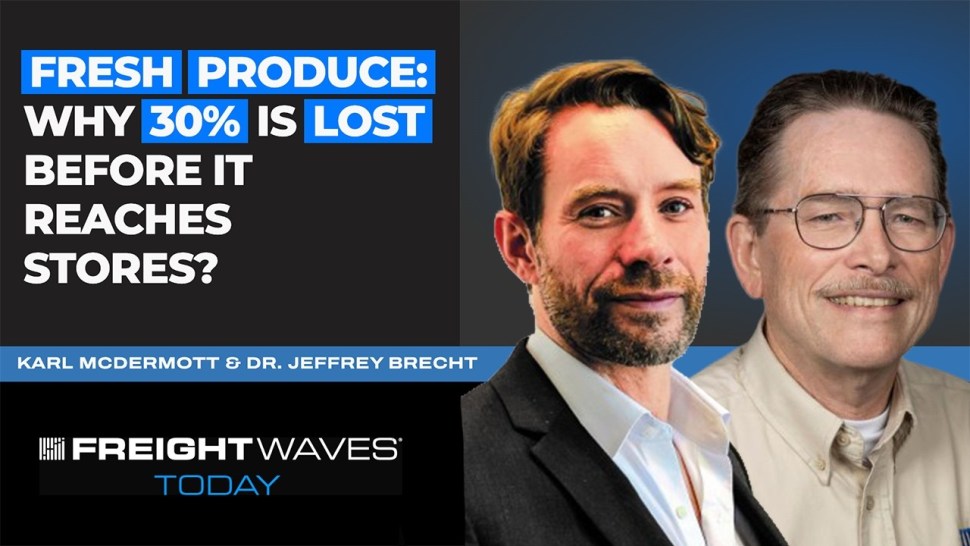
This video reveals the shocking amount of fresh produce lost in the supply chain before it even reaches consumers. Learn how temperature mismanagement directly impacts shelf life, leading to significant waste and higher costs. DeltaTrak and Dr. Jeffrey Brecht explain how new technologies like Fresh IDX can predict spoilage, optimize delivery, and recover lost revenue, ensuring fresher produce for everyone.
Nearly a third of strawberry shipments lost at least half a day of shelf life before reaching distribution centers, according to DeltaTrack’s analysis of more than 8,000 loads. The finding underscores how temperature mismanagement in transit is quietly eroding margins for growers, shippers, and grocers — at a time when a clamshell of Kirkland-brand strawberries at Costco runs about $4.50 and food inflation remains elevated.
At the center of the issue is DeltaTrack’s FreshIDx platform, which ingests temperature and time-since-harvest data, runs it through an algorithm built on USDA-mandated respiration curves, and predicts remaining shelf life at any point in the supply chain. The tool can flag when mold onset is imminent on strawberries and recommend downstream actions — routing loads to a closer store, triggering a two-for-one promotion, or repositioning product to a high-visibility aisle end cap — before quality loss becomes irreversible.
“What freshness index allows us to do is to really see which lane, which supplier, which time of year are you losing shelf life,” said Karl McDermott, Chief SaaS Revenue Officer at DeltaTrack. “And that’s something that we can try and fix. Maybe we need to improve the pre-cooling. Maybe it’s a cut-to-cool time. Maybe it’s a receiving process on the dock.”
The financial stakes are tangible. DeltaTrack’s modeling suggests that recovering just one day of shelf life on affected shipments could allow grocers to shift a full day of two-for-one promotions back to full-price selling, recovering roughly 27% to 28% of revenue that would otherwise be written off as shrink. Currently, a typical strawberry flat might see three days of full-price sales, one day of promotional pricing, and three days of waste.
“If we shift that one day, which our modeling is telling is possible, suddenly you can recover maybe 27%, 28% of the revenue. And we think that’s a huge benefit for the whole industry,” McDermott said.
When cold chain failures do result in a load falling short of spec, the financial hit depends on how the load is received. An outright rejection places 100% of the loss on the shipper or grower. Acceptance “under protection” triggers a partial revenue clawback — a credit issued against future business — meaning losses are shared but rarely eliminated.
Dr. Jeffrey Brecht, Emeritus Professor of Post-Harvest Physiology at the University of Florida — who authored the USDA handbook on respiration curves that underpins the FreshIDx algorithm — emphasized that the initial cooling step after harvest is the single most critical intervention. “If you break the cold chain and the temperature rises in the produce, it’s practically impossible to get them cooled down again,” he said. Quality deterioration in fresh produce is driven by chemical reactions that accelerate at higher temperatures, making rapid post-harvest cooling and unbroken refrigeration the primary levers available to supply chain operators.
Looking ahead, GS1 2D barcodes — set for a broader “sunrise event” next year — could eventually carry shelf-life data accessible to consumers via QR code scans. For now, McDermott said, grocers are focused on using the data internally to shift from first-in, first-out inventory management to a first-expired, first-out model, with consumer-facing transparency likely to follow as the business case matures.
- DeltaTrack’s analysis of 8,000-plus loads found nearly one-third of strawberry shipments lost at least half a day of shelf life before reaching distribution centers.
- Recovering just one day of shelf life could allow grocers to recapture 27%–28% of revenue currently lost to markdowns and shrink.
- Post-harvest cooling speed is the single most critical cold chain variable, as quality-degrading chemical reactions accelerate rapidly at higher temperatures.
This Summary is generated thanks to a transcription of the interview, for the full interview please enjoy the video above.
