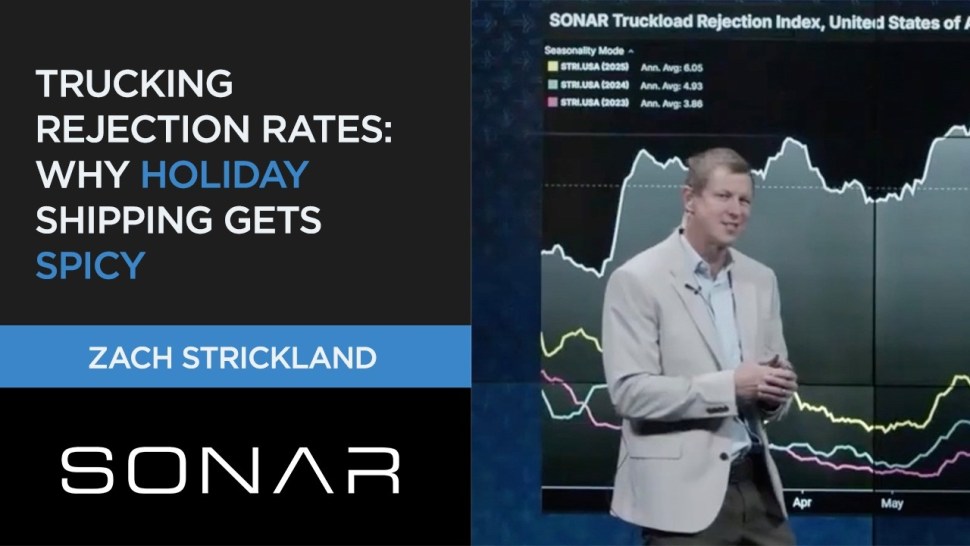
FreightWaves SONAR data reveals early signals of a tightening market ahead of Thanksgiving. Historically, this period sees a slight increase in tender rejection rates. This year, expect a significant jump potentially pushing rates over 14% as low inventory levels drive last-minute shipping demands. Coupled with potential port strikes, capacity could become extremely constrained in certain regions.
Truckload tender rejection rates jumped back toward 13% in the days leading up to Thanksgiving, and Zach Strickland of SONAR is forecasting a further climb to roughly 14% over the following week as holiday capacity pressures intensify. The move matters for carriers, brokers, and shippers because rejection rates signal how much pricing power carriers hold — and how difficult it will be to cover loads at contracted rates.
Strickland said demand signals, as measured by the tender volume index, remain underwhelming heading into the holiday. That is not unusual. “We call it peak season because capacity gets tighter,” he said. “You lose a lot of drivers, they get boundaried around 500 miles, and the larger fleets — you’ve got to convince these guys to get on the road during the holidays when they want to be home with their family. So a premium comes with that.”
“So spot rates start to take off. So the tender volume index in white there, it really never gets going until like a few days in front of Thanksgiving. And that’s really a lot of tenders that are getting pushed out for after the break.” — Zach Strickland
Two compounding factors could push rejection rates and spot rates higher than seasonal norms. Strickland noted that inventory levels heading into the holiday are not as robust as typical, raising the risk of last-minute shipping activity. A potential port strike was also cited as a source of shipper anxiety over freight positioning, though Strickland said a resolved strike would likely produce only a modest bump — with more meaningful rate movement expected closer to Christmas.
On the spot rate side, Strickland was more emphatic about upside risk. The van spot rate index, along with refrigerated and flatbed rates, have already seen some elevation this month. Diesel prices are declining, so fuel is not the driver. “This is not a fuel-related situation,” Strickland said. “We’re seeing actual elevation and already elevated rates on all three modes.” He added that ad hoc and transactional freight hitting the spot market in the coming weeks makes a downward trend unlikely — and noteworthy if it occurs.
Regionally, the weighted rejection index — which accounts for volume — is flashing week-over-week increases in the Midwestern corridor including Iowa, Kansas, and Topeka, as well as Phoenix and Gulf Coast markets such as New Orleans and Mobile. Because these are lower-volume markets, the blue signal on the weighted rejection index map carries outsized significance for capacity availability.
The Pacific Northwest is another area to watch. Strickland pointed to heavy freight inflows at the ports of Seattle and Tacoma from shippers diverting cargo to avoid Los Angeles congestion, combined with atmospheric rivers hitting the West Coast and snow in the Rockies and Cascades. Low freight density in mountain and prairie regions makes loads harder to cover, adding to rate pressure in those lanes. Temperature-controlled freight rounds out the concern, with refrigerated rates elevated on the West Coast even as the reefer market’s true seasonal peak typically arrives in January.
- Tender rejection rates climbed back toward 13% ahead of Thanksgiving and are forecast to reach roughly 14% the following week.
- Spot rates are already elevated across van, refrigerated, and flatbed modes, with the increase driven by capacity tightening rather than fuel costs.
- Pacific Northwest ports, mountain corridors, and low-volume Gulf Coast and Midwest markets are the regional hotspots to monitor for capacity constraints.
This Summary is generated thanks to a transcription of the interview, for the full interview please enjoy the video above.