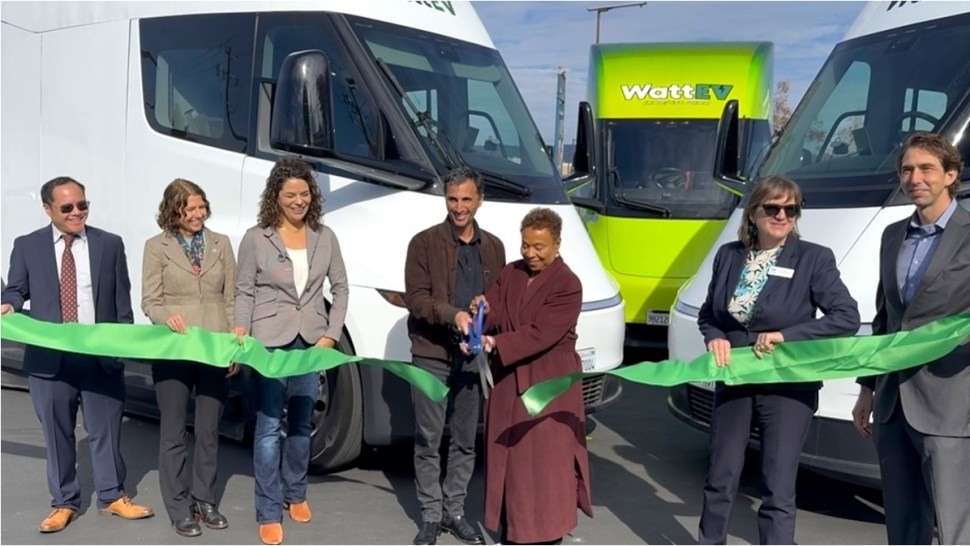
The Port of Oakland and heavy-duty charging provider WattEV have opened a public electric truck charging depot, pairing new infrastructure with a planned purchase of 300 Tesla Semis to expand zero-emission freight service across Northern California and beyond.
Officials at a ceremony Monday described the depot as the first of its kind in Northern California. The first batch of trucks is expected before the end of the year, with the remaining vehicles arriving in 2027.
The project represents a northward expansion of electric trucking infrastructure on the West Coast. According to WattEV, heavy-duty truck charging has so far been concentrated largely in Southern California. The Oakland depot is intended to help establish a zero-emission freight corridor connecting the Bay Area with Sacramento, the Central Valley, Nevada and other destinations.
“We’re seeing real progress in transforming how our industry moves goods to and from the Oakland Seaport,” Port of Oakland Executive Director Kristi McKenney said at a port ceremony. “Together with our industry partners, we’re delivering projects throughout Oakland that support cleaner freight operations, healthier communities, and a more sustainable future.”
Charging capacity targets freight schedules
The public depot will be capable of charging 25 medium- and heavy-duty trucks simultaneously at up to 240 kilowatts each, or seven trucks at 1.2 megawatts each.
Its megawatt-charging design is intended to reduce charging stops to 30 minutes or less, a duration project officials describe as comparable to diesel refueling.
The opening puts charging infrastructure in place ahead of the full fleet’s arrival, to begin this year and into 2027.
WattEV also said that, at current high diesel prices, the new electric trucks would cost about half as much to operate as comparable diesel models. The company did not provide a detailed cost breakdown in the announcement.
The 300-truck fleet could represent roughly $87 million in vehicle purchases, based on a reported $290,000 price for the 500-mile Tesla Semi. WattEV has not disclosed its actual purchase price or the total cost of the Oakland charging depot.
WattEV Chief Executive and co-founder Salim Youssefzadeh said the project brings together the port, the Bay Area Air District, Tesla and the California Air Resources Board to expand electric freight options for Northern California truckers.
“Until now, most truck charging infrastructure has been concentrated in Southern California, and the options for electric trucks limited their capability,” Youssefzadeh said. “We’re thrilled to enable zero-emission freight transport from a key port like Oakland.”
Oakland Mayor Barbara Lee said community input helped shape the project, with an emphasis on ensuring that neighborhoods disproportionately affected by pollution benefit from investment at the port.
“Today is a significant milestone for Oakland, our port, and the future of green transportation in California,” Lee said.
Why it matters: Oakland’s project pairs two essential pieces of port electrification: trucks to move freight and charging infrastructure to keep them operating, across Northern California and adjoining region.
Read more articles by Stuart Chirls here.
Read more:
Largest US-based port terminal operator appoints Maersk veteran as CEO
Savannah handles 565,366 TEUs in October, up 25% year-over-year on strong import demand
Asia–US East Coast ocean freight rates top $10,000, up 300% from a year ago
Tentative union deal averts strike at Port of LA-Long Beach
Zim Q3 profit surges to $830 million as freight rates jump 55%