Oil prices are in the middle of a massive reset and the benchmark price that is the basis for most fuel surcharges is rapidly reflecting those changes.
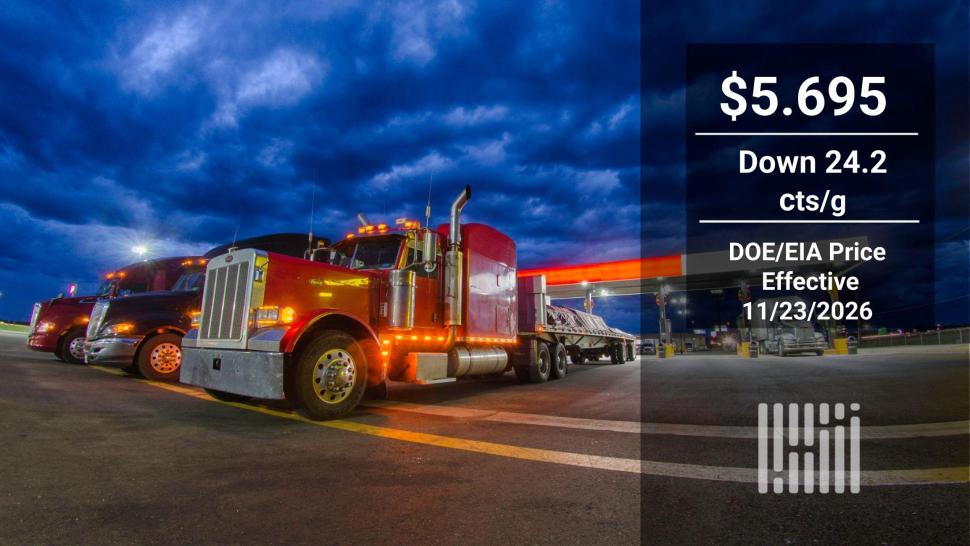
The Department of Energy/Energy Information Administration average retail diesel price declined 24.2 cents/gallon to $5.695/g, effective Monday but published Tuesday. That is the largest one-week decline since the Iran war began.
It’s also the fourth consecutive week of a falling benchmark price. The total decline during that time is 65.7 cts/g.
It put the price 83.4 cts/g less than it was September 22, when it hit its all-time high at $6.529/g. It’s also the lowest level since August 31.
However, this week’s price is still $1.798/g more than where it stood on March 2, the final DOE/EIA price published before the impact of the start of the Iran war over the prior weekend.
Retail prices always lag changes in futures and wholesale prices, so even the big drop posted this week doesn’t fully reflect just how much prices have come down in the futures market.
With November coming to a close, the scope of the fall in ultra low sulfur diesel (ULSD) on the CME commodity exchange this month becomes more striking.
ULSD settled November 2, the first trading day of the month, at $4.4216/g. A day later, it reached its high settlement for November at $4.5306/g. That followed an October where the average settlement was $4.79/g.
But as no new major military flareups occurred during the month, and a U.S. election that signaled U.S. exhaustion with the Iran war, prices began to fall.
On Wednesday, October 18, ULSD settled at less than $4/g for the first time since August. Three days later on Monday, ULSD hit its low settlement for November at $3.6975/g.
An increase of 0.55 cts/g Tuesday was the first time the price had risen in eight trading sessions.
Softening spread
What should also give diesel consumers additional relief is that the spread between diesel and crude, which hit stunning levels earlier in the recent cycle, is starting to soften.
The spread between world crude benchmark Brent and second-month ULSD on the CME settled Monday at about 63.7 cts/g. It opened the month at 77.3 cts/g and was consistently between 90 cts/g and $1/g through August.
But the push by refiners around the globe to cash in on strong refining margins, combined with signs pointing to a price-driven softening of demand, is weakening that spread. That’s good news for diesel consumers who at the peak of the spread blowing out wondered why the numbers they were hearing about increases in the price of crude were growing at a slower rate than what they were paying at the pump for their fuel.
Refiners working hard
U.S. refiners are working at maximum operating rates. The 95.7% operating rate for U.S. refiners in the week ending November, the latest data available, appears to be the highest in history for the second week of November.
The change in diesel inventories not just in the U.S. but worldwide is reflected in the difference between the first month and second ULSD price on CME.
That spread is in a structure known as backwardation, where the first month contract traded–December–is higher than the second month contract. It reflects the fact that the barrel for most immediate delivery is the one most desired in a tight market. It also discourages inventory-building.
The reverse of that is called contango. That is the structure where prices rise as they go out the calendar. It is the structure found in a perfectly-balanced market to reflect the costs of storage and the time value of money, and it reflects adequate inventories. If the stocks get too high, that contango will widen.
In the ULSD contract on CME, the spread between the first and second month contract settled Monday at 5.29 cts/g. That was the amount that December ULSD exceeded January ULSD.
That was the lowest level since July. It has averaged just over 9 cts/g for the month so far.
More articles by John Kingston
SCOTUS action revives shipper/receiver liability post-Montgomery
Denial of funds to NY over non domiciled CDLs overturned: appellate court
C.H. Robinson: no evidence of racketeering, wants RICO case moved