If you’re looking for a peak season container shipping trend over the last decade, the first thing you need to do is split the decade in half.
There was the half of growth and then there is the half of stagnation.
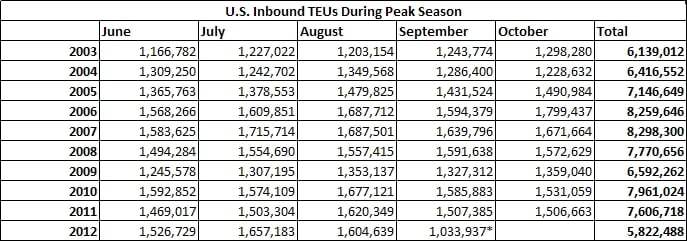
Looking at peak season volume figures for U.S. inbound containerized cargo, provided to American Shipper by the trade intelligence firm Zepol Corp., the pattern is clear to see.
In the period from 2003 to 2007, for the months of June through October, monthly volume rose year-on-year in 17 of 20 months. In two of those years (2004 to 2005, and 2005 to 2006), the jump in volume was significant.
In the period from June 2008 through August 2012, volume has risen year-on-year just seven of 23 months. And five of those came during the recovery year of 2010, where growth was largely inevitable based on the demand downfall in 2009.
What’s more, peak season monthly volume in 2010-2012 looks quite similar year-on-year. It looks remarkably like 2008, which signaled the end of the halcyon days of the post-China WTO accession shipping boom.
The industry was probably of the mind that 2008 was an anomaly in a period of sustained heady growth. But four years later, it is looking like the rule, not the exception.
Throwing out the growth in early 2010, when shippers were palpably restocking inventories that had been drawn down to bare bones levels in 2009, there’s just no escaping that monthly peak season volumes have stabilized.
It’s notable that peak season volume crested in 2006 and 2007. The 1.8 million TEUs of cargo moved in October 2006 looks like an unattainable level in the near-term.
That said, U.S. inbound shippers brought in nearly 1.7 million TEUs in July, the most in any month since August 2010. It’s difficult to say how much of that was due to shippers being anxious about a potential work stoppage at U.S. East and Gulf coast ports and shifting volume to earlier in the year. It’s clear some shippers did this. But volume fell from July to August (as well as compared to August 2011), and September is tracking about even with August.
Also notable is the true “peak” of peak season continues to be elusive. This year, it looks like July will be the busiest month, but last year, July was the fourth busiest month.
In the past nine years, October has been the busiest month four times, August three times, July once and September once. There is no true single month where shippers always move their holiday goods. – Eric Johnson
Analysis: Finding the peak season