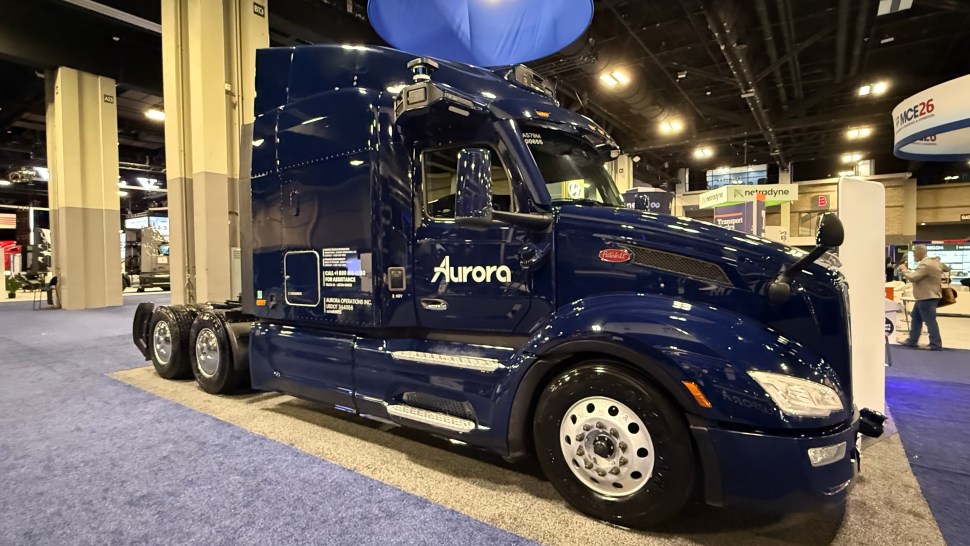
Aurora Innovation cut its 2026 revenue forecast to about $9 million on Wednesday, down from the $14 million to $16 million reported in its second-quarter results, after a six-week manufacturing delay. The company reported third-quarter revenue of $3 million and an operating loss of $257 million.
Over the past month, output at Roush, which upfits Aurora’s trucks in Livonia, Michigan, was held back by material shortages, component quality problems and issues found in end-of-line testing, CEO Chris Urmson said on the earnings call. Aurora now expects Roush to reach 20 trucks a week in early December and delivering 200 trucks by the end of February
“Instead of producing 20 trucks a week in October, we’re going to do that in December, it really has no impact on our ability to go and scale and deliver a thousand trucks next year,” Urmson told Bloomberg, which interviewed him about Aurora’s quarterly results.
Aurora re-sources parts for the Roush line
Some of the delay traced to complex components that arrived late or below Aurora’s quality bar. Maday said Aurora moved some of those parts, including wire harnesses, to “a more capable production supplier.” He said that in most cases the change was cost-neutral or could save money once reduced rework is counted, and that it would not materially affect gross margin.
Other problems are typical of any new line, where some parts don’t fit together perfectly at first. Aurora Driver kits from supplier Fabrinet are running ahead of truck builds, and Roush is adding a second shift, Maday said.
“I really do think that this is just a little bit of a pivot to the right in terms of when we can start hitting the run rate, but there is nothing that is really prohibiting us from hitting the run rate at this point,” Maday said.
Aurora said Roush can push past 20 trucks a week by expanding the line.
Cash use rises with the fleet
Third-quarter revenue rose to $3 million from $1 million a year earlier. The operating loss widened to $257 million from $222 million and included $54 million in stock-based compensation. Net loss was $234 million, or 12 cents a share, compared with $201 million, or 11 cents, a year earlier.
Aurora used about $170 million in operating cash during the quarter and spent $36 million on capital expenditures, which it said was within its quarterly average target.
Asked by a Morgan Stanley analyst on the call whether the fourth-quarter increase reflected a structurally higher expense base, Maday said the money goes to hardware kits, components and truck builds at Roush. Research and development spending will change little, he said, with some added general and administrative cost to support hundreds of trucks.
“The vast majority of the increase is planned, it has been expected, and it is all related to building up the fleet,” he said.
The bill for the fleet is arriving before the revenue.
Aurora ended September with just over $1 billion in cash and short-term investments, down from nearly $1.2 billion at the end of June. During the quarter, it sold 6 million shares through its at-the-market program for $41 million in net proceeds and used $23 million of that to cover taxes on vesting employee stock.
Maday said Aurora should reach positive cash flow in 2028 with more revenue and fewer assets on its books, via Insurance Journal / Bloomberg News.
MOUs now cover 1,000 trucks
Charger Logistics signed a nonbinding memorandum of understanding to own and operate 500 Aurora Driver-powered trucks under Aurora’s driver-as-a-service model, with deliveries expected in 2027 and 2028. With Hirschbach Motor Lines’ 500-truck MOU in April, Aurora’s announced MOUs now cover 1,000 trucks.
The Charger MOU builds on the transportation-as-a-service agreement Charger signed with Aurora in July for freight between Dallas and Laredo, Texas. Aurora said the deal represents a potential multiyear revenue stream in the hundreds of millions of dollars.
“Since launching autonomous operations along the Laredo corridor, we’ve realized immediate operational benefits that point to a clear path to scaling,” Charger President Andy Khera said in Aurora’s shareholder letter.
Maday said Aurora and its customers agreed on pricing and volumes in the MOUs and that the remaining terms are operational, such as who services the trucks and how they are disposed of at the end of their lives.
“On the two MOUs, we fully expect these to convert,” he said.
Urmson said the initial 200 trucks are fully contracted, and Maday said Aurora has 10 driverless customers.
Weigh stations, customer sites and beacons
Autonomous trucks have relied on voluntary enhanced pre-trip inspections, or EPTI, to bypass weigh stations, Aurora said in its shareholder letter. Its system can now determine whether a station is open, pull into an available scale lane and handle different scale layouts, the company said.
“EPTI is a really useful tool that allows you to have certainty and bypass weigh stations, but it also adds complexity in training and operations at customer sites,” Urmson said.
In November, Aurora trucks will begin running directly to sites for several driverless customers, including navigating security checkpoints on their own.
Federal rules require the driver of a stopped truck to set out reflective triangles or flares. On Oct. 7, the Federal Motor Carrier Safety Administration granted a five-year exemption letting Level 4 autonomous trucks use cab-mounted amber beacons instead. Other carriers running Level 4 trucks can use it after notifying the agency, according to the Federal Register notice.
Volvo and PACCAR to follow Roush
Roush is the first step in a phased manufacturing plan. Aurora is integrating its driver directly on Volvo’s factory line while preparing for full production with Volvo and PACCAR, according to the earnings release. Volvo Autonomous Solutions plans to launch driverless trucks with the Aurora Driver in the first quarter of 2027 and deploy more than 300 that year. AUMOVIO plans to start production of Aurora’s third-generation hardware kit in the second half of 2027.
Urmson tied the end-of-2027 goal back to February.
“We still expect to get 200 trucks out of this in February, and we see this still enabling the 1,000+ trucks we expect on the road by the end of next year,” he said.
Why it matters: Aurora still needs more than 1,000 trucks on the road by the end of 2027, now from a later start. For Charger and Hirschbach, whose 1,000 trucks still need binding contracts, and for investors facing a $250 million quarter, December’s 20-truck week at Roush is the next test.