
The weekly diesel price used as the basis for most fuel surcharges dropped this week just as diesel futures surged to a new post-war record high.
Ultra low sulfur diesel (ULSD) on the CME commodity exchange settled Tuesday at $4.6773/g. That is an increase of 18.36 cts/gallon, up 4.09%.
The previous high settlement after the start of hostilities between Iran on one side and the U.S. and Israel on the other was $4.6084/g on March 20.
Tuesday’s settlement also appears to be the second-highest in the history of the contract on CME, which began life as a heating oil contract before becoming a ULSD contract as quality specifications between the two middle distillates narrowed.
That one higher settlement before Tuesday was $5.1354/g on 4/28/2022, just a few weeks after Russia invaded Ukraine. The fact that it was on the next to last day of the May 2022 contract before its expiration suggests that the price was driven higher by a short squeeze that left some traders scrambling to cover their positions.
The following day, the last day of the May contract, the price was down more than $1/g, a sure sign that shortcovering was the factor driving the price the prior day.
What all that means is that the Tuesday settlement could almost be viewed as the highest “explanation-free” settlement in the history of the contract.
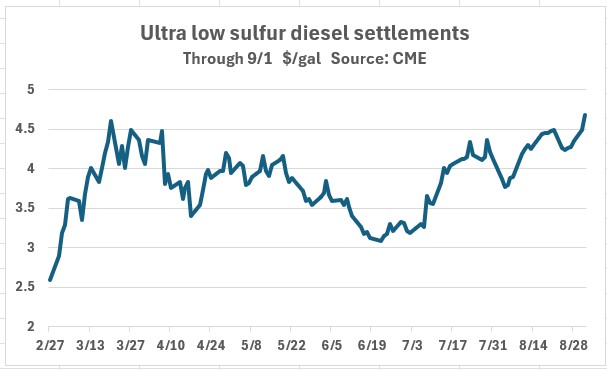
With retail prices lagging futures prices, and with ULSD prices having taken a slide of a few days’ duration last week, the Department of Energy/Energy Information Administration average weekly retail price fell 5.3 cts/gallon to $5.5999/g, effective Monday but published Tuesday. That’s only the second decline in that price in the last eight weeks.
The highest post-war DOE/EIA price was established a week ago at $5.562/g.
There was no particular single piece of news in the diesel market that led to the price climb Monday and Tuesday. It is a combination of a long list of developments that have sent diesel prices surging well above increases in gasoline and crude: loss of Middle East crude supplies that have physical characteristics conducive to producing a strong yield of diesel in a refinery; Ukrainian attacks on Russian refineries and export facilities, also which have an outsized exposure to diesel prices; and tight global inventories just as winter looms, as diesel is structurally highly similar to heating oil.
The recent increase in the price of ULSD on the CME commodity exchange, and concurrent increases in the physical price of diesel traded on a pipeline or barges in key markets, have erased the decline that led to this week’s drop in the DOE/EIA price.
ULSD on August 21 settled at $4.4948/g. The price then fell sharply the next two days on optimism for some sort of easing of tensions in the Strait of Hormuz, the latest in a long line of head fakes that might result in some increase in ships passing through that bottleneck but nothing that could be thought of as a more permanent resolution.
But prices began to climb soon after that, surging back to just under $4.50/g Friday before its even further leap higher Monday and Tuesday.
The recent increase in the price of diesel in the futures market is likely to increase the chance that the highest post-war price for retail diesel published daily by the AAA also can be knocked off its perch.
The highest AAA price was $5.689 recorded on April 9. Tuesday’s price was $5.6325/g.
More articles by John Kingston
Likely BMO swan song shows trucking credit strengthening
A newcomer to Roadcheck driver violations top 5: speaking English
2 key trucking groups in filing raise alarm on Penske decision fallout