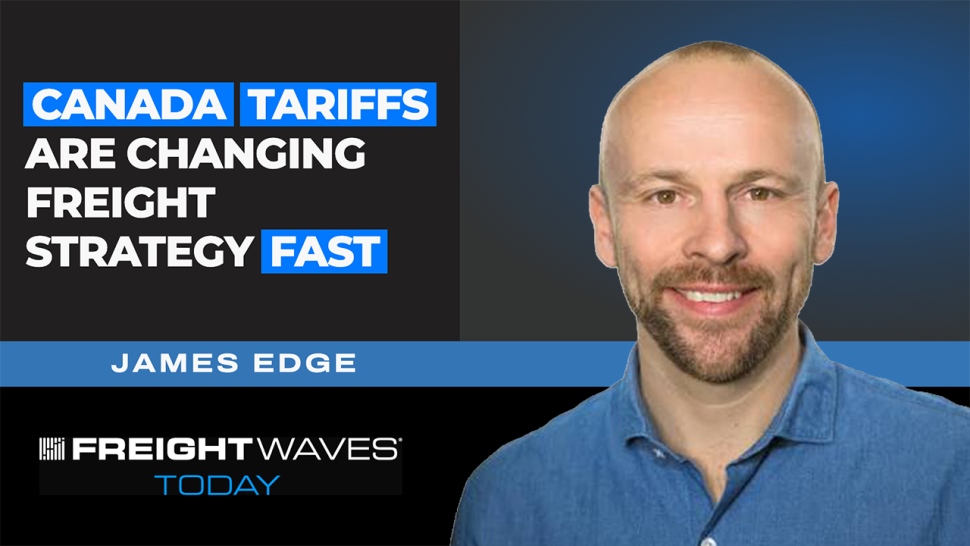
Canada-US trade tension is forcing fast changes in cross-border logistics. James Edge breaks down how importers, exporters and retailers are handling tariffs, shifting demand and new data requirements. In this FreightWaves conversation, Edge explains the real operator playbook: split U.S. and Canadian fulfillment, add warehouse capacity inside Canada, and stay ahead of changing customs rules. If you move freight across the border, this is the practical takeaway. #CrossBorder #CanadaTrade #Tariffs
Rapidly shifting U.S.-Canada tariffs are compelling importers and exporters to restructure their warehouse networks and sourcing strategies, according to James Edge, CEO of Cross Border at Bnode and chairperson at Landmark Global. Edge, who works daily with retailers moving goods across the U.S.-Canada border, said the unpredictability of policy changes — not the tariffs themselves — has been the hardest element to manage in 2025.
Edge offered a concrete example of how shippers are adapting: a client that had planned to serve both U.S. and Canadian customers from a single U.S. warehouse was forced to change course when tariffs hit. “We helped them set up a second Canadian warehouse,” Edge said, explaining that bulk importing into Canada lowers the effective tariff on individual orders. The client now fulfills Canadian orders domestically and U.S. orders from the American facility — a dual-node model Edge said many others are replicating.
“If an additional tariff means $5 extra, is that all of your margin, or do you have some room to play? That’s the math that’s going on.” — James Edge, CEO of Cross Border at Bnode
Beyond warehousing, Edge said sourcing flexibility has become critical. Brands heavily reliant on Chinese manufacturing are evaluating alternatives in Vietnam, Turkey, and Bangladesh to reduce tariff exposure. He added that retailers must also maintain rigorous data hygiene — including country of origin and product identifiers — because compliance requirements are shifting alongside tariff policy. “The changing tariffs and the management of those tariffs makes it difficult to do that cross-border shipment,” he said.
Canadian consumer sentiment is adding another layer of pressure. Edge noted that Canadian television is running commercials promoting domestic buying alternatives, which is dampening demand for U.S.-origin goods shipped northbound. He described the surge in Canadian nationalism as a new phenomenon: “It takes a lot to get the Canadians riled,” he said, calling the degree of friction between the two countries unprecedented in his experience.
On the technology front, Edge said artificial intelligence is already improving customs classification accuracy, with AI-assisted systems now achieving success rates “in the upper 90s” compared to roughly 80% with earlier machine-learning tools. However, he cautioned that the physical clearance process — including direct interaction with government agencies — remains firmly in human hands. Errors in customs documentation can result in delayed or seized shipments, raising the stakes for any over-reliance on automation.
Looking ahead, Edge said he expects tariff volatility to gradually stabilize into something more manageable, even if final rates remain higher than most importers would prefer. The geopolitical dimension, he acknowledged, is harder to forecast. His top advice for brands bracing for the next policy shift: get product data — origin, materials composition, classification — fully in order, and align with logistics partners who can navigate compliance requirements in real time.
- Importers are splitting inventory into dual U.S.-Canada warehouse networks to reduce per-order tariff impact on Canadian fulfillment.
- AI-assisted customs classification now reaches accuracy rates in the upper 90s, up from roughly 80% with earlier machine-learning tools, but human oversight of physical clearance remains essential.
- Rising Canadian nationalism and ‘buy Canadian’ campaigns are suppressing northbound cross-border demand, adding a sentiment risk on top of tariff and compliance pressures.
This Summary is generated thanks to a transcription of the interview, for the full interview please enjoy the video above.
Brokerage Compliance Symposium
The day before F3. Every compliance issue you face - fraud exposure, carrier liability, FMCSA rules, cargo theft, insurance gaps - navigated by attorneys and operators defining best practices in a changing industry.
F3 Awards Dinner
The night before F3. FreightTech100 companies honored. FreightTech 25 and Shipper of Choice winners revealed live. Cocktail reception into dinner and live music - 300 industry leaders in one purpose-built room.
F3: Future of Freight Festival
Industry-defining keynotes, rapid-fire technology demos, and industry leaders networking in experiences across Chattanooga - plus the inaugural F3 Awards Dinner featuring the FreightTech and Shipper of Choice reveals.
The day before F3. Every compliance issue you face - fraud exposure, carrier liability, FMCSA rules, cargo theft, insurance gaps - navigated by attorneys and operators defining best practices in a changing industry.
The Signal at Chattanooga Choo Choo • Chattanooga, TN Register NowThe night before F3. FreightTech100 companies honored. FreightTech 25 and Shipper of Choice winners revealed live. Cocktail reception into dinner and live music - 300 industry leaders in one purpose-built room.
The Signal at Chattanooga Choo Choo • Chattanooga, TN Register NowIndustry-defining keynotes, rapid-fire technology demos, and industry leaders networking in experiences across Chattanooga - plus the inaugural F3 Awards Dinner featuring the FreightTech and Shipper of Choice reveals.
The Signal at Chattanooga Choo Choo • Chattanooga, TN Register Now