




By Eric Johnson
It’s not easy to ascertain confidence levels on north-south container trades.
Rate indexes and growth forecasts tend to focus wholly on the performance of the major east-west trades, and generally for good reason. Those trades, along with the intra-Asia trade, see the lion’s share of containerized goods movement globally.
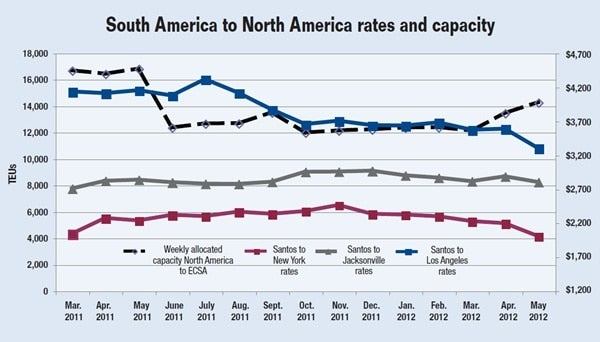
But shippers on the trades between North and South America need information too. Using capacity data from BlueWater Reporting, a new service from American Shipper’s affiliate ComPair Data, gives an indication of where the trade has gone in the past 10 months.
BlueWater Reporting breaks capacity information down by individual trade lane, so that capacity and vessel deployment can be viewed separately between the east and west coasts of South America and North America in both directions.
(Note: allocated capacity refers to BlueWater Reporting’s estimate of the weekly capacity available to shippers on a specific trade route. Nominal capacity refers to the total capacity of all ships deployed on that trade in a given week.)
The numbers show that allocated capacity from the west coast of South America to North America more than halved in the past 10 months, from nearly 5,500 TEUs per week at the end of June 2011 to around 2,300 TEUs per week on May 6, a drop of more than 57 percent. The trade has seen total vessel capacity fall 48.6 percent.
An interesting facet of this trade, according to BlueWater Reporting, is that less than half of the nominal vessel capacity operated between the west coast of South America to North America is allocated strictly to trade between ports in those regions. With ports in the Caribbean, Central America, and north coast of South America in between, much of the allocated capacity is allocated for those calls, especially since many of those ports (like Kingston, Panama, and Cartagena) are key transshipment points for east-west trades.
Less than 42 percent of nominal capacity on services from the west coast of South America to North America is allocated to trade between those regions.
Capacity from the east coast of South America to North America is affected by similar dynamics, but to a lesser extent. Fifty-four percent of nominal capacity on vessels plying this lane is allocated to trade from the east coast of South America to North America.
In the southbound direction to the east coast of South America, the ratio is 56 percent. Southbound to the west coast of South America, the ratio is 43 percent.
Capacity from the east coast of South America to North America has risen in the past year, from 11,600 TEUs per week at the end of June 2011 to nearly 13,000 TEUs per week on May 6, an 11.5 percent increase. That includes a 9 percent hike just since April 1.
Export capacity from North America to South America fell or rose largely in line with northbound developments on the respective coasts in the past 10 months.
Allocated capacity rose 5.7 percent to the east coast of South America in that period to 13,361 TEUs per week. However, capacity fell steeply in between early April and early May of this year, with 18.7 percent stripped away, despite the number of vessels on the trade remaining exactly the same.
Export capacity to the west coast of South America fell 39.3 percent to 2,400 TEUs, from late June 2011 to May 6 – that’s not as steep a drop as northbound, but still significant.
(Note that with such relatively small amounts of capacity offered each week, capacity growth or contraction can be heavily influenced by the addition or suspension of a single service.)
Only eight carriers provide regular liner service between the west coast of South America and North America. Between North America and South America’s east coast, the number of service providers jumps to 16.
While the number of providers sounds low, it gets even lower when you filter for the number of actual vessel operators on the trade. For instance, from the east coast of South America to North America, only nine lines operate vessels, with Hamburg Süd, Mediterranean Shipping Co. and CSAV operating a collective 30 of the 43 vessels on the trade alone. The collective allocated capacity share of the trade aboard their vessels sat at 75 percent on May 6.
The three lines’ southbound share is 70 percent. On the west coast South America/North America trade, only four lines operate vessels.
So a seemingly small yet fragmented trade is still reliant on the service plans of less than a handful of lines.
Another factor to note is the ratio of reefer plugs to allocated capacity. It’s easy to see that trade from the west coast of South America is heavily reliant on reefer cargo, with one reefer plug for every 2.1 TEUs of allocated capacity, compared to one reefer plug for every 5.3 TEUs from east coast South America.
Brokerage Compliance Symposium
The day before F3. Every compliance issue you face - fraud exposure, carrier liability, FMCSA rules, cargo theft, insurance gaps - navigated by attorneys and operators defining best practices in a changing industry.
F3 Awards Dinner
The night before F3. FreightTech100 companies honored. FreightTech 25 and Shipper of Choice winners revealed live. Cocktail reception into dinner and live music - 300 industry leaders in one purpose-built room.
F3: Future of Freight Festival
Industry-defining keynotes, rapid-fire technology demos, and industry leaders networking in experiences across Chattanooga - plus the inaugural F3 Awards Dinner featuring the FreightTech and Shipper of Choice reveals.
The day before F3. Every compliance issue you face - fraud exposure, carrier liability, FMCSA rules, cargo theft, insurance gaps - navigated by attorneys and operators defining best practices in a changing industry.
The Signal at Chattanooga Choo Choo • Chattanooga, TN Register NowThe night before F3. FreightTech100 companies honored. FreightTech 25 and Shipper of Choice winners revealed live. Cocktail reception into dinner and live music - 300 industry leaders in one purpose-built room.
The Signal at Chattanooga Choo Choo • Chattanooga, TN Register NowIndustry-defining keynotes, rapid-fire technology demos, and industry leaders networking in experiences across Chattanooga - plus the inaugural F3 Awards Dinner featuring the FreightTech and Shipper of Choice reveals.
The Signal at Chattanooga Choo Choo • Chattanooga, TN Register Now