




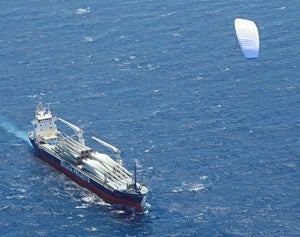
The giant agri-marketer has signed an agreement with SkySails GmbH of Hamburg, Germany, to install a 320-square-meter kite system in December on a handysize vessel of 25,000 to 30,000 deadweight tons that the company operates under a long-term charter. Handysize vessels are more maneuverable and have shallower draft than larger vessels, and make up the majority of the world's oceangoing cargo fleet.
SkySails is the same company that in late 2007 installed a giant parasail on a multipurpose heavy-lift ship operated by Beluga Shipping.
Cargill, based in Minneapolis, Minn., said the sail could generate enough power to reduce consumption of bunker fuel by up to 35 percent in ideal sailing conditions, and that it is part of a corporate effort to reduce greenhouse gas emissions.
The two companies are developing and testing the technology and plan to have the system fully operational in the first quarter of 2012. Cargill said it has identified a ship owner that will allow one of its ships to be modified with the kite.
| SkySails installed a giant parasail on the multipurpose vessel Beluga. Photo ' SkySails |
Such complex launch, recovery and control systems, as well as the durability of the sail material, have been drawbacks to use of wind power on ships so far, according to a 2009 International Maritime Organization study on reducing greenhouse gas emissions.
A study by the Technical University of Berlin referred to in the IMO report said ships operating in favorable weather conditions could achieve fuel savings of 15 percent at 15 knots and 44 percent at 10 knots.
'For some time, we have been searching for a project that can help drive environmental best practice within the shipping industry and see this as a meaningful first step,' said G.J. van den Akker, head of Cargill's ocean transportation business in Geneva.
The ocean transportation group time charters a fleet of about 300 dry and liquid bulk tankers and offers extensive supply chain services to customers. Last year, Cargill generated $107.9 billion in revenue, with earnings of $2.6 billion. ' Eric Kulisch
