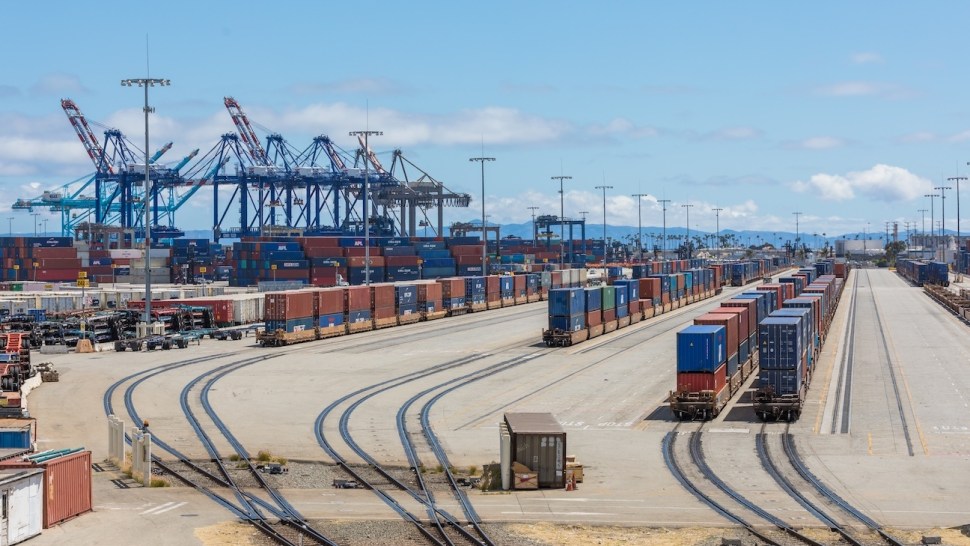
Container dwell times were mixed in August, with truck-bound cargo moving through marine terminals improving while rail-destined containers remained longer at the nation’s busiest port complex.
Average local truck dwell was 2.95 days in August, down slightly from 3.03 days in July and broadly consistent with the sub-three-day levels recorded over the past year, the Pacific Merchant Shipping Association said. Rail-destined cargo dwell, however, rose to 6.75 days from 6.34 days in July, extending a period of elevated intermodal dwell at the Los Angeles-Long Beach gateway.
The increase came as the ports handled near-record 1.88 million twenty-foot equivalent units (TEUs) in August. The volume total of 1,875,899 TEUs shows sustained import, export and transshipment activity even as inland rail capacity and terminal operations face pressure from traffic flows moving through the gateway.
Truck flows remain stable
The modest month-to-month decline in truck dwell suggests that local drayage operations and terminal gate activity remained relatively fluid despite the high cargo throughput.
Truck dwell measures the average time containers remain at marine terminals before pickup by local trucking providers. At 2.95 days, August’s figure was in line with the performance seen during much of the previous year, indicating that terminals continued to turn local cargo at a comparatively stable rate.
The steadiness in truck dwell is notable because the San Pedro Bay complex relies heavily on drayage to move containers to Southern California warehouses, distribution centers, transload facilities and nearby rail ramps. Maintaining dwell below three days reduces pressure on terminal yards and helps preserve appointment availability and chassis circulation.
Rail cargo faces added pressure
Rail dwell reached 6.75 days in August, a 0.41-day increase from July and a high point relative to the past year. The figure indicates that containers moving inland by rail remained at terminals for nearly a week on average before departure.
The slowdown comes after Class I carriers serving the ports, Union Pacific (NYSE: UNP) and BNSF (NYSE: BRK-B), saw their network performance slow in late spring on a then-modest surge of import traffic. That lead observers to question how UP would handle the vast amount of freight it claims it would win over from trucks if its proposed merger with Norfolk Southern (NYSE: NSC) is approved by regulators.
The divergence between truck and rail dwell highlights the importance of intermodal performance to overall cargo fluidity at Los Angeles and Long Beach. A significant share of containers arriving at the gateway is destined for inland U.S. markets, including major distribution regions in the Midwest and South, making the reliability of on-dock and near-dock rail service a key factor in terminal productivity.
Pacific Merchant Shipping Association officials said terminals and transportation providers were continuing to adjust operations as cargo patterns evolve.
“Cargo volumes moving through the San Pedro Bay ports remain strong, with truck dwell holding steady and rail dwell experiencing some additional upward movement,” Natasha Villa, senior manager of public affairs for PMSA, said. “Marine terminals, drayage providers, and rail partners are adapting to changing cargo patterns to maintain fluid operations, demonstrating the strength and resilience of our supply chain in the face of continued global uncertainty.”
The August results suggest the ports’ local delivery network has so far absorbed strong volumes without a material deterioration in truck-side performance. But the higher rail dwell figure will remain a closely watched measure for beneficial cargo owners, ocean carriers, railroads and terminal operators heading into the fall shipping period, when sustained cargo demand could further test inland intermodal capacity.
Why it matters: Rising rail dwell at the busiest U.S. maritime gateways can signal a growing bottleneck in moving imports beyond Southern California to inland markets, even when local truck flows remain stable.
Read more articles by Stuart Chirls here.
Read more:
U.S. container imports climb 3.8% to 2.6 million TEUs, 3rd highest monthly level
Houthi gains deepen risk as carriers restore Red Sea services
Almost 1 million TEUs in new record for this U.S. container gateway
SC Ports, Norfolk Southern expand intermodal access to Huntsville
Brokerage Compliance Symposium
The day before F3. Every compliance issue you face - fraud exposure, carrier liability, FMCSA rules, cargo theft, insurance gaps - navigated by attorneys and operators defining best practices in a changing industry.
F3 Awards Dinner
The night before F3. FreightTech100 companies honored. FreightTech 25 and Shipper of Choice winners revealed live. Cocktail reception into dinner and live music - 300 industry leaders in one purpose-built room.
F3: Future of Freight Festival
Industry-defining keynotes, rapid-fire technology demos, and industry leaders networking in experiences across Chattanooga - plus the inaugural F3 Awards Dinner featuring the FreightTech and Shipper of Choice reveals.
The day before F3. Every compliance issue you face - fraud exposure, carrier liability, FMCSA rules, cargo theft, insurance gaps - navigated by attorneys and operators defining best practices in a changing industry.
The Signal at Chattanooga Choo Choo • Chattanooga, TN Register NowThe night before F3. FreightTech100 companies honored. FreightTech 25 and Shipper of Choice winners revealed live. Cocktail reception into dinner and live music - 300 industry leaders in one purpose-built room.
The Signal at Chattanooga Choo Choo • Chattanooga, TN Register NowIndustry-defining keynotes, rapid-fire technology demos, and industry leaders networking in experiences across Chattanooga - plus the inaugural F3 Awards Dinner featuring the FreightTech and Shipper of Choice reveals.
The Signal at Chattanooga Choo Choo • Chattanooga, TN Register Now