




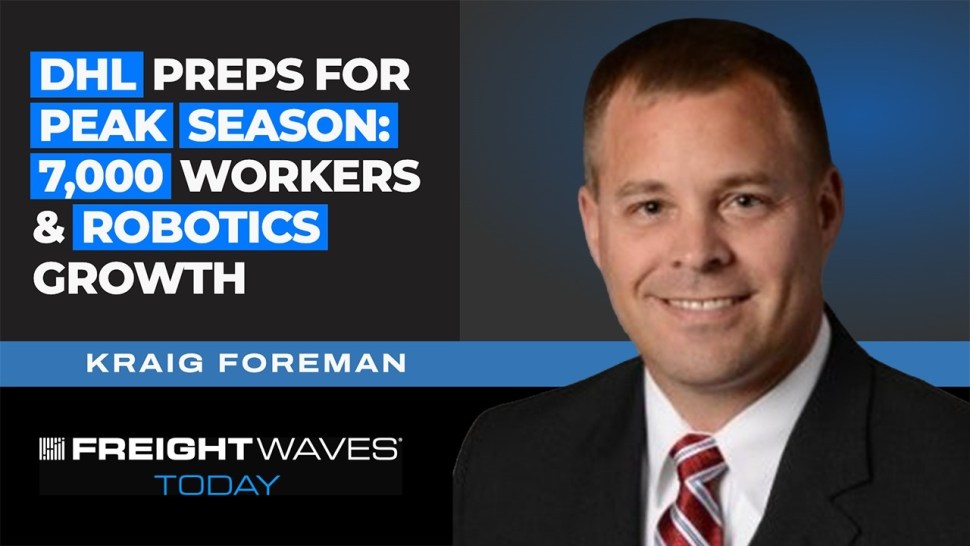
Peak season is getting longer and less predictable. Kraig Foreman, President of eCommerce at DHL Supply Chain, joins us to discuss how evolving consumer behavior and early deals are shaping this year’s holiday logistics landscape. Discover DHL’s strategy, including adding robots and hiring thousands of temporary workers, and how private label brands are changing the game for cost-conscious shoppers.
DHL Supply Chain plans to hire 7,000 temporary workers and expand its robotics footprint heading into peak season, as the company braces for a holiday period that starts earlier but delivers more modest unit-volume growth than headline sales figures suggest, according to Kraig Foreman, president of e-commerce at DHL Supply Chain.
Foreman said total holiday sales are expected to rise roughly 5% in dollar terms, but inflation is masking the underlying reality. “I think you’ll see that we’ll probably be up a little bit, but it’s probably more that 2 to 3% rate, whereas the total dollars in sales will be anywhere from that 5 to 10% range due to inflationary aspects to cost of goods,” he said. That gap matters for carriers and operators planning labor and capacity, since package volumes — not revenues — drive network demand.
Peak season itself is shifting. Foreman noted that flash sales began accelerating in October this year, and that virtually all major retailers and e-tailers are launching promotions around November 19 — one week before Thanksgiving — rather than waiting for Black Friday. That represents a marked evolution from a decade or two ago, when operations had to plan for peak-to-average ratios as high as 10-to-1 driven almost entirely by Black Friday and Cyber Monday.
“9 in 10 shoppers that are going to be shopping online are said to be going to use AI to find the best deal for them. That’s a pretty powerful statement. So the promotions are going to matter more because there’s going to be engines that are running to try and find it for the consumer.”
Foreman flagged AI-assisted shopping as a structural shift that will intensify price competition this season. Tools such as ChatGPT, Google, and Microsoft Copilot are expected to surface the best deals automatically, raising the stakes for retailers whose promotions may now be compared algorithmically in real time rather than discovered through manual browsing.
On consumer spending patterns, Foreman described a cost-conscious buyer stretched by elevated living costs but still willing to spend — selectively. He said the direct-to-brand channel has been one of the most significant structural changes in e-commerce over the past four to five years, with strong brands using that direct relationship to shape consumer behavior around their own promotional calendars. Private-label products are also gaining share, particularly in consumables and consumer packaged goods, though Foreman noted branded loyalty tends to hold in categories such as apparel and electronics where quality is more memorable than price.
When a brief FAA system outage disrupted U.S. airspace, Foreman said DHL’s air network — which falls under a separate division — managed through the event without significant impact. He attributed the smooth handling partly to timing: the roughly four-to-five-hour outage occurred earlier in the day than when most U.S. freighter departures are scheduled, limiting the operational collision.
- DHL Supply Chain is adding 7,000 temporary workers and expanding robotics ahead of peak season.
- Real unit volume growth is expected at only 2–3%, even as dollar sales rise 5–10% due to inflation.
- AI shopping tools are expected to be used by 9 in 10 online shoppers this season, intensifying promotion competition.
This Summary is generated thanks to a transcription of the interview, for the full interview please enjoy the video above.
