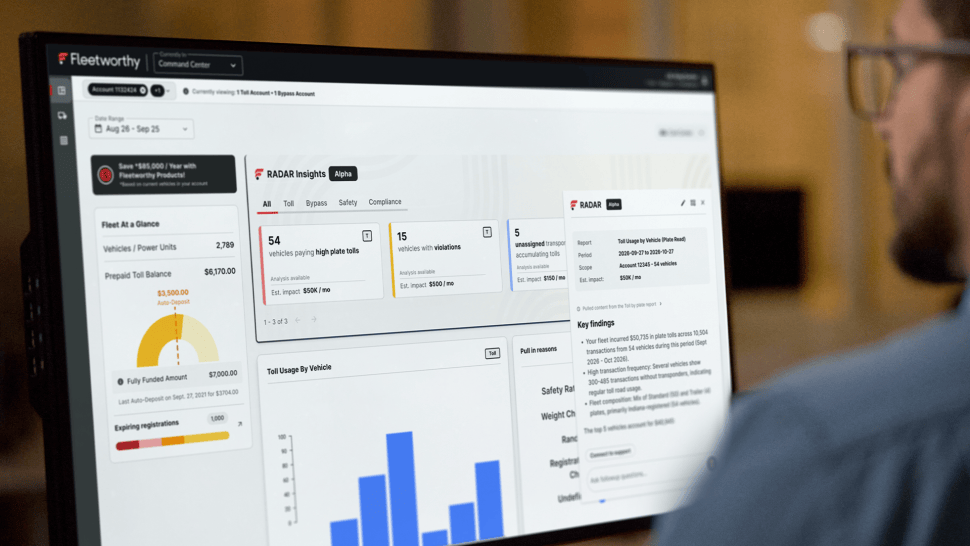
Fleetworthy is adding AI-powered capabilities to its fleet management platform, giving customers new tools to monitor toll activity, identify spending trends and receive recommendations without manually reviewing reports.
The new technology, called RADAR (Real-time AI, Decisioning and Automated Resolution), is embedded directly into the company’s existing software rather than offered as a standalone chatbot or analytics product.
RADAR is initially launching exclusively within Fleetworthy’s Toll Management product, with general availability for Toll Management customers expected in the first quarter of 2027. The company also plans to introduce RADAR capabilities in its safety and compliance and weigh station bypass products, with beta versions expected around the same time. Fleetworthy announced the new technology at its roadshow in Nashville, Tennessee, on Nov. 4.
Fleetworthy developed RADAR to help fleet managers identify operational issues, including toll leakage and problems that could keep vehicles or drivers off the road, Chief Product Officer Shay Demmons said. Toll leakage can include discrepancies between what a fleet should have paid and what it was actually charged, such as higher plate-based toll costs.
The launch comes as trucking companies face rising operating expenses. The average cost of operating a truck reached $2.336 per mile in 2025, up 3.4% from the previous year, while toll expenses increased 13.2%, according to the American Transportation Research Institute.
RADAR allows fleet managers to ask questions about their toll activity, including why a particular charge appeared or how a transponder is performing. RADAR does not use information from other Fleetworthy customers to generate industry benchmarks. Instead, its answers and insights are based exclusively on each customer’s own data, giving fleet managers a view of their individual toll activity, spending trends and potential opportunities for improvement.
The platform uses a commercial large language model to explain results in plain language. However, the AI model does not generate the underlying figures. Those calculations come from defined queries against the customer’s Fleetworthy data, which the company said are auditable.
The technology also displays fleet-specific insights on the platform’s dashboard, highlighting toll anomalies, spending trends and potential cost-saving opportunities. It can recommend next steps based on those findings, while fleet managers retain control over operational decisions.
Because RADAR draws on information from customers’ Fleetworthy accounts, the company said it takes steps to protect confidential customer information from being shared with other users.
“We’re doing all the things necessary to make sure that we’re not exposing any confidential information that shouldn’t be shared with someone else,” Fleetworthy President Mike Precia said.
Fleetworthy has already tested RADAR with several customers, incorporating their feedback into the product’s development.
“They’ve been able to quickly identify toll leakage that otherwise was difficult to find,” Demmons said. Customers have also used RADAR to identify trucks without transponders and locate transponder information without searching through reports, he noted.
Fleetworthy didn’t disclose the specific companies who have tested the new technology.
If a response is inaccurate or conflicts with fleet’s records, the company recommends contacting its customer support team for assistance. Moreover, while RADAR is a significant step in Fleetworthy’s incorporation of AI into their systems, the company views the tool as something that supports human decision making, not replace it.
“AI from our perspective is we believe we want it to be human centered, meaning it’s not a black box,” Demmons said.
Fleetworthy’s broader AI strategy
RADAR is part of a broader effort by Fleetworthy to incorporate artificial intelligence across its fleet management platform. The company began building its AI capabilities about 18 months ago, establishing a dedicated department to explore how the technology could address operational challenges for its customers.
That effort has included investments in the company’s underlying data infrastructure, connecting information across its products to support the development of AI tools.
Precia said Fleetworthy sees opportunities to use AI to help customers identify inefficiencies, understand fleet performance and make better operational decisions.
The company also plans to eventually expand RADAR beyond surfacing insights and recommendations to helping customers resolve operational issues through guided workflows. Those capabilities would allow fleet managers to investigate a problem, review its potential impact and receive guidance on how to address it.
“We don’t want to stop at, ‘Hey, here’s the highest areas you should know about,’ but more so on how we actually resolve those issues,” Demmons said.
Fleetworthy has not established a timeline for the workflows. It also has not finalized pricing for RADAR. Demmons said basic functionality, including the ability to ask questions, would likely be included in the core product, while more advanced workflows could carry an additional cost.
Why this matters
As trucking companies face rising operating costs, identifying unnecessary expenses and operational inefficiencies is increasingly important. Fleetworthy’s RADAR aims to help fleet managers find issues such as toll leakage and missing transponders more quickly, while giving the company a foundation to expand AI capabilities across its fleet management platform.