




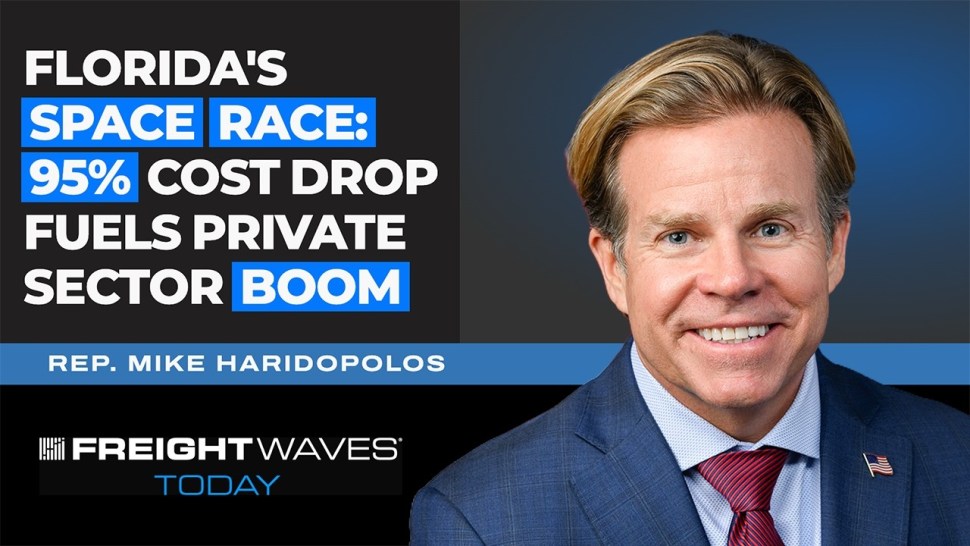
Florida is rapidly becoming the epicenter of the new space race, with groundbreaking public-private partnerships driving down costs and opening new frontiers. Rep. Mike Haridopolos explains how the private sector has dramatically reduced the cost of putting a pound into space by 95%, fueling job growth and innovation. Discover why the Sunshine State is set to lead America to the moon and beyond, fostering a new ‘Silicon Valley’ for aerospace. #SpaceCommercialization #FloridaSpace #PrivateSector
The cost of putting a pound of payload into space has fallen 95% thanks to private-sector competition, the congressman representing Florida’s 8th Congressional District and chairman of the House Space and Aeronautics Subcommittee said at the Up Summit near Kennedy Space Center this week. The figure underscores a structural shift in the economics of the space industry — one with direct implications for satellite communications, defense logistics, and the domestic supply chains that support them.
The congressman, who has represented the Space Coast since 1989, said the region has moved from roughly four launches a year to four launches a week, a cadence that is pulling manufacturers, defense contractors, and technology companies into the area. “We’ve reduced the cost of putting a pound into space by 95% by using the power of the private sector,” he said, adding that the job creation spans college-degreed engineers as well as high school graduates working as machinists and welders.
“What I love about SpaceX and a lot of these emerging companies, they embrace like capitalism is a better product at a lower price.”
For freight and logistics professionals, the satellite density enabled by lower launch costs is already a tangible reality. The congressman pointed to Starlink as an example of connectivity infrastructure — available on planes, trucks, boats, and RVs — that bypasses the expense of terrestrial cable networks. He said the ability to communicate at lower cost through satellite systems is now a national-security priority as well as a commercial one.
On supply chain resilience, the congressman drew a direct line from COVID-era disruptions to a legislative push for domestic manufacturing. NASA received $24 billion in base funding over the past two years, plus an additional $10 billion passed in a separate bill last July, money he said is intended to anchor supply chain investment at home and reduce dependence on foreign sources. Florida’s diverse energy grid and growing STEM workforce — he cited University of Central Florida, Embry-Riddle Aeronautical University, and Florida Tech as feeders — are central to that argument.
The congressman said he expects the United States to return to the moon’s South Pole in less than two years, partly to secure water ice and solar energy resources ahead of China. He framed the race in explicitly competitive terms, noting that the Chinese “don’t share our values” and have a poor environmental record on resource stewardship. Blue Origin’s lander and SpaceX’s Starship, he said, are the vehicles most likely to drive the next wave of satellite deployment and further compress launch costs.
Florida is also positioning itself as the host for a proposed new space academy, competing against Huntsville, Alabama, and Texas. The congressman argued that Texas’s recent election results signal a shift toward policies less friendly to the aerospace sector, while Florida offers available land, a trained workforce, and a regulatory environment he described as more business-friendly than California or New York. The Up Summit itself, held at a federal facility on the Space Coast, was organized in four months — a timeline he called “record time for the government” and evidence that the region can execute quickly.
- Private-sector competition has cut the cost of launching a pound of payload into orbit by 95%, according to the House Space and Aeronautics Subcommittee chairman.
- NASA received $24 billion in base funding plus an additional $10 billion passed in July to support the space race and domestic supply chain investment.
- Florida’s Space Coast has gone from roughly four launches per year to four launches per week, driving demand for manufacturing, defense, and logistics workers at all skill levels.
This Summary is generated thanks to a transcription of the interview, for the full interview please enjoy the video above.
