




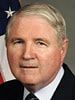
| Lidinsky |
Lidinsky said there are also several pending matters before the commission and initiatives that he thinks it will undertake in coming months. He spoke after Thursday’s vote to initiate a rulemaking to relieve non-vessel-operating common carriers from having to publish rate tariffs.
Lidinsky said his appointment last year and the addition of a fourth member to the commission, Michael A. Khouri in January, are helping the commission work off a backlog, but he also said he wants “to see a much more activist commission. Over the years some people felt the commission was becoming too reactive and possibly too comfortable in its role of letting issues come to it rather than moving ahead and bringing some issues forward.”
 |
| Khouri |
He said he is also trying to bring a “green activism” to the FMC. He said an environmental assessment committee is preparing a list of best environmental practices in the maritime industry that can be shared among carriers, terminal operators and ports.
He said the most important step the FMC has taken to bolster the environment was its decision to approve an amendment to the Transpacific Stabilization Agreement allowing them to discuss and implement slow steaming and other environmental measures.
The revised part of the agreement says members may 'exchange views, information, data and reports, and discuss and agree upon practices, terms and conditions relating to,' among other things, 'slow steaming of vessels in order to reduce fuel consumption and air pollution, including any matters related to slow steaming such as expected fuel and other cost savings, various operational slow steaming methods, and adjustment of vessel operations, schedules, or deployments to address service levels in connection with slow steaming practices; cold ironing; use of alternative fuel types to reduce emission levels; vessel or engine design and propulsion issues; route planning practices including weather-related routing; practices with respect to treatment of ballast water and other vessel discharges; navigational practices; noise reduction measures; and technological developments with respect to any of the above.'
The amendment was filed Dec. 23 and went into effect of Feb. 6.
“I don’t think it is an exaggeration to say that this is most significant green transport environmental action that has been taken so far by the federal government, to allow this slow steaming to take place under the aegis of the TSA antitrust agreement,” said Lidinsky.
TSA carriers carry the majority of containers coming into the country, and the agreement with the FMC allows them to discuss “all or any part of the round trip transpacific trades (eastbound and westbound.)”
Lidinsky said he has been told shippers would share in the savings that carriers realize from slow steaming, perhaps through lower fuel surcharges.
Information service Alphaliner said last week that 39 percent of all transpacific services to the U.S. West Coast have adopted extra-slow steaming and 42 percent of Far East-to-U.S. East Coast services are slow steaming. Alphaliner said in the Far East to North Europe trade, where much larger ships are in use than in the transpacific, 20 loops are slow steaming and only three are not.
Soren Stig, senior director of sustainability at Maersk Line, which rejoined the TSA in November, said Maersk's 'entire global network is now configured and set up to slow-steam — with a mix between super and ‘regular’ slow-steaming. Super-slow steaming is mainly on backhaul legs from Europe to Asia and North America to Asia' which he notes have less time sensitive cargo.
Stig said Maersk defines 'slow steaming' as reducing to 40 percent engine power, which was previously the lowest limit possible according to the major engine designers guarantees and service bulletins, until Maersk challenged them, testing further reductions on 110 of its own vessels.'
Maersk uses the term 'super-slow steaming' when engines are dropped to an operational range to between 10 percent and 40 percent engine power, which can reduce speed to as little as 12 knots.
“Twelve knots is indeed performed on long haul, continuous ocean stretches,” Stig said.
He added, 'engine designers have now changed their guarantees after we shared our test results and operational experience with them.'
Lidinsky also said he has pledged to 'refocus the activities of the commission the consumer' including small businesses, people moving household goods.
'You are going to see in coming months some actions in that regard,' he said.
On March 3 the commission will hold a hearing on possible revision to the bonds that cruise ship companies must post. He explained that passenger carriers must post bonds to protect consumers in case voyages are canceled, and that the issue has not been looked at closely since 1991. Since then, he noted, the size of cruise ships have grown enormously, but the bond amount has remained at $15 million per cruise per operator. ' Chris Dupin
Brokerage Compliance Symposium
The day before F3. Every compliance issue you face - fraud exposure, carrier liability, FMCSA rules, cargo theft, insurance gaps - navigated by attorneys and operators defining best practices in a changing industry.
F3 Awards Dinner
The night before F3. FreightTech100 companies honored. FreightTech 25 and Shipper of Choice winners revealed live. Cocktail reception into dinner and live music - 300 industry leaders in one purpose-built room.
F3: Future of Freight Festival
Industry-defining keynotes, rapid-fire technology demos, and industry leaders networking in experiences across Chattanooga - plus the inaugural F3 Awards Dinner featuring the FreightTech and Shipper of Choice reveals.
The day before F3. Every compliance issue you face - fraud exposure, carrier liability, FMCSA rules, cargo theft, insurance gaps - navigated by attorneys and operators defining best practices in a changing industry.
The Signal at Chattanooga Choo Choo • Chattanooga, TN Register NowThe night before F3. FreightTech100 companies honored. FreightTech 25 and Shipper of Choice winners revealed live. Cocktail reception into dinner and live music - 300 industry leaders in one purpose-built room.
The Signal at Chattanooga Choo Choo • Chattanooga, TN Register NowIndustry-defining keynotes, rapid-fire technology demos, and industry leaders networking in experiences across Chattanooga - plus the inaugural F3 Awards Dinner featuring the FreightTech and Shipper of Choice reveals.
The Signal at Chattanooga Choo Choo • Chattanooga, TN Register Now