




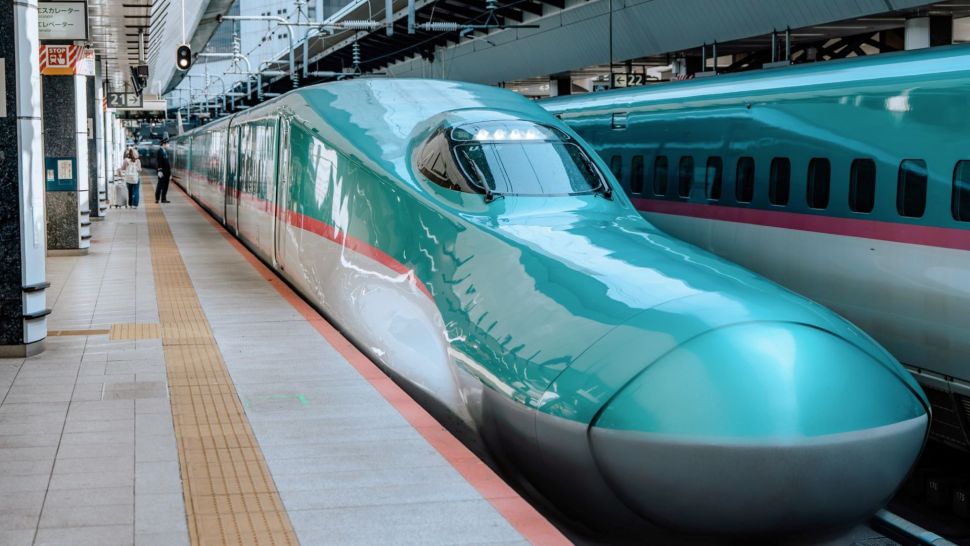
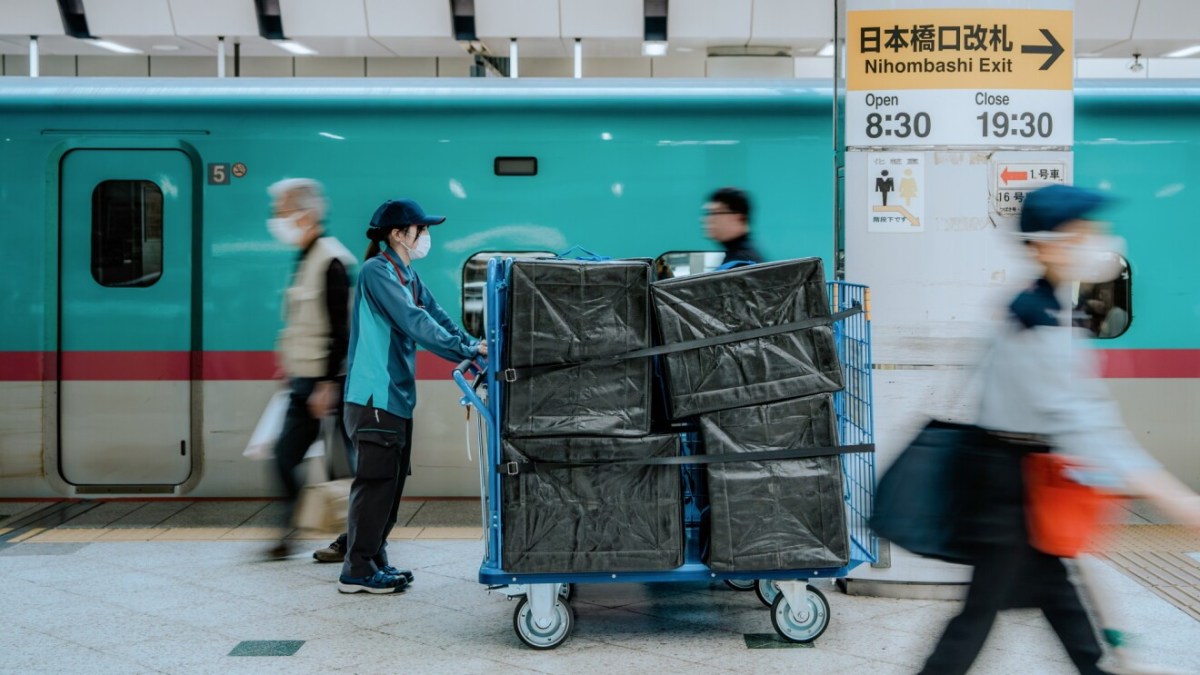
Amazon’s use this year of the famed Shinkansen bullet trains for line-haul transportation of packages has made same-day delivery possible from Tokyo to parts of central and northern Japan.
Incorporating the train’s speed and reliability into the middle-mile network has reduced transit time and carbon emissions. Management is pleased with the results so far, spokesman Steve Kelly said.
Meanwhile, Amazon (NASDAQ: AMZN) is deploying e-cargo bikes — a decidedly slower, but tactically efficient mode for dense, urban environments — in the U.S. West Coast for the first time.
The e-commerce platform this year contracted with three Japan Railway companies to haul parcels on three high-speed routes connecting Amazon fulfillment centers in the Greater Tokyo area with the Hakodate, Aomori and Kanazawa areas. Packages are stored in non-passenger compartments.
Traveling at speeds of up to 200 mph, the Sinkansen network is recognized for its high level of punctuality, enabling Amazon to provide faster and more secure deliveries, according to the company.
Using the trains helps reduce emissions and road congestion compared to long-distance truck transport between cities.
The new package delivery system began in March on the Tohoku Shinkansen and Tohoku-Hokkaido Shinkansen lines, and in May on the Hokuriku line.
Bullet trains are not the only creative method Amazon uses to get packages to customers faster and more sustainably.
In more than 50 cities across Europe, compact e-cargo bikes are a convenient way for associates to make deliveries in crowded neighborhoods, reduce noise and zero tailpipe emissions, and take vehicles off the road.
Amazon is also testing e-cargo bikes, which resemble golf carts with a rear compartment, in Washington, D.C.. Last week it launched e-cargo bike operations in Culver City, California., outside of Los Angeles. The service, which will be operated by two independent delivery partners, began with 25 bikes and will ramp up to full capability over the next four to six weeks, spokeswoman Leigh Anne Gullett said.
Amazon also plans to roll out e-cargo bikes in the Los Angeles County city of Burbank in the next few weeks.
Both Culver City and Burbank e-cargo bike operations are permanent. Full implementation takes several weeks because couriers need to be trained and delivery service providers want to deploy in small batches on shorter routes to ensure deliveries run smoothly while operators learn on the job. The gentle onramp gives them room to work through any hiccups that pop up during a launch. Eventually, Amazon will operate dozens of routes out of the Culver City and Burbank delivery stations, said Gullett.
Amazon’s e-bike training covers safety, local road regulations, onsite procedures, on-road delivery methods, and daily vehicle safety inspections, followed by a practical assessment and a road course test. The e-bikes also include multiple safety features, such as rear cameras, regenerative braking to help control speed downhill, automatic parking brakes, and electronic locks. Drivers wear helmets and reflective safety vests.
Each pedal-assist e-bike, which can reach a top speed of 12 mph, can carry around 240 packages per shift, using one refill stop. The vehicles open a wider pool of hiring candidates because a drivers’ license is required to operate them.
The retailer’s logistics arm this year is also scaling up drone delivery across the United States and has launched operations in England.
On Michigan’s Mackinac Island, where motor vehicles have been banned since the end of the nineteenth century, the resort’s 500 or so residents rely on horse-drawn carriages to receive their deliveries. And in Venice, last-mile deliveries are often made by boat on the city’s famous waterways.
To reach the small island of Monhegan, 10 miles off the central coast of Maine, Amazon partners with the operator of a 65-foot wooden boat to transport packages. The Laura B. was built in 1943 and sailed in the South Pacific during World War II as a patrol boat carrying troops, supplies and two 50-caliber machine guns on deck. When the boat arrives at the dock in Monhegan, the local mail carrier loads the packages into her pickup truck for delivery.
Why It Matters: Amazon’s focus on pleasing the customer means it will try any mode that increases speed, efficiency or access to remote areas, which few companies are able to do.
Click here for more FreightWaves/American Shipper articles by Eric Kulisch.
Write to Eric Kulisch at ekulisch@freightwaves.com.
RECOMMENDED READING:
Amazon deploys drones outside U.S. for 1st time
Brokerage Compliance Symposium
The day before F3. Every compliance issue you face - fraud exposure, carrier liability, FMCSA rules, cargo theft, insurance gaps - navigated by attorneys and operators defining best practices in a changing industry.
F3 Awards Dinner
The night before F3. FreightTech100 companies honored. FreightTech 25 and Shipper of Choice winners revealed live. Cocktail reception into dinner and live music - 300 industry leaders in one purpose-built room.
F3: Future of Freight Festival
Industry-defining keynotes, rapid-fire technology demos, and industry leaders networking in experiences across Chattanooga - plus the inaugural F3 Awards Dinner featuring the FreightTech and Shipper of Choice reveals.
The day before F3. Every compliance issue you face - fraud exposure, carrier liability, FMCSA rules, cargo theft, insurance gaps - navigated by attorneys and operators defining best practices in a changing industry.
The Signal at Chattanooga Choo Choo • Chattanooga, TN Register NowThe night before F3. FreightTech100 companies honored. FreightTech 25 and Shipper of Choice winners revealed live. Cocktail reception into dinner and live music - 300 industry leaders in one purpose-built room.
The Signal at Chattanooga Choo Choo • Chattanooga, TN Register NowIndustry-defining keynotes, rapid-fire technology demos, and industry leaders networking in experiences across Chattanooga - plus the inaugural F3 Awards Dinner featuring the FreightTech and Shipper of Choice reveals.
The Signal at Chattanooga Choo Choo • Chattanooga, TN Register Now