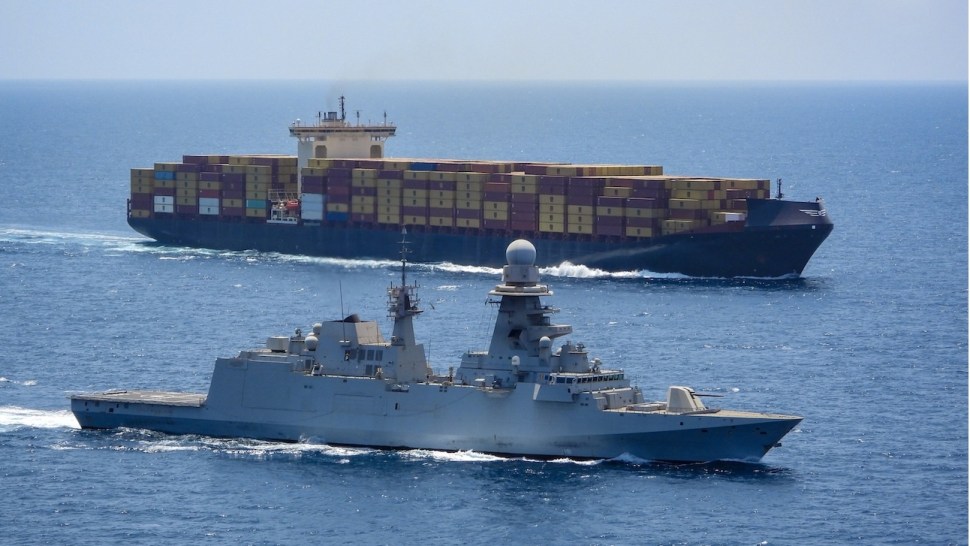
Container shipping lines are pushing freight rates higher even as a gradual return to the Red Sea promises to release capacity into a softening market, as competing forces shape ocean freight heading into 2027.
The recovery in Suez Canal routings is unfolding despite persistent security risks in the Middle East, said analyst and SONAR data contributor Freightos (NASDAQ: CRGO). Meanwhile, increased vessel traffic through the Strait of Hormuz has coincided with more Iranian attacks, as some operators resume passage through threatened waterways.
Iranian attacks on ships crossing Hormuz have surged as Persian Gulf oil flows recovered toward prewar levels, Bloomberg reported. As of its Oct. 13 report, however, there was no clear evidence of a corresponding reduction in oil loadings among several major regional producers.
Iranian forces sank a Dubai-linked container vessel this past week, demonstrating that some container operators are also accepting the risks of transiting Hormuz, although tankers still account for most traffic. Crude prices remain around $100 per barrel despite the recovery in exports, reflecting continued concern over potential supply disruptions.
In the Red Sea, escalating violence between Yemen-based Houthi rebels and the Saudis have added to concerns about the security of shipping through the Bab el-Mandeb Strait at the route’s southern end. Nevertheless, container lines are steadily restoring services through the Suez Canal after the widespread diversions that began in late 2023.
Maersk (OTC: AMKBY) and Hapag-Lloyd’s Gemini Cooperation expects to return nearly all its services to Suez routings during the first quarter of 2027, provided conditions do not change, Hapag-Lloyd Chief Executive Rolf Habben Jansen said recent public comments.
The partners plan to introduce another Asia-Mediterranean service through Suez in November. The service, designated AE18 by Maersk and SE5 by Hapag-Lloyd, will connect Chinese ports with western Mediterranean transshipment hubs, with its first sailing scheduled to leave Shanghai on Nov. 22.
Liner analyst Lars Jensen estimated that Suez routing had returned to roughly 30% to 35% of normal across the market, with the recovery slightly further advanced on backhaul voyages than on headhaul sailings. He described the measured pace as a positive surprise, reducing the risk of an abrupt network transition.
High fuel costs and port congestion may help explain carriers’ willingness to return from longer diverted routings around Africa despite the security threats. It also points to evolving geopolitical calculations, including the possibility that the Houthis could avoid commercial shipping while directing greater pressure toward Riyadh.
The phased return should help ports manage the arrival of ships completing shorter voyages, limiting the vessel bunching and schedule disruption that could accompany a sudden, industrywide shift.
Habben Jansen said Gemini’s step-by-step approach had allowed it to manage workloads at European and Mediterranean hubs without major problems so far.
In a potential benefit to shippers, the restoration follows the early-July Asia-Europe demand peak and will continue through lower-demand months, reducing the potential disruption compared with a peak-season transition.
Port congestion continues to absorb some vessel capacity, although backlogs at major Asia hubs are easing. That provides a partial counterweight to the capacity released as ships circulate more quickly through the Red Sea.
Over time, however, shorter voyages would increase effective fleet capacity, adding to the risk of excess supply in 2027 if demand fails to keep pace.
Trans-Pacific rates were largely unchanged in the past week but remained elevated, according to the Freightos Baltic Index. Asia-U.S. West Coast prices stood at $8,126 per FEU, while East Coast rates increased 1% to $9,700 per FEU.
On the Asia-Europe trades, carriers have secured some spot-rate gains despite weakening demand and the gradual release of capacity.
Asia-North Europe rates rose 6% last week to $3,442 per forty-foot equivalent unit, while Asia-Mediterranean rates increased 3% to $3,927 per FEU.
The increases follow recent general rate increases aimed at strengthening pricing as negotiations for 2027 long-term contracts begin. Some forwarders remain skeptical that the gains will hold given current supply-and-demand conditions.
Daily readings early this week indicated further upward pressure despite expectations that volumes are cooling. Capacity reductions as the trade enters its slower season may be helping support prices.
On the trans-Atlantic, announced October increases have produced more modest gains. Spot rates have risen about $200 per FEU since the end of September to approximately $2,850 per FEU.
That leaves trans-Atlantic prices about 25% above year-earlier levels, potentially reflecting pressure from elevated bunker costs, even as carriers struggle to implement the full increases they sought.
Read more articles by Stuart Chirls here.
Read more:
No. 2 container line studying US-UK route for nuclear ships
Trans-Pacific facing new booking risks as reliability sinks
Container ship attacks escalate in Strait of Hormuz
New Long Beach record as volume nears 1M containers
Houthi attacks add new geopolitical risk to softening container rates
Brokerage Compliance Symposium
The day before F3. Every compliance issue you face - fraud exposure, carrier liability, FMCSA rules, cargo theft, insurance gaps - navigated by attorneys and operators defining best practices in a changing industry.
F3 Awards Dinner
The night before F3. FreightTech100 companies honored. FreightTech 25 and Shipper of Choice winners revealed live. Cocktail reception into dinner and live music - 300 industry leaders in one purpose-built room.
F3: Future of Freight Festival
Industry-defining keynotes, rapid-fire technology demos, and industry leaders networking in experiences across Chattanooga - plus the inaugural F3 Awards Dinner featuring the FreightTech and Shipper of Choice reveals.
The day before F3. Every compliance issue you face - fraud exposure, carrier liability, FMCSA rules, cargo theft, insurance gaps - navigated by attorneys and operators defining best practices in a changing industry.
The Signal at Chattanooga Choo Choo • Chattanooga, TN Register NowThe night before F3. FreightTech100 companies honored. FreightTech 25 and Shipper of Choice winners revealed live. Cocktail reception into dinner and live music - 300 industry leaders in one purpose-built room.
The Signal at Chattanooga Choo Choo • Chattanooga, TN Register NowIndustry-defining keynotes, rapid-fire technology demos, and industry leaders networking in experiences across Chattanooga - plus the inaugural F3 Awards Dinner featuring the FreightTech and Shipper of Choice reveals.
The Signal at Chattanooga Choo Choo • Chattanooga, TN Register Now