




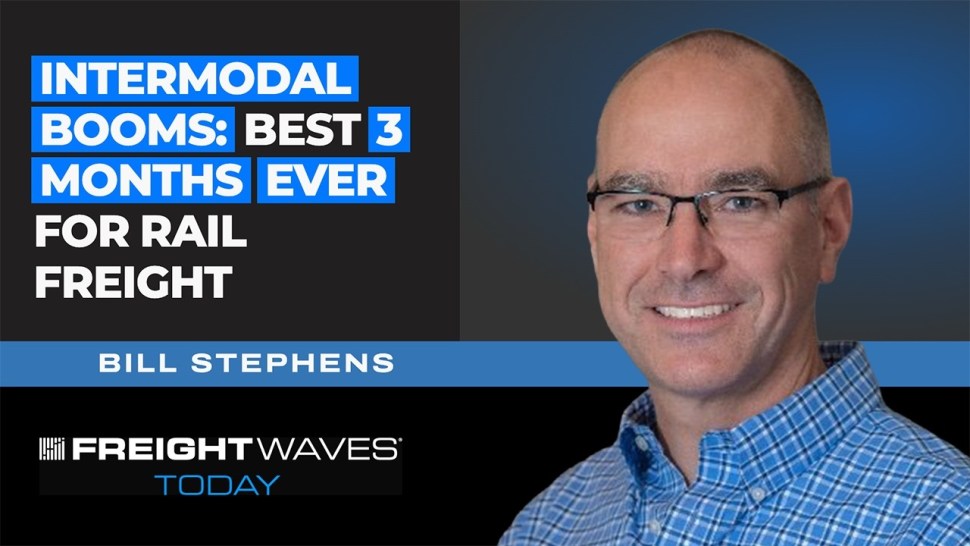
North American rail traffic is on a roll! The latest AAR monthly outlook reveals the best three months for intermodal EVER, culminating in an all-time high in October. This broad-based strength, beyond just market share gains from trucks, signals a robust industrial economy. Despite inflation and rising interest rates, rail volumes are projected to continue growing into 2027. We break down the key numbers from carloads to commodities and discuss the Genesee & Wyoming split.
U.S. intermodal rail traffic set an all-time monthly record in October, the third consecutive month of record volumes, the Association of American Railroads reported in its latest Rail Industry Overview. The 9.6% year-over-year gain far outpaced the 4.9% growth rate recorded for the year to date, underscoring a sustained surge in demand that the AAR attributed to broad industrial strength rather than simple market share gains from trucking.
The October numbers carry weight beyond a single data point. Carload traffic rose 3.4% year over year — the largest percentage increase in eight months, the AAR said. Excluding coal, carloads climbed 4.5%, well above both the year’s average and the 2021-to-2025 average of 1.7%. Fifteen of 20 carload commodity segments posted year-over-year gains in October, and 16 of 20 are positive for the year to date, signaling strength across the industrial economy.
Motor vehicles and parts led carload volume growth at 10% for the month and are running roughly flat for the full year after showing consistent week-over-week strength. The AAR’s freight rail index — which strips out coal and grain — hit its second-highest level ever in October. For week 44, U.S. intermodal volume was up 11% compared to a year ago, above the prior four-week trend of 9.6%.
“What this says is: one, you’ve got that broad economic strength in the industrial economy; you’ve got a strong consumer economy that’s helping with intermodal demand; and then also the high diesel prices and the tighter trucking capacity driving freight from truckload to rail, whether that’s intermodal or in certain carload segments,” said Bill Stephens, editor of Trains Magazine.
The AAR flagged several headwinds, including inflation, rising interest rates, housing affordability pressures, and weakening consumer confidence. Despite those caution flags, the association said economic indicators suggest the economy is still expanding at a solid pace and projected rail volumes to keep growing into 2027.
In a separate development, Genesee & Wyoming — the largest shortline holding company, with roughly 110 short lines, 13,000 miles of track, 2,000 customers, and approximately 1.5 million carloads per year representing about 9% of North American carload volume — announced it will split into three regional holding companies in January. Brookfield Infrastructure Partners and GIC, a Singapore-based wealth fund, took G&W private in 2019 for $8.4 billion. Stevens said the split is designed to broaden the pool of potential buyers ahead of an eventual sale, noting that Brookfield’s CEO had cited G&W as a model for breaking large infrastructure assets into smaller, more sellable pieces.
BNSF’s latest results, reported through parent Berkshire Hathaway, also fit the broader industry trend: volume was up nearly 4%, revenue rose 14%, and the railroad posted double-digit net income and pre-tax income growth while improving fuel efficiency. BNSF was a positive contributor to Berkshire’s overall earnings even as the conglomerate’s results fell short of some expectations.
- U.S. intermodal rail set an all-time monthly record in October, up 9.6% year over year, marking three straight months of record volumes.
- Genesee & Wyoming, operator of ~110 short lines and ~9% of North American carload volume, will split into three regional holding companies in January ahead of a potential sale.
- BNSF posted nearly 4% volume growth and 14% revenue growth in its latest results, with double-digit net income gains consistent with publicly traded Class 1 peers.
This Summary is generated thanks to a transcription of the interview, for the full interview please enjoy the video above.
