




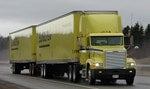
Federal rules limit fully loaded trucks to 80,000 pounds and trailers to 53 feet in length. Some states, primarily in the Mountain West, were granted exemptions many years ago to allow longer tractor-trailer combinations with more weight on certain interstate routes. Those states were grandfathered when Congress subsequently froze weight limits on interstate highways in 1991. Efforts by the trucking industry to raise the caps elsewhere have proven unsuccessful in the face of opposition from safety groups who argue that bigger trucks are difficult to handle and pose a danger to motorists.
Companies can obtain special permits from states to exceed the regular weight limits.
Railroads have generally opposed efforts to increase truck size and weight limits, which potentially threaten their intermodal franchises that seek to convert truckloads to the rail network for long-distance moves. The American Association of Railroads (AAR) and the American Trucking Associations in 2003 agreed to abstain from efforts to change the limits through September 2009 in order to collaborate on issues of common interest and obtain funds for highway and rail freight projects in a multi-year transportation bill.
The ATA and others are now working to obtain an increase in existing limits.
 |
| Branscum |
'If the trucking industry and shippers could identify those areas, and deal honestly about, 'This is really all we need and we're not looking for a carte blanche change in truck size and weight so we become more competitive relative to rail and put more freight on the highways,' ' then progress could be made towards a middle ground that meets shippers' needs, he said.
The BNSF's official position is that it doesn't oppose an increase on truck size limits as long as the trucking industry pays its full share of wear and tear on the highway system, especially bridges. The AAR and other railroads are more absolute in their opposition.
 |
| Rose |
The railroad industry points to a Department of Transportation study that tractor-trailers only pay half the cost of the damage they cause to highways, with trucks weighing more than 100,000 pounds only paying 40 percent of the repairs through fuel taxes and fees.
 |
| Cairns |
There is no consensus on bigger trucks within the trucking industry either. Some truckers worry the extra capacity would undercut their pricing power and smaller carriers are concerned they would be at a competitive disadvantage because they could not afford to swap out their equipment.
Shippers in the home building industry, who often weigh out a trailer before they can fill it all the way, said they want the extra truck capacity, especially as congestion worsens around the country.
Jeff Hoy, senior manager of western division transportation at the Home Depot, told industry colleagues in Anaheim that the retailer needs the 97,000-pound gross vehicle weight for trucks because it ships more than 3 million flatbed truckloads per year.
 |
| Johnson |
But intermodal executives cautioned that dumping more cargo in an intermodal box is not as simple as it sounds. Among the complications is that a change could make their equipment obsolete.
Railroads and equipment providers would have to re-engineer the containers and specialized railcars they ride on to handle the extra weight at a cost of hundreds of millions of dollars, said Brian P. McDonald, vice president of intermodal at Union Pacific.
'It's not just a load 'em up and move 'em out. That proposition will not work. And it's dangerous,' he said, noting that the western railroad can't double-stack 40-foot containers loaded with grain because the weight is too great.
J.B. Hunt, one of the largest U.S. truckload and intermodal carriers, is taking a wait-and-see approach to the truck size issue because all the potential economic, safety and business ramifications aren't well understood yet, said Chad Thomas, the company's intermodal director.
A carrier may charge more in proportion to the additional weight it is carrying, but it is not clear whether the higher price would cover any additional taxes the government might subsequently impose to pay for road maintenance, he said, noting the delay in passing a new surface transportation authorization bill with a defined funding mechanism only adds to the uncertainty.
James A. Bolander, group vice president for domestic intermodal at Norfolk Southern Corp., was skeptical that shippers would sustain paying higher rates if railroads invested in bigger containers.
'It's interesting to hear that shippers are going to be willing to pay more per lading with a higher lading weight. It's kind of like when we got more money when trains got longer — for at least a year,' he said.
Branscum said a weight increase for interchangeable rail-truck containers that exceeds the capabilities of railcar fleets may end up backfiring on shippers — the intended beneficiaries — because they would lose the option of cheaper, more efficient intermodal rail transport That's why both sides need to engage in a common sense dialogue if there are going to be any changes to truck size and weight regulations, he said, hypothetically suggesting a 10 percent improvement in weight might stay within existing railcar tolerances and serve as a compromise for proponents seeking 20 percent to 30 percent weight increases.
Johnson, the wallboard shipper, agreed that triple-trailers, for example, aren't required in big cities and urged the AAR and ATA to follow up on Branscum's suggestion for talks.
The ATA is casting its push for 97,000-pound tractor-trailers, heavier double 33-foot trailers and triples as a pro-environment move that would reduce carbon emissions and fuel consumption by reducing the number of trucks needed on the road. The truck size and weight increases are listed in the trade association's sustainability program outlined in May 2008 to portray the industry's green credentials.
 |
| Michaud |
Also supporting the bill is the Coalition for Transportation Productivity (CTP), which is heavily comprised of dozens of shippers from the food, agriculture, and paper industries such as Kraft Foods, Coca Cola, Weyerhaeuser, and the National Confectioners Association.
A Maine Department of Transportation study found that the state would save $1.7 million to $2.3 million per year in reduced pavement repair using the heavier trucks, according to the congressman's Web site.
In September, the Senate included language in the 2010 DOT appropriations bill enabling Maine to conduct a one-year demonstration allowing 100,000-pound trucks with six axles on interstates.
The trucking industry has requested Congress authorize similar pilot programs in five other states.
The ATA and CTP oppose competing legislation that attempts to permanently lock in the existing weight freeze, extend it to non-interstate highways in the federal system and make it more difficult for weight exemptions to be granted. The bill, and a Senate companion, would prohibit a state from allowing an oversize trailer unless operation of the unit was authorized as of June 1, 2008.
 |
| McGovern |
In a Sept. 29 letter to members of Congress, the CTP said transportation corridors feeding ports and intermodal hubs are areas where heavier weight limits would minimize the number of vehicles needed to move goods. And it disputed any adverse impact on railroads from heavier trucks.
'Even if H.R. 1799 is fully implemented nationwide, average railroad rates would still be significantly less expensive than truck rates,' CRT Executive Director John Runyan wrote, pointing to a Wisconsin Department of Transportation study in January that predicted no significant displacement of freight rail by trucks with passage of truck weight limit reform.
'Shippers need both industries to be as efficient as possible. Furthermore, the path to a more efficient rail industry should not lie in blocking productivity reforms for the trucking industry,' the letter said. ' Eric Kulisch
Brokerage Compliance Symposium
The day before F3. Every compliance issue you face - fraud exposure, carrier liability, FMCSA rules, cargo theft, insurance gaps - navigated by attorneys and operators defining best practices in a changing industry.
F3 Awards Dinner
The night before F3. FreightTech100 companies honored. FreightTech 25 and Shipper of Choice winners revealed live. Cocktail reception into dinner and live music - 300 industry leaders in one purpose-built room.
F3: Future of Freight Festival
Industry-defining keynotes, rapid-fire technology demos, and industry leaders networking in experiences across Chattanooga - plus the inaugural F3 Awards Dinner featuring the FreightTech and Shipper of Choice reveals.
The day before F3. Every compliance issue you face - fraud exposure, carrier liability, FMCSA rules, cargo theft, insurance gaps - navigated by attorneys and operators defining best practices in a changing industry.
The Signal at Chattanooga Choo Choo • Chattanooga, TN Register NowThe night before F3. FreightTech100 companies honored. FreightTech 25 and Shipper of Choice winners revealed live. Cocktail reception into dinner and live music - 300 industry leaders in one purpose-built room.
The Signal at Chattanooga Choo Choo • Chattanooga, TN Register NowIndustry-defining keynotes, rapid-fire technology demos, and industry leaders networking in experiences across Chattanooga - plus the inaugural F3 Awards Dinner featuring the FreightTech and Shipper of Choice reveals.
The Signal at Chattanooga Choo Choo • Chattanooga, TN Register Now