




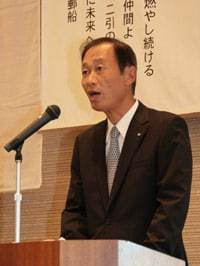
'The problem, however, is that even if all operators resort to ship layup during the next slack season, it may not be truly possible to expect such a measure on a permanent basis,' said Kudo, during a speech to mark the 125th anniversary of Japan's largest shipping company.
| NYK President Yaumi Kudo. |
“We should not alter our strategy of maintaining coexistence between asset-oriented business sectors and light-asset-type forwarding sectors like non-vessel-operating common carriers, warehousing, customs clearance, and trucking, and making both the mainstays of the general cargo transport division for such cargoes as consumer goods and machinery parts to enlarge this division as a whole through the complementary and synergistic relationship of the two mainstays.'
After experiencing its largest losses as a result of the financial crisis, Kudo said NYK is 'now certain to end the first half of the current fiscal year with sufficient profits.' NYK had a $187.5 million loss in the year ending March 31, with profit from other operations partially offsetting a $553 million operating loss in its liner business.
Kudo said NYK's containership business 'has pulled off an unexpectedly swift recovery,' which he attributed to industry-wide trends such as the surge in fuel prices and a steep fall in cargo traffic, which he said led almost all containership operators to resort to slow steaming and ship layups. He said that restriction in supply, combined with the swift recovery of freight volumes and caution by carriers about increasing capacity, resulted in rising freight rates.
'As such, it would be a mistake to claim that the containership business has become a fully sustainable business model,' he cautioned. 'As usual, some containership operators have been quick to explore the possibility of expanding shipping capacity at a pace faster than the recovery of cargo traffic. Meanwhile, another cause for concern is an unexpectedly slow recovery in European and U.S. cargo traffic.”
Kudo said NYK's air cargo business, like the containership business, is quickly recovering. After drastic structural reform, he said the company should be able to achieve its fiscal 2010 target 6 billion yen ($72 million) of ordinary profit.
