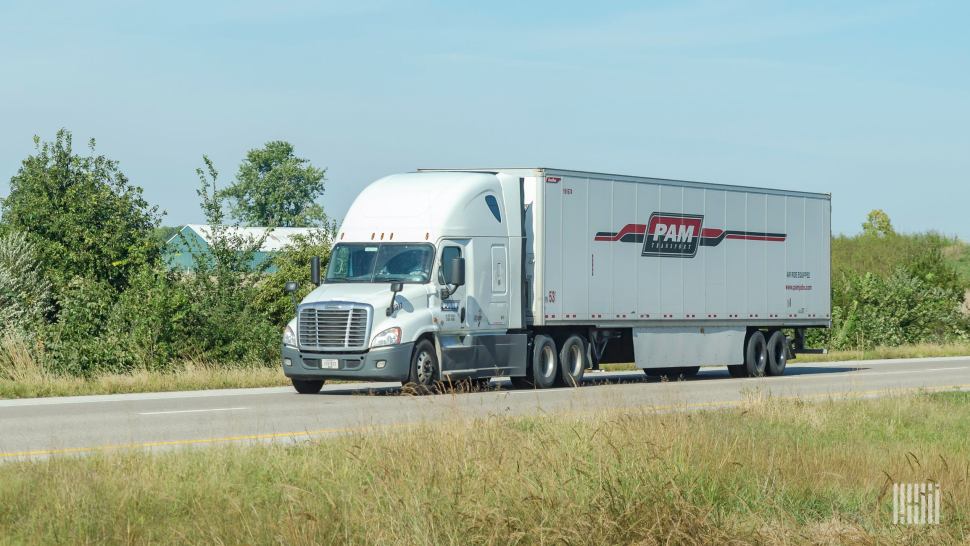
Pam Transportation, the auto industry-focused truckload carrier whose stock has been battered in the past year and beyond, is buying back some of its shares through a process known as a Dutch auction.
Companies buy back their stock frequently but generally do so in a lower-key manner, entering the market as an occasional or frequent buyer operating through the normal processes of the equity markets. Companies often declare their intention to buy back stock over a certain period, but the specifics of those purchases are far less transparent and open-ended than in a Dutch auction.
By contrast, Pam (NASDAQ: PTSI) announced the Dutch auction in a press release and in a Securities and Exchange Commission filing Wednesday.
If one of the goals of the Dutch auction was to boost the company’s stock price, it was working Thursday. At approximately 1:30 p.m., Pam stock was up $2.97, a gain of 20.43%, to $17.51.
Pam’s stock set its 52-week high on June 7, 2023, when it reached $28.77. Its 52-week low was $13.51 on Monday, a decline of 53% since the 52-week high.
The stock decline has been more dramatic since its high-water mark of near $40 in November 2022. The percentage decline from the peak to the recent 52-week low is roughly two-thirds.
Pam has not paid a dividend since a special one-time payout in 2012.
Pam executives are prohibited from discussing the offer while it is in what is known as “quiet time” before an action governed by SEC rules.
However, the goals of the auction were set forth in a company filing with the SEC.
“Our Board of Directors has determined that the Offer is a prudent use of our financial resources and presents an appropriate balance between meeting the needs of our business and delivering value to our stockholders,” the document said. “Our Board of Directors determined that a cash tender offer is an appropriate mechanism to return capital to stockholders that seek liquidity under current market conditions while, at the same time, allowing other stockholders to share in a higher portion of our future potential.”
The auction “provides stockholders (particularly those who, because of the size of their shareholdings, might not be able to sell their shares without potential disruption to the share price) with an opportunity to obtain liquidity with respect to all or a portion of their shares, without potential disruption to the share price and the usual transaction costs associated with market sales.”
One shareholder who fits the bill of not being able to sell without “potential disruption to the share price” is Pam Chairman Matthew Moroun and the trusts his family controls. Those individuals and trusts own more than 50% of the company, according to Pam’s 10-K filing with the SEC in March.
The SEC filings note that management participation in the Dutch auction is permitted.
But even shareholders who get shut out or choose to sit out the auction will benefit, Pam’s filing said. “If we complete the offer, stockholders who do not participate in the offer will automatically increase their relative percentage ownership interest in us and our future operations at no additional cost to them,” the company said.
In a Dutch auction, shareholders are invited to offer their shares at a designated price. Pam has set the range for bids it will accept as $15.50 to $18. All of the bids are in increments of 50 cents.

What the Dutch auction offer looks like
Pam then would review the bids and accept up to 550,000 shares at the lowest price it can select to fulfill its goal of buying that quantity. The quantity is about 2.5% of the number of outstanding Pam shares.
Under Dutch auction procedures, the company can choose to accept fewer than 550,000 shares. Pam also can buy shares in excess of 550,000.
The offer is open until May 22.
Master Class, the online education offering, laid out in one of its presentations the pros and cons of a Dutch auction. Its benefits: It is faster than a traditional auction (and the normal process for buying and selling shares is a type of auction); it might benefit a company like Pam because the shareholders looking to sell their shares “don’t know what prices the other bidders are willing to pay. This uncertainty can make them more willing to pay a higher price to make a successful bid and quickly achieve closure”; and the process can “help determine the best asking price.” For that reason, Dutch auctions are often used to sell shares in an IPO rather than having the underwriters set the price.
Pam’s fortunes have long been tied to the fate of the automotive industry. In its 10-K filing with the SEC for this year, Pam said its top five customers, based on revenue, accounted for about 34% of its revenue. General Motors accounted for about 12%.
Few analysts cover Pam stock. But CFRA, an independent research firm, has a buy rating on the company’s stock.
Pam had a tough first quarter. Its revenue net of fuel was $161 million, down from $193.4 million a year earlier. The company was barely profitable, with net earnings of 1 cent per share, but posted an operating loss. A year ago, net income was 23 cents.
More articles by John Kingston
Pam, flying high on Wall Street, sets $1 billion target for 2025
5 auto haulers combining to create publicly traded trucking company
Brokerage Compliance Symposium
The day before F3. Every compliance issue you face - fraud exposure, carrier liability, FMCSA rules, cargo theft, insurance gaps - navigated by attorneys and operators defining best practices in a changing industry.
F3 Awards Dinner
The night before F3. FreightTech100 companies honored. FreightTech 25 and Shipper of Choice winners revealed live. Cocktail reception into dinner and live music - 300 industry leaders in one purpose-built room.
F3: Future of Freight Festival
Industry-defining keynotes, rapid-fire technology demos, and industry leaders networking in experiences across Chattanooga - plus the inaugural F3 Awards Dinner featuring the FreightTech and Shipper of Choice reveals.
The day before F3. Every compliance issue you face - fraud exposure, carrier liability, FMCSA rules, cargo theft, insurance gaps - navigated by attorneys and operators defining best practices in a changing industry.
The Signal at Chattanooga Choo Choo • Chattanooga, TN Register NowThe night before F3. FreightTech100 companies honored. FreightTech 25 and Shipper of Choice winners revealed live. Cocktail reception into dinner and live music - 300 industry leaders in one purpose-built room.
The Signal at Chattanooga Choo Choo • Chattanooga, TN Register NowIndustry-defining keynotes, rapid-fire technology demos, and industry leaders networking in experiences across Chattanooga - plus the inaugural F3 Awards Dinner featuring the FreightTech and Shipper of Choice reveals.
The Signal at Chattanooga Choo Choo • Chattanooga, TN Register Now