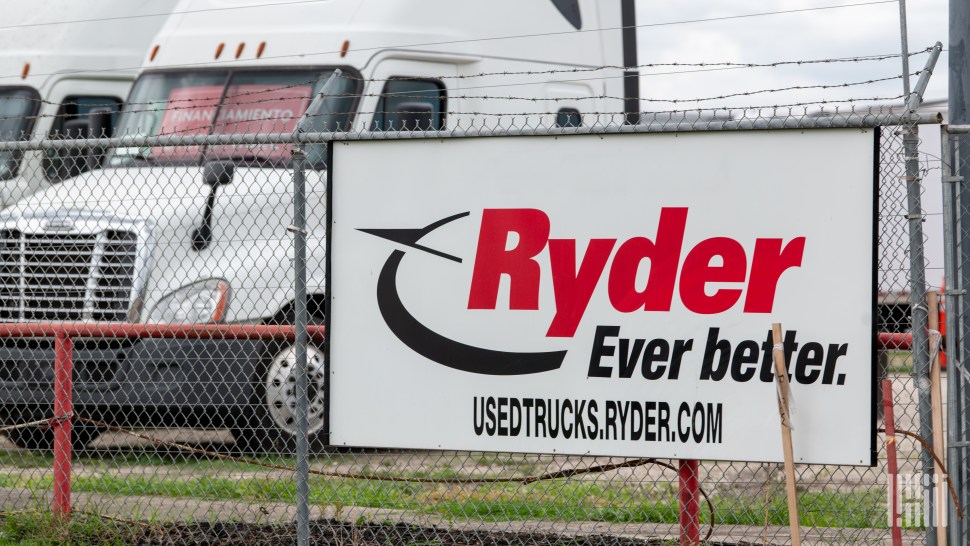
With the EPA ‘27 engine rules impacting nitrogen oxide (NoX) emissions in heavy duty vehicles getting closer every day, the new rules will have a major impact on anybody who buys new vehicles…like Ryder.
Ryder’s (NYSE: R) third quarter earnings released early Thursday were solid enough that it propelled the stock up 10.49% to $265.53, a gain of 25.22%. It is still below its 52-week high of $284.25 set on June 12.
With the strong quarter in the books leading to a discussion on the company’s earnings call with analysts about its growth prospects, the concurrent issue is what will be Ryder’s strategy to power that growth with new vehicles.
Ryder’s new truck purchases work side-by-side with its activity in its ChoiceLease business, which is the longer-term leasing of vehicles (as opposed to its Rental segment, which are for shorter-term arrangements.) The price of a new vehicle can kick back into the actions of customers, as one analyst noted who asked on the call, “Are your customers hesitant to be placing orders for ‘27 now? Does this impact you?”
No buying yet
Ryder CEO John Diez said the company had not seen any sort of “pre-buy surge activity with the change in technology.” But that doesn’t mean it isn’t part of the planning process.
Tom Havens, who is the president of Ryder’s Fleet Management Solutions, which includes its leasing and rental activities, said “it’s pretty well understood at this point that price increases are coming in 2027. And despite that, there was not any significant prebuy activity” in the quarter.
Some customers “took advantage of it, but not to any large extent,” Havens added.
Buying EPA ‘27 compliant vehicles now faces the problem of not knowing what the final rule will be. The EPA has rolled out an amendment process to the initial rule, including such measures as noncompliance penalties and a change in the “deratement” rules that would slow or stop a vehicle if its levels of diesel exhaust fluid got too low.
Fleet numbers lower than normal
Analyst Jeffrey Kauffman of Citizens JMP Securities noted that Ryder’s data on the size of its fleet has been below historic norms, particularly for tractors. Adding new tractors, Kauffman said, “is going to be kind of tough over the next six to nine months just because of the EPA mandate.” He asked whether Ryder had secured an adequate number of “slots” with OEMs to fill any increase in the company’s demand.
Diez said Ryder is “confident we can grow that fleet.” He also said Ryder has “already taken action in the quarter of starting to bring in equipment,” which Diez added is visible in the company’s capital expenditure budget.
But Diez cautioned that utilization of the Ryder fleet “is not yet to screaming red levels like we saw post-COVID, but it will get there if we don’t have fleet, and we’re going to continue adding to meet that demand.”
The rental fleet had utilization of 77% in the quarter, compared to 70% a year ago. For the nine months, that figure stands at 73%. In the second quarter of 2022, the peak of the post-COVID surge, it was 81.6%.
Used vehicle sales remain a key driver of Ryder earnings. Diez noted that current inventories of used vehicles at Ryder are at 7,300, which he said is at the low end of the company’s target range of 7,000. They were 8,500 a year ago.
“We’re going to continue to sell through that inventory,” Diez said. The used vehicle market remains tight enough that Diez said Ryder would expect to sell more of its used vehicles through retail rather than wholesale channels, which is generally more profitable. Retail sales accounted for 61% of all used vehicle sales in the quarter, according to Ryder data, compared to 54% in the third quarter a year ago and 56% sequentially with the second quarter.
Bigger retail footprint
But Diez forecast that the retail number will cross the 70% mark in 2027. “We have that lever for us based on the thin inventories we expect to face later next year,” he said. “That’s the biggest hedge against market forces.”
Diez noted that the company had forecast a $40 million used vehicle gain for the year, which would have been up $20 million from 2025. But now with the used vehicle market at its current levels, the CEO projected that the full-year gain on used vehicle sales will be $50 million to $60 million.
Diez wrapped up the equipment discussion on the call by saying that “when we get back together (on the fourth quarter earnings call), we’ll give you a look at the full year for 2027.”
Ryder’s Dedicated Transportation Solutions (DTS) segment is the window into the market for drivers, as it needs to either hire new drivers to service its dedicated customers or take steps to retain the drivers at companies whose fleet responsibilities have been turned over to DTS.
John Sensing, the president of both DTS and contract logistics segment Supply Chain Solutions (SCS), said DTS has been seeing “about a mid to single digit wage increase in certain regions” at DTS.
The unit has what Sensing called “annual CPI openers” that passes on wage increases directly to customers. But he added there also are “driver wage indices” used by Ryder “that allow us if we see a drastic change to go back and open discussions with these customers.”
Sensing also stressed that Ryder’s experience in the driver market is not necessarily indicative of the broader competition for drivers. The DTS operation often works in highly specialized areas, he said, and “80% of our jobs are home every day or every night. So that’s very attractive.”
More articles by John Kingston
English language rule’s comments bring criticism from Sikh organization
Texas judge upholds nuclear verdict against C.H. Robinson
CEO’s letter boasts of lots of arrows pointing up at Triumph Financial
Brokerage Compliance Symposium
The day before F3. Every compliance issue you face - fraud exposure, carrier liability, FMCSA rules, cargo theft, insurance gaps - navigated by attorneys and operators defining best practices in a changing industry.
F3 Awards Dinner
The night before F3. FreightTech100 companies honored. FreightTech 25 and Shipper of Choice winners revealed live. Cocktail reception into dinner and live music - 300 industry leaders in one purpose-built room.
F3: Future of Freight Festival
Industry-defining keynotes, rapid-fire technology demos, and industry leaders networking in experiences across Chattanooga - plus the inaugural F3 Awards Dinner featuring the FreightTech and Shipper of Choice reveals.
The day before F3. Every compliance issue you face - fraud exposure, carrier liability, FMCSA rules, cargo theft, insurance gaps - navigated by attorneys and operators defining best practices in a changing industry.
The Signal at Chattanooga Choo Choo • Chattanooga, TN Register NowThe night before F3. FreightTech100 companies honored. FreightTech 25 and Shipper of Choice winners revealed live. Cocktail reception into dinner and live music - 300 industry leaders in one purpose-built room.
The Signal at Chattanooga Choo Choo • Chattanooga, TN Register NowIndustry-defining keynotes, rapid-fire technology demos, and industry leaders networking in experiences across Chattanooga - plus the inaugural F3 Awards Dinner featuring the FreightTech and Shipper of Choice reveals.
The Signal at Chattanooga Choo Choo • Chattanooga, TN Register Now