




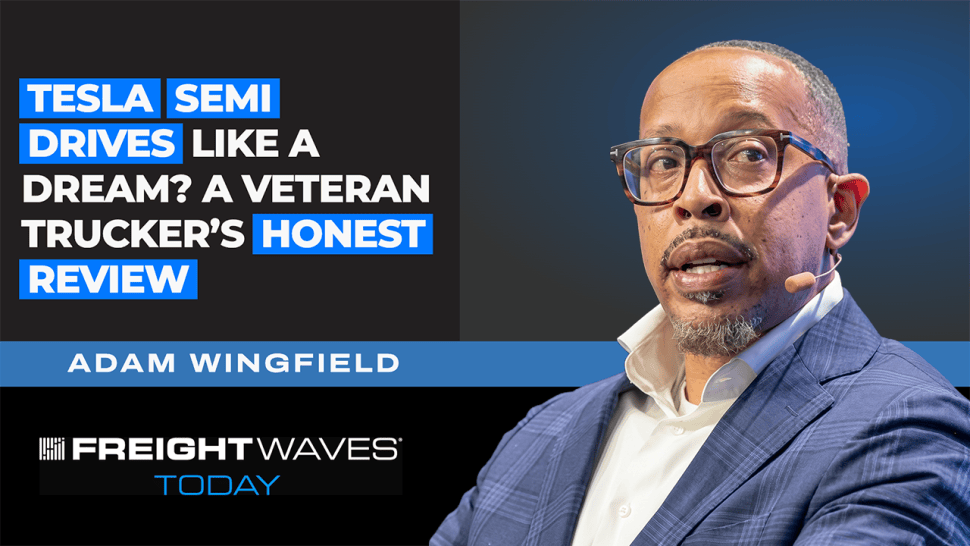
After years of skepticism, FreightWaves’ Adam Wingfield, a former over-the-road truck driver, finally got behind the wheel of a fully loaded Tesla Semi. He shares his honest, unfiltered experience – from tackling an 8% grade with ease to the surprising comfort and advanced features that could reshape the future of short-haul trucking. Was it enough to convert this diesel veteran?
A veteran trucker and former Schneider driver who describes himself as having been “negative” on electric vehicles reversed course after getting behind the wheel of the Tesla Semi for the first time — loaded — calling it “truly a dream to drive.” The firsthand account underscores growing driver-level acceptance of battery-electric Class 8 trucks even as Tesla remains far short of the 200,000-unit production target Elon Musk outlined in 2017.
Adam Wingfield, who holds a commercial driver’s license and drove over-the-road before moving into the industry analyst space, tested the truck both as a bobtail unit and hooked to a loaded trailer. The most striking moment came on a hill climb: sitting at 70,000 pounds-plus on an 8% grade, Wingfield said he intentionally waited until reaching the base of the hill before applying the accelerator — a technique that would be counterproductive in a diesel, where drivers build momentum ahead of grades.
“When I say it walked that hill, it walked that hill with no problems. And I even had to ask the engineer that was with me, like, hey man, you guys, is this trailer even loaded?” said Wingfield.
Wingfield visited Tesla’s 1.7 million-square-foot production facility, which he said is designed to produce 1,000 trucks per week and is heavily automated with robotics. He noted engineers made significant changes between the Gen 1 prototype and the current production model, incorporating feedback from early fleet customers such as PepsiCo. Among the updates: side windows were redesigned to include a smaller pass-through slot for bills of lading, screen interfaces were revised, and the truck was reduced to just three physical buttons in the cab. The production version also goes 250,000 miles before requiring an oil change and eliminates belts and hoses that can fail on the road.
Regenerative braking was the adjustment that required the most acclimation. Wingfield said he used the physical brake pedal only once or twice during the entire test drive, relying instead on lift-off deceleration — a dynamic he noted has long-term implications for brake pad wear and maintenance costs. The center-driving position, another point of early skepticism, took only “a mile or two” to feel natural, aided by cameras that eliminate traditional blind spots. Backing the trailer from the center seat, he said, was easier than expected thanks to the camera system.
Wingfield’s remaining reservation is range. Tesla’s product team told him the 500-mile rating is an intentional trade-off — extending range requires added battery weight, which reduces payload capacity. He views the 500-mile ceiling as steering the Semi toward regional, local, and pickup-and-delivery applications rather than long-haul runs, and suggested the long-haul segment may increasingly shift toward automated solutions. Tesla has already partnered with Pilot Flying J to expand charging infrastructure along key corridors, Wingfield noted.
“Diesel will always remain king long haul,” Wingfield said, adding that electric equipment “just makes more sense” for hauls of 500 miles or less. He estimated a diesel long-haul tractor can cover 1,200 to 1,300 miles per tank depending on efficiency, roughly double the Tesla Semi’s current range. Still, he said driver comfort and the overall operating experience in shorter-range applications give electric trucks a meaningful edge that will accelerate adoption as infrastructure matures.
- Tesla’s production facility is designed to build 1,000 Semi trucks per week from a 1.7 million-square-foot, heavily automated plant.
- The Tesla Semi requires no oil change until 250,000 miles and eliminates belts, hoses, and a differential — reducing roadside failure risk.
- Tesla’s 500-mile range limit is a deliberate payload trade-off, positioning the Semi for regional and P&D runs rather than long-haul lanes.
This Summary is generated thanks to a transcription of the interview, for the full interview please enjoy the video above.
Brokerage Compliance Symposium
The day before F3. Every compliance issue you face - fraud exposure, carrier liability, FMCSA rules, cargo theft, insurance gaps - navigated by attorneys and operators defining best practices in a changing industry.
F3 Awards Dinner
The night before F3. FreightTech100 companies honored. FreightTech 25 and Shipper of Choice winners revealed live. Cocktail reception into dinner and live music - 300 industry leaders in one purpose-built room.
F3: Future of Freight Festival
Industry-defining keynotes, rapid-fire technology demos, and industry leaders networking in experiences across Chattanooga - plus the inaugural F3 Awards Dinner featuring the FreightTech and Shipper of Choice reveals.
The day before F3. Every compliance issue you face - fraud exposure, carrier liability, FMCSA rules, cargo theft, insurance gaps - navigated by attorneys and operators defining best practices in a changing industry.
The Signal at Chattanooga Choo Choo • Chattanooga, TN Register NowThe night before F3. FreightTech100 companies honored. FreightTech 25 and Shipper of Choice winners revealed live. Cocktail reception into dinner and live music - 300 industry leaders in one purpose-built room.
The Signal at Chattanooga Choo Choo • Chattanooga, TN Register NowIndustry-defining keynotes, rapid-fire technology demos, and industry leaders networking in experiences across Chattanooga - plus the inaugural F3 Awards Dinner featuring the FreightTech and Shipper of Choice reveals.
The Signal at Chattanooga Choo Choo • Chattanooga, TN Register Now