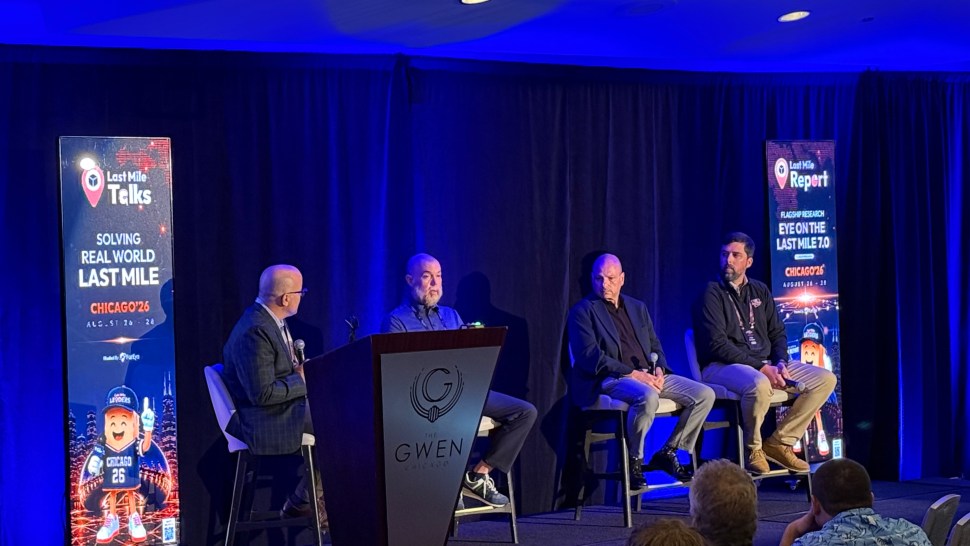
CHICAGO — Parcel shippers spent years handing one national carrier all their volume and negotiating once. At FarEye’s Last Mile Leaders America 2026 conference in August, panelists described why shippers are moving away from single-carrier agreements. Rising surcharges are part of the reason. Software that lets shippers manage multiple carriers has also made the shift easier.
Kyle Langley, Vice President of Final Mile at Tractor Supply Co., has watched that shift from the shipper side over about 15 years at the company. The rural lifestyle retailer has almost 2,500 stores in 49 states, and many of its delivery customers live on 5- to 15-acre properties. Tractor Supply now ships through parcel carriers, gig delivery networks and its own private fleet.
Langley shared the stage with Nick Costides, founder of C-Level Advisory and retired global president of information technology at UPS, and Brock Johns, Director Analyst at Gartner.
The panel moderator cited FarEye’s Eye on the Last Mile America 2026 report, released at the event, which found that 45.8% of U.S. delivery operators said delivery costs are rising faster than revenue. Including operators whose costs are keeping pace, 88% said delivery costs are growing as fast as revenue or faster. The same survey found that median last-mile costs rose 12% for a second year.
Carrier pricing now changes through surcharges as well as the annual general rate increase (GRI).
“Over the last couple of years, what we’ve seen coming out of small package is these variable charges that get applied in surcharges—not just surcharges, but how they define certain package types, big and bulky, and additional handling,” Langley said. “All those are somewhat unpredictable. GRI is not the only thing we have to worry about every year now.”
“Gone are the days when, as a retailer, we can kind of change our shipping and handling rates as changes come upstream from carriers,” he said. “We can’t do that. Customers want and expect reliable, standard shipping, and in a lot of cases, free.”
When one carrier applies surcharges to push bigger packages out of its network, Tractor Supply can redirect those packages to another carrier, he said, and limit the cost increase early in the year.
Splitting parcel volume by package type
The retailer moved to multiple parcel carriers about seven or eight years ago.
“We had a belief that if we give all of our volume to a single carrier, naturally that’s going to allow us more leverage to negotiate, and that’s not necessarily the case,” Langley said.
A single carrier blends a shipper’s whole package mix into one cost, he said, which can leave the biggest and smallest packages at unfavorable rates. Splitting the volume lets Tractor Supply decide which package types and regions go to which carrier.
Johns said using one carrier still works for some companies because it keeps pickups and procurement simple. Spreading volume costs a shipper some negotiating leverage overall, he said, and adds leverage in specific areas, along with flexibility.
How carriers tried to keep shippers
Costides traced the shift to the 1990s, when the first multi-carrier shipping software reached shipping desks and let administrators compare rates and transit times. Carriers noticed, he said.
“We tried to get our technology as far into companies’ supply chains as possible. That’s what happened,” Costides said. “You couldn’t switch because we were in too deep, and it was too expensive to leave.”
Two demand shocks loosened that grip, he said: the 2013 e-commerce surge that outran carrier forecasts before Christmas, and the supply chain crisis of the COVID-19 pandemic.
“So technology was the great equalizer, and it took an e-commerce hockey stick and a geopolitical crisis to actually accelerate this move and take the power out of carriers’ hands,” he said.
A carrier cannot successfully sell carrier-neutral technology itself, Costides said.
“We couldn’t bring a product to market like FarEye and say, look, it’s better when it’s UPS, but we’re also enabling other carriers,” he said. “Nobody was going to give us competitor data”.
Costides noted that the Teamsters have already started campaigning for the 2028 contract and that UPS is shifting toward higher-margin healthcare business.
“I got a screw the other day. It was 99 cents,” Costides said. “There’s no way with a unionized workforce I could deliver a 99-cent screw in one day.”
Rate shopping and discount tiers
Parcel agreements often tie discounts to volume thresholds, Langley said, so someone has to watch each carrier’s volume to keep the account inside its tier.
Tractor Supply tried real-time rate shopping when orders entered its warehouse management system, setting its carrier agreements against each other for the lowest cost on each package.
But that created a volume-balancing problem, Langley said.
“Because if all of a sudden too much volume shifts into one, well then you’re going down a discount tier with another carrier, and then it’s a self-fulfilling prophecy,” he said. “Then all the volume before you know it is just going to get eaten by that carrier that won originally.”
Choosing the cheapest carrier for each package does not always reduce overall shipping costs. Shifting too much volume away from another carrier can cost a shipper its negotiated discounts.
Managing those carrier agreements is work companies often overlook, Johns said.
“It’s a big step from just managing that one carrier to five, six, maybe ten, depending on where your strategy takes you,” he said. “We know it’s going to happen, but the amount of work and the time that goes into that is a different thing.”
A private fleet for rural delivery
Tractor Supply started its private fleet about two years ago, after adding gig networks for same-day and next-day service outside its parcel agreements. Langley said the fleet was meant to add a big-and-bulky service its customers did not have, with cost savings to follow.
“Our fleet is built to be able to take three or four pallets of horse feed to a 10-acre property and go into the stall, and our drivers know to go place it where the customer needs and what stall they need,” he said.
The retailer now handles deliveries from small packages to 10,000-pound loads. Third-party carriers still handle the smallest packages and the overflow, and Tractor Supply is adding more carriers for complex white-glove deliveries.
Putting service first is the one part of the launch Langley said he would not change.
“If you go the other way and you start low cost, low service, it’s very hard for an organization to have an appetite to increase costs over time to improve service,” he said. “So I would do it the same way ten out of ten times: start with service, and then have a three-year roadmap of how we’re going to claw back all that cost while not sacrificing your customer experience.”