




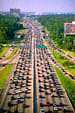
| Traffic congestion |
Drivers spent 4.2 billion hours stuck in their vehicles — on average a week per person — and burned 2.9 billion gallons of fuel due to traffic bottlenecks, an increase of $5 billion, 220 hours stuck in traffic and 140 million gallons of fuel from 2004, the Texas Transportation Institute said. The volume of motor vehicles on the roads during peak periods means that unforeseen events such as accidents, weather, or stalled vehicles can turn slow traffic patterns into gridlock, the authors at Texas A&M University said.
They defined the value of travel as worth $14.60 per person and $77.10 per truck, per hour to quantify the cost of travel delays. The total cost today would be significantly higher because of the significant rise of gasoline and diesel fuel prices since 2005.
The top five worst metropolitan areas for traffic jams are: Los Angeles; San Francisco-Oakland; Washington, D.C; Atlanta; and Dallas-Fort Worth.
The report reinforced daily evidence that rush hour periods are stretching to affect more of the day, more cities, and more road systems, and that congestion is also becoming more normal on weekends, making travel more unreliable.
In large cities, slow conditions extend for more than seven hours per day.
Recommendations for dealing with congestion included maximizing utilization of existing infrastructure through design changes, operational management and technology, adding roads and transit systems in critical corridors, relieving chokepoints, changing usage patterns, and diversifying development patterns.
Low-cost efficiency improvements include synchronizing traffic lights, quickly removing crashed or stalled vehicles, as well as electronic tolls to put a price on peak demand, changeable lane assignments and better construction planning, the report said. Improving freeway ramps and intersections, and investing in rail transit systems are more expensive options that should be part of a multi-dimensional strategy, it said.
Solutions are not keeping up with population growth in part because of the length of time from concept to construction. In the 15 worst congested metropolitan areas, traffic growth outstripped new road capacity by more than 45 percent in the previous 23-year period.
“Congestion is not a problem that can be addressed and then ignored for a decade,” the report said.
Researchers said they revised their methodology to make the findings more accurate.
To read the full report, go to: https://tti.tamu.edu/documents/mobility_report_2007_wappx.pdf.
