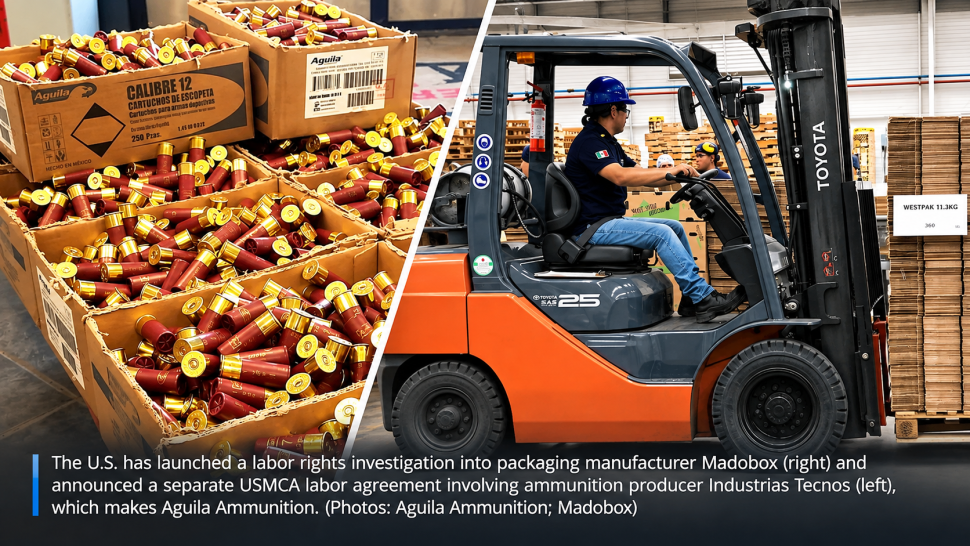
The U.S. has launched a labor rights investigation into a Mexican packaging manufacturer and announced a separate agreement to address labor rights concerns at an ammunition factory.
The two cases highlight continued enforcement of worker protections under the United States-Mexico-Canada Agreement (USMCA).
The Office of the U.S. Trade Representative (USTR) announced Monday that it has requested Mexico review allegations that workers at Madobox S.A. de C.V., a manufacturer of commercial packaging boxes in Uruapan, Michoacán, have been denied their rights to freedom of association and collective bargaining.
As part of the action, USTR directed the U.S. Treasury Department to suspend liquidation of unliquidated customs entries involving goods produced at the Madobox facility.
The suspension is a trade enforcement measure that delays final customs processing and duty assessments on affected imports. It does not necessarily prevent the goods from entering the U.S.
The investigation was initiated under the USMCA’s Rapid Response Labor Mechanism, which allows the United States to challenge alleged violations of workers’ rights at specific facilities in Mexico.
Union alleges interference, retaliatory firings
The U.S. investigation follows a Sept. 30 petition filed by a Mexican labor union affiliated with the Confederación Central Nacional (COCENA).
The union alleges that Madobox interfered with workers’ organizing activities by arranging a collective bargaining agreement without worker participation, coercing and misleading employees about their labor rights, and unlawfully dismissing workers in retaliation for union activity.
After reviewing the petition, the U.S. Interagency Labor Committee for Monitoring and Enforcement determined there was sufficient credible evidence to invoke the USMCA enforcement process.
Mexico has 10 days from the Nov. 2 request to agree to conduct a review. If it accepts, the Mexican government has 45 days from Nov. 2 to complete its investigation.
Madobox manufactures corrugated cardboard packaging for agricultural products, including avocados, mangoes, berries and tomatoes, according to its website. Based in Uruapan, a major avocado-producing region, the company supplies packaging used in agricultural supply chains, including products destined for export markets.
US, Mexico reach agreement in separate factory dispute
In a separate announcement Monday, USTR said the U.S. and Mexico reached a memorandum of understanding addressing labor rights concerns at Industrias Tecnos S.A. de C.V., an ammunition manufacturer in Cuernavaca, Morelos.
The agreement follows a labor dispute dating to May 2024, when a Mexican union filed a petition alleging workers at the facility were being denied collective bargaining and freedom of association rights.
The U.S. requested Mexico review the allegations in June 2024. Mexican authorities subsequently found no denial of rights, prompting Washington to request a dispute settlement panel under the USMCA.
The new agreement establishes corrective measures intended to protect workers and prevent future violations.
Under the agreement, Industrias Tecnos must verify that dismissed workers receive compensation owed under Mexican law, implement workplace neutrality policies, train employees on labor rights and establish confidential complaint mechanisms.
Mexico also agreed to monitor compliance, review determinations involving dismissed workers and conduct additional training for supervisors, human resources personnel and other company officials.
The memorandum established an Oct. 15 deadline for completing the corrective actions, although USTR’s Nov. 2 announcement did not specify whether all measures had been implemented.
Industrias Tecnos manufactures Aguila Ammunition, which serves sporting, hunting, law enforcement and military markets. Texas Armament & Technology, a U.S.-based distributor, identifies itself as Aguila’s exclusive master distributor in North America and other markets.
Why it matters: USMCA labor enforcement can create customs compliance risks for Mexican manufacturers and their U.S. customers, adding another consideration for cross-border supply chains.