




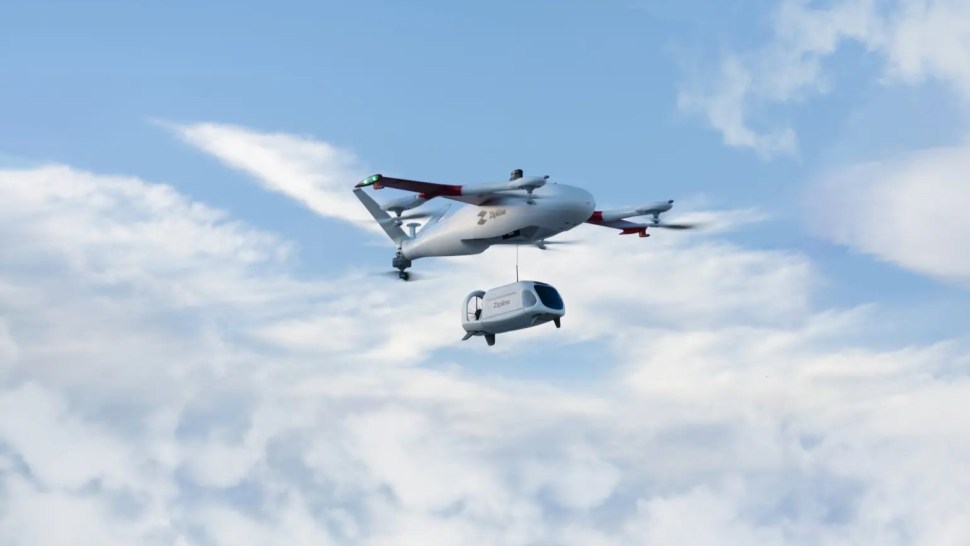
Walmart will significantly scale up its drone delivery network in partnership with Zipline, which will operate the small unmanned aerial vehicles from 300 new store locations and has raised $1.5 billion in new funding to build out a nationwide drone delivery capacity, the companies announced on Thursday.
Zipline, the world’s largest drone delivery provider by miles flown, said it will use the capital to expand its U.S. manufacturing facilities and ramp hiring to meet demand for ultra-fast delivery by air.
Big retailers like Walmart (NASDAQ: WMT) and Amazon are racing to build out same-day and one-hour store-to-delivery networks of their own to meet growing customer expectations for speed and convenience, which is viewed as important to converting online shoppers to buyers. Drone delivery supplements last-mile ground delivery provided by gig-based drivers using digital delivery platforms for assignments. At Walmart, U.S., e-commerce sales grew 24% during the second quarter, with deliveries fulfilled from local stores up 43%.
Amazon recently said it plans to offer Prime Air drone delivery to nearly 500 U.S. communities by year’s end, covering about 30 million people, up from a dozen locations.
Walmart currently has 21 sites with Zipline and also uses Alphabet’s Wing drone delivery service. In July, Wing and Walmart launched drone delivery at five locations in Central Florida. Walmart previously launched drone delivery in Houston, Atlanta and Dallas-Fort Worth. The partners are working to offer drone delivery from more than 270 locations in nearly 20 metro areas, including Seattle and Denver in 2027.
Walmart and Wing are poised to begin drone delivery in West Memphis, Arkansas, any day now, according to DroneXL.co. Wing also recently applied with the city of Manchester, Missouri, to launch delivery service from the local Walmart store, said KMOV TV.
Wing also provides drone delivery for companies like DoorDash and Lowe’s.
Walmart says it has completed more than 2 million drone deliveries since it started with Zipline in 2021. The service is designed to deliver everyday essentials in as little as 30 minutes.
The company does not have a timeline or list of areas for the Zipline expansion, spokeswoman Lindsey Coulter said.
“We see customers try drone delivery for the novelty and then continue to come back to it for the convenience when they need something in minutes,” said Greg Cathey, senior vice president, e-commerce fulfillment transformation at Walmart, in a news release. “Walmart’s stores put us close to the communities we serve. With Zipline, we can build on that proximity and bring this fast delivery option to even more customers across the country.”
The retail giant has thousands of stores and says 90% of the U.S. population is within 10 miles of a store.
Zipline growth
Zipline is one of a handful of drone operators with Part 135 air carrier permissions and authorized for operations beyond the visual line of sight of the pilot. The company promotes that it minimizes neighborhood noise by having drones hover at about 330 feet above the ground during delivery while a pod containing the order descends on a tether.
Customers see drone delivery as an option when they use the Walmart app or Walmart.com if the address associated with their account is within the delivery range. Customers can then add items to their cart just like any other delivery order, place their order, and then track their items as they fly to their home. Orders are delivered to the customer’s home in the front yard, backyard or driveway, according to Walmart.
Zipline said the $1.5 billion investment in the company puts the company’s value at $21.5 billion. It was led by Paradigm, WCM Investment Management and Layer Global, with other participation by Tiger Global, Uber, J.P. Morgan and others.
Zipline says hundreds of businesses use its service. Last month, the company began offering unmanned aerial delivery in Austin, Texas. Data from long-tenured restaurant users shows Zipline’s share of delivery revenue tripled to 35% in the past six months, but the increase didn’t decrease demand from other platforms. Uber is targeting one million deliveries a day with Zipline by 2029.
Offering automated aerial deliveries expands the number of customers businesses can reach, says Zipline, because delivery orders are usually limited to destinations within two or three miles of a store for reasons such as fuel cost and food freshness. Restaurant holding company Wonder is actually building new storefronts and kitchens that are optimized specifically for Zipline delivery to seize the market opportunity for fast delivery, according to Zipline.
“Zipline has already brought the future of delivery to the communities it serves. Now, the opportunity is to reach millions more,” said Anton Levy, founder and managing partner of Layer Global. “With partners like Uber and Walmart and a repeatable model for entering new markets, Zipline is well positioned to make drone delivery a mainstream part of everyday life.”
Since its founding 10 years ago, Zipline has also built an international logistics network that serves more than 5,000 hospitals.
Last summer, Zipline launched its first U.S. healthcare home delivery service with Cleveland Clinic, beginning in a Cleveland suburb. Eligible patients can opt-in to receive certain prescription deliveries at home at no additional cost. Over time, the program will expand to include deliveries of lab samples, medically tailored meals, medical and surgical supplies, and hospital-at-home materials between Cleveland Clinic facilities. It also partners with the Mayo Clinic.
Click here for more FreightWaves/American Shipper stories by Eric Kulisch.
Write to Eric Kulisch at ekulisch@freightwaves.com.
RELATED STORIES:
DoorDash launches retail returns service, self-designed drones
Lowe’s test drives drone delivery
Amazon drone delivery expansion targets 500 cities by year’s end
