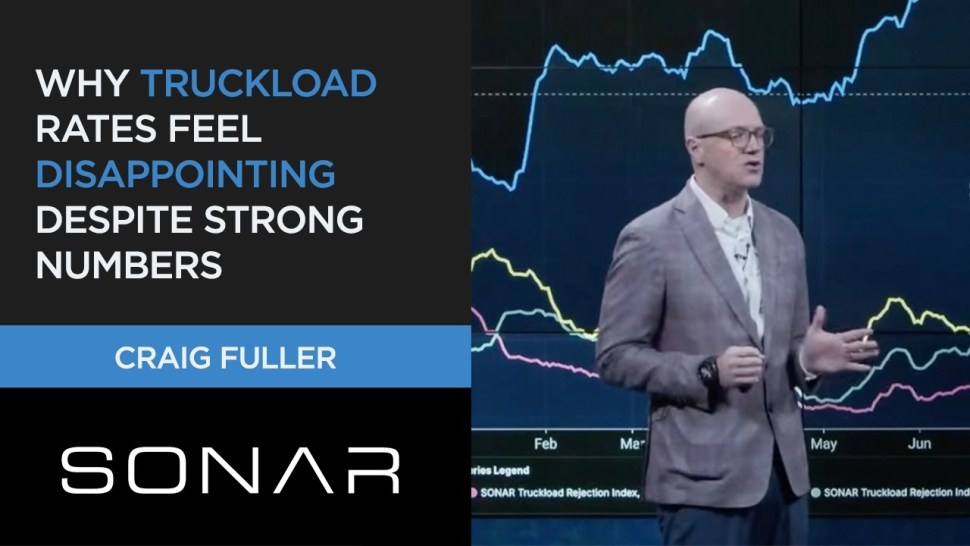
This FreightWaves SONAR update dives deep into the current freight market, analyzing peak season performance, truckload rejection rates, and their impact on spot and contract rates. Discover why carriers might feel disappointed despite seemingly strong numbers, and what this means for shippers preparing their routing guides for next year. We also break down the latest trends in diesel prices and their effect on the overall energy market.
Truckload spot rates have pulled back from recent highs to $2.58 per mile — net of fuel — after briefly surpassing $3 per mile earlier this year, according to FreightWaves SONAR data reviewed during the latest SONAR Update. The retreat mirrors a softening in the Truckload Rejection Index, which has plateaued after a strong start to 2025, signaling that relative capacity has loosened slightly against demand.
The rejection index currently sits at 12.78%, a figure that is roughly equal to the peak reached during all of December 2024. While that level reflects a healthy market by historical standards, the deceleration from earlier momentum has tempered optimism. “Is this a strong year or is it a weakening year? I would say we’ve lost some momentum, but things are actually pretty good,” said Craig Fuller.
“If you had told a trucker a year ago that we would be looking at $2.58 a mile, they would have celebrated and absolutely been ecstatic. The fact that we went above $3 a mile — and this is net of fuel, by the way — feels a little bit less exciting.”— Craig Fuller
Fuller framed the psychological dynamic facing carriers: after spot rates crested above $3 per mile, a retreat to $2.58 feels deflating even though the number would have been cause for celebration just 12 months ago. The rejection index, which measures the percentage of truckloads turned down by carriers, remains a key barometer of capacity tightness — a rising rate favors carriers, while a declining rate favors shippers.
The more consequential signal for the industry may be contract rates, which continue to trend upward. With peak season underway, shippers are actively building routing guides and preparing requests for proposals for 2026. Fuller noted that the narrowing spread between spot and contract rates indicates shippers are willing to lock in higher prices to secure capacity. Larger public truckload carriers, including Orca, have already predicted rate increases ahead. “If you don’t pay up, you don’t get to play,” Fuller said.
On the cost side, diesel prices have eased from a national average of $6.50 per gallon to $6.02, providing some relief for carriers. FreightWaves energy reporter John Kingston reported the decline the previous day, attributing it in part to a cooling crack spread — the margin that determines diesel refining profitability — and reduced tensions around the Strait of Hormuz, which has allowed refining capacity to expand.
Fuller suggested that if energy market volatility continues to subside — alongside the fading of tariff-related uncertainty that port executive Gene Soroka had previously flagged — the conditions could set up a stronger freight environment heading into 2027.
- Truckload spot rates have retreated to $2.58/mile net of fuel after topping $3/mile earlier in 2025
- The SONAR Truckload Rejection Index stands at 12.78%, near last December’s peak but losing upward momentum
- Contract rates are still rising and the spot-contract spread is narrowing, signaling shipper willingness to pay up ahead of RFP season
This Summary is generated thanks to a transcription of the interview, for the full interview please enjoy the video above.