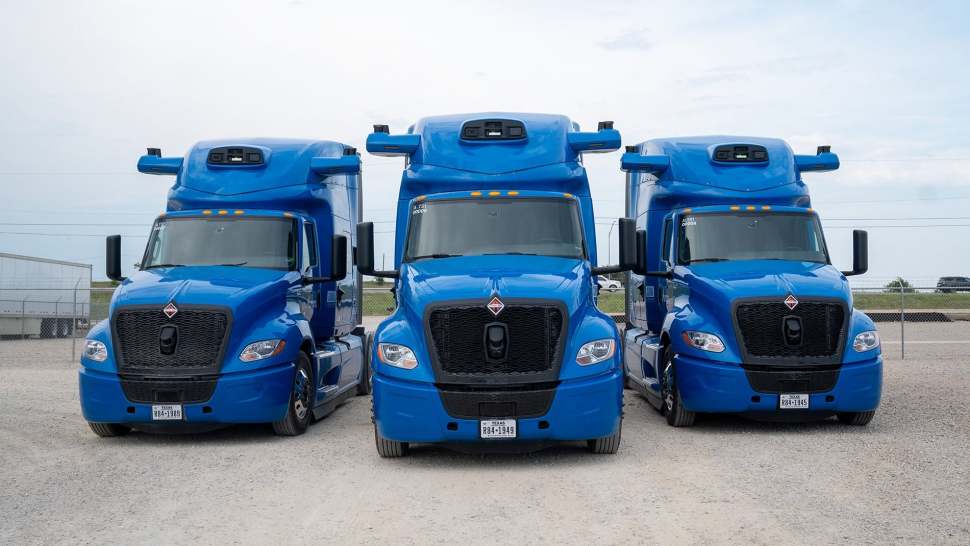
Aurora Innovation (Nasdaq: AUR) plans to run more than 30,000 driverless trucks by 2030, the company told analysts and investors at its Analyst and Investor Day in Dallas on Sept. 23. The plan calls for more than $5 billion in revenue that year and a target gross margin of about 60%, according to the company’s investor day presentation.
Aurora is fully allocated to exit 2026 with 200 driverless trucks in operation, which CFO David Maday said would represent an $80 million revenue run rate. The company said the Aurora Driver has logged more than 500,000 driverless miles since commercial launch.
Daragh Mahon, executive vice president and chief information officer at Werner Enterprises, said Werner is still negotiating with Aurora and that the two companies are working through legal and contract work and economics.
“And I will be quite honest that we have a gap. We’ve got to figure this out,” Mahon said. “I think the economics become viable at scale, I mean, really viable at scale where nobody is eating some of the cost.”
“I think that sometime in the next few months, we will get to a point where we believe that economically, we can make this work,” he said.
Gross margin breakeven moves to 2027
By the end of 2027, Aurora expects more than 1,000 trucks and roughly $200 million in revenue. It now targets breakeven gross margin on a run-rate basis in the first half of 2027, at about 500 trucks. Aurora’s fourth-quarter 2025 shareholder letter had targeted breakeven exiting 2026, and Maday said the change is “really just reflecting a slightly slower fleet ramp.”
The company expects to exit 2028 with positive free cash flow on a run-rate basis. Maday said that would come with roughly 7,500 trucks on the road. Maday expects capital spending to total about $185 million in 2027, mostly for trucks in Aurora’s own fleet and the last of its second-generation hardware kits. He said that figure drops below $50 million in 2028.
The margin goal shifted too. Aurora’s 2024 investor day presentation targeted a gross margin of about 70% by 2028. When asked about the change by Craig-Hallum analyst Ryan Sigdahl, Maday said 70% is still the aim, and later told another analyst it “might just take a year longer to get there.”
“There is no reason we can’t deliver outstanding gross margins and reach 70%,” Maday said. “And frankly, there’s been a lot of supply chain headwinds as well that we’re accounting for and addressing.”
Maday said the 30,000-truck figure balances a top-down view of the market against customer demand and how many kits and trucks Aurora and its partners can build each year. Aurora sizes U.S. trucking at $1 trillion across 200 billion vehicle miles traveled and expects to be able to operate in 150 billion of those miles by 2030.
“30,000 trucks does sound like a lot to some people. But when you look at the market, there’s over 2 million trucks operating on the roads today. They build over 250,000 trucks every year,” Maday said. “So I know it seems like a lot, and it will be.”
Carriers take ownership of the trucks
Most of the growth depends on a change in who owns the equipment. Aurora owns and operates its current trucks for customers under Transport as a Service, or TaaS. Aurora expects those trucks to average roughly 200,000 miles a year at about $2 per mile, including a fuel surcharge. Maday called the model capital-intensive and said Aurora will cap that fleet at roughly 500 trucks.
Under Driver as a Service, or DaaS, the carrier owns and operates the truck and pays Aurora for the driving. Maday expects miles per truck to climb closer to 250,000 a year as carriers run the trucks through their own networks. Aurora’s revenue drops to 85 cents or more per mile.
“Now we’re just focused on replacing the driver cost and not the overall cost,” Maday said.
Hirschbach intends to own and operate 500 trucks under a DaaS agreement, with deliveries slated to begin in 2027. Aurora’s April release describes that commitment as a nonbinding memorandum of understanding.
Matt Detmar, CEO of Detmar Logistics, hauls frac sand in the Permian Basin. He said 10% to 15% of his trucks’ miles are sometimes off-road, which puts maintenance at the center of the ownership decision.
“So as we buy the asset, we like to bring our own maintenance in-house because that really helps us accelerate the uptime as well,” Detmar said.
Utilization drives the customer pitch
Driverless trucks hauling for McLane, Werner and other customers are averaging an annualized rate of more than 225,000 miles per year, according to Aurora’s release. The company said that is more than double the utilization of a traditional truck.
Aurora co-founder and CEO Chris Urmson said the company is doubling the number of trips per day Detmar can run. Detmar’s drivers work three weeks on and one week off, drive about 11 hours a day and take a 34-hour reset on top of that, which leaves tractor utilization below 40%. On a 60-mile loop, Detmar said, drivers average 2 to 2.5 loads a day, and the driverless trucks are getting into the range of five to six.
“So you’re taking that 40% to greater than 90%, so effectively almost more than doubling the utilization,” Detmar said.
President Ossa Fisher said an Aurora total-cost-of-ownership analysis built on American Transportation Research Institute data shows savings of upward of 20%, or 50 cents per mile, against a solo-driven truck. On the company’s Phoenix-to-Fort Worth lane, she said, Aurora’s model of a single truck over a year showed an added $340,000 in revenue and $160,000 in margin.
Mahon said length of haul decides how much of that a carrier captures. Werner sees the best fit on long-haul, middle-mile runs of 500 miles or more.
“The longer we can run, the more utilization we can get out of the asset, the better fuel economy we get once we’re running those long hauls,” Mahon said. “When we can run at 22 hours a day or 20 hours a day out of 24, all of that matters, shorter length of haul doesn’t allow us to do quite that much.”
Insurance still prices the unknown
Fisher listed insurance alongside the driver and fuel as the costs Aurora can lower for carriers. Chris Moore of Apollo said autonomous trucks currently price slightly above human drivers. Apollo is a Lloyd’s of London syndicate that insures Aurora.
“It differs by state, but we’re probably slightly above where human driver is, purely on that unknown, the severity,” Moore said.
For now, insurance is the one line that Aurora’s cost pitch is still running against.
Moore said Apollo has enough data to price in fewer crashes. Few claims involving autonomous vehicles have reached court, which leaves severity as the open question in a trucking market that has seen a lot of nuclear verdicts. He expects rates to fall 15% to 25% a year.
“If I’m insuring a human driver, it’s a very linear relationship to the risk,” Moore said. “It’s not that for autonomy because every mile driven is slightly better than the mile previously.”
Hardware supply ramps at Roush and Volvo
Aurora’s second-generation hardware kit is built by contract manufacturer Fabrinet in Thailand. The company said the kit is engineered for a 1-million-mile operating life while cutting costs by more than half. Roush upfits the kits onto International LT Series trucks at a dedicated facility in Livonia, Mich., and is targeting a rate of 20 trucks per week in October.
Roush added a second shift the week before the event and is building trucks 16 hours a day, said Brad Rzetelny of Roush. Twenty trucks a week works out to 1,000 a year, said Sandor Barna, Aurora’s senior vice president of hardware.
Volvo Autonomous Solutions said in June it plans to begin driverless operations in the first quarter of 2027 with Volvo VNL Autonomous trucks, which get the Aurora Driver on the assembly line at Volvo’s New River Valley plant in Virginia. Sasko Cuklev of Volvo Autonomous Solutions said Volvo expects more than 300 of those trucks in operation by the end of 2027. He said one large fleet told Volvo it has to turn down business because it doesn’t have drivers.
“Another one, one of the big ones, they said, ‘We want half of the 300 directly,'” Cuklev said.
The third-generation kit, developed with AUMOVIO, shifts to a hardware-as-a-service structure. Barna said hardware cost is paid per mile, which means no new upfront capital expense for customers, and that production should start in the second half of 2027, with material economic benefit in 2028 and beyond. Jeremy McClain of AUMOVIO said the company is ramping up a plant in New Braunfels, Texas, to build it. PACCAR and Aurora are working out how to integrate it on PACCAR’s assembly lines.
“I think that’s the real inflection point for us is when they get to scale and all of a sudden, those prices start to drop, not just for the truck and the hardware in the truck, but the tech and everything that Aurora does becomes more economically viable,” said Werner’s Mahon.
Brokerage Compliance Symposium
The day before F3. Every compliance issue you face - fraud exposure, carrier liability, FMCSA rules, cargo theft, insurance gaps - navigated by attorneys and operators defining best practices in a changing industry.
F3 Awards Dinner
The night before F3. FreightTech100 companies honored. FreightTech 25 and Shipper of Choice winners revealed live. Cocktail reception into dinner and live music - 300 industry leaders in one purpose-built room.
F3: Future of Freight Festival
Industry-defining keynotes, rapid-fire technology demos, and industry leaders networking in experiences across Chattanooga - plus the inaugural F3 Awards Dinner featuring the FreightTech and Shipper of Choice reveals.
The day before F3. Every compliance issue you face - fraud exposure, carrier liability, FMCSA rules, cargo theft, insurance gaps - navigated by attorneys and operators defining best practices in a changing industry.
The Signal at Chattanooga Choo Choo • Chattanooga, TN Register NowThe night before F3. FreightTech100 companies honored. FreightTech 25 and Shipper of Choice winners revealed live. Cocktail reception into dinner and live music - 300 industry leaders in one purpose-built room.
The Signal at Chattanooga Choo Choo • Chattanooga, TN Register NowIndustry-defining keynotes, rapid-fire technology demos, and industry leaders networking in experiences across Chattanooga - plus the inaugural F3 Awards Dinner featuring the FreightTech and Shipper of Choice reveals.
The Signal at Chattanooga Choo Choo • Chattanooga, TN Register Now