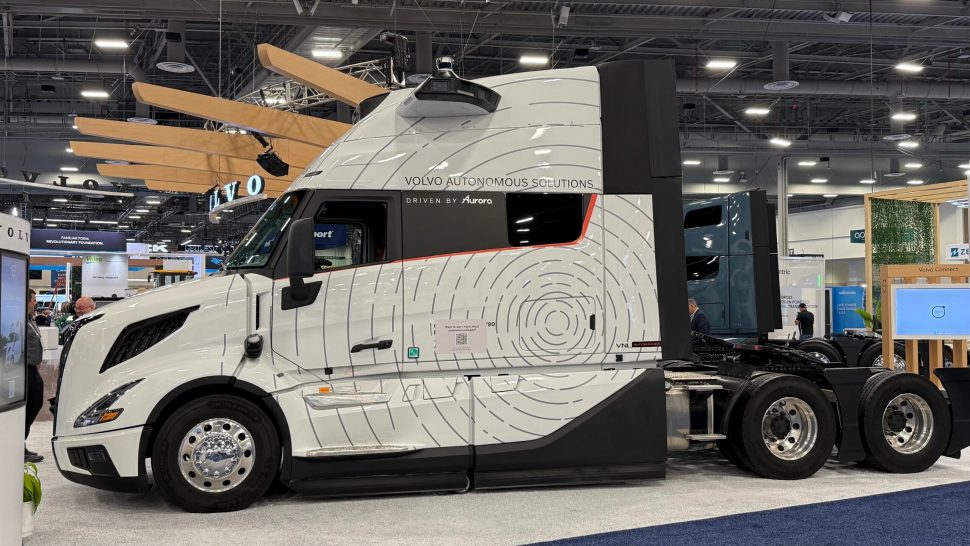
Volvo Autonomous Solutions plans to remove safety drivers from its autonomous trucks and begin fully driverless operations on U.S. highways in the first quarter of 2027.
The company detailed its timeline and scaling ambitions at Volvo Group’s recent Capital Markets Day. It aims to have more than 300 autonomous trucks operating by the end of 2027, with industrial scaling beginning in 2028. Revenue from the autonomous business is projected to approach approximately $3 billion within five years.
Aurora Innovation, one of Volvo’s technology partners, confirmed the driverless milestone in a LinkedIn post: “In Q1 2027, we’ll deploy those trucks with nobody behind the wheel in Texas.”
From Safety Drivers to Full Autonomy
Volvo Autonomous Solutions currently operates commercially in Texas with safety drivers aboard. It moves freight daily on routes between Dallas and Houston, Fort Worth and El Paso, and most recently Dallas to Oklahoma City. The Oklahoma City expansion, launched earlier this year, represents an operational leap: point-to-point delivery directly into customer facilities rather than hub-to-hub transfers.
“We are moving freight there daily together with our customers in a real commercial setup autonomously, still with a safety driver,” said Sasko Cuklev, head of On-Road Solutions at Volvo Autonomous Solutions, in an interview with FreightWaves at ACT Expo. “We are now expanding that to also cover a third lane, which is Dallas to Oklahoma City.”
The Oklahoma City route eliminates the drayage segment that previously required separate first- and last-mile operations from autonomous hubs near highways.
“We are driving the whole way into the customer facility, which of course removes that drayage piece,” Cuklev said. “But it will also require higher operational precision and much deeper integration into the customer.”
Doubling Asset Utilization
In trucking, the economic case for driverless operations centers on asset utilization. Trucks that sit idle during parts of the day can operate around the clock with autonomous technology, unbound by human hours-of-service rules.
“The most important impact? Doubling asset utilization,” Volvo Autonomous Solutions stated in its Capital Markets Day presentation. “This is a change the industry cannot ignore.”
Cuklev noted that realizing those gains requires more than autonomous-capable trucks. The company has built an uptime network with its dealers across operating lanes to ensure high availability.
“One of the big benefits with autonomous is that you should be able to utilize the truck much, much more than a manually driven truck,” Cuklev said. “But in order to do that, you need to have the truck available and high uptime. So that is super important, and sometimes it feels like we don’t talk about that enough.”
Network Expansion and Customer Integration
Volvo Autonomous Solutions is pursuing aggressive network growth based on customer demand. Phoenix, Atlanta, San Antonio and Laredo are under consideration. California has become particularly attractive following recent regulatory changes opening the state to autonomous trucking.
“We are expanding based on our customers, where they want us to go,” Cuklev said. “See it as we are starting around Dallas, and then we are expanding from there, expanding the network.”
The company unlocked the Oklahoma City lane with partner Aurora in approximately four to six weeks. That speed demonstrates how quickly driverless deployment capabilities have matured.
For fleet operators and shippers, Cuklev offered direct advice: Engage now.
“If you’re a customer, engage. Start to engage with us, and we will sit down and share the plans for how we will expand,” he said. “We can start small and start to move some loads together. We learn together, we understand what this is, because one of the most important things for our customers is to guide them and help them in their own transformation.”
The Road to Hundreds of Trucks
The scaling trajectory is steep. From a current base of approximately 20 trucks, Volvo Autonomous Solutions plans to reach hundreds by late 2027 and begin industrial scaling in 2028.
“For us, it’s important that we do it right,” Cuklev said. “Better to spend a couple of extra months or extra weeks to make it right than to rush it. And then when we get it right, I think the expansion will come naturally.”
Aurora, Volvo’s technology partner since 2021, described the Q1 2027 driverless deployment in Texas as the culmination of years of collaboration. The partnership led to the 2024 debut of the Volvo VNL Autonomous integrated with the Aurora Driver and will deliver the first fully driverless commercial operations next year.
Brokerage Compliance Symposium
The day before F3. Every compliance issue you face - fraud exposure, carrier liability, FMCSA rules, cargo theft, insurance gaps - navigated by attorneys and operators defining best practices in a changing industry.
F3 Awards Dinner
The night before F3. FreightTech100 companies honored. FreightTech 25 and Shipper of Choice winners revealed live. Cocktail reception into dinner and live music - 300 industry leaders in one purpose-built room.
F3: Future of Freight Festival
Industry-defining keynotes, rapid-fire technology demos, and industry leaders networking in experiences across Chattanooga - plus the inaugural F3 Awards Dinner featuring the FreightTech and Shipper of Choice reveals.
The day before F3. Every compliance issue you face - fraud exposure, carrier liability, FMCSA rules, cargo theft, insurance gaps - navigated by attorneys and operators defining best practices in a changing industry.
The Signal at Chattanooga Choo Choo • Chattanooga, TN Register NowThe night before F3. FreightTech100 companies honored. FreightTech 25 and Shipper of Choice winners revealed live. Cocktail reception into dinner and live music - 300 industry leaders in one purpose-built room.
The Signal at Chattanooga Choo Choo • Chattanooga, TN Register NowIndustry-defining keynotes, rapid-fire technology demos, and industry leaders networking in experiences across Chattanooga - plus the inaugural F3 Awards Dinner featuring the FreightTech and Shipper of Choice reveals.
The Signal at Chattanooga Choo Choo • Chattanooga, TN Register Now