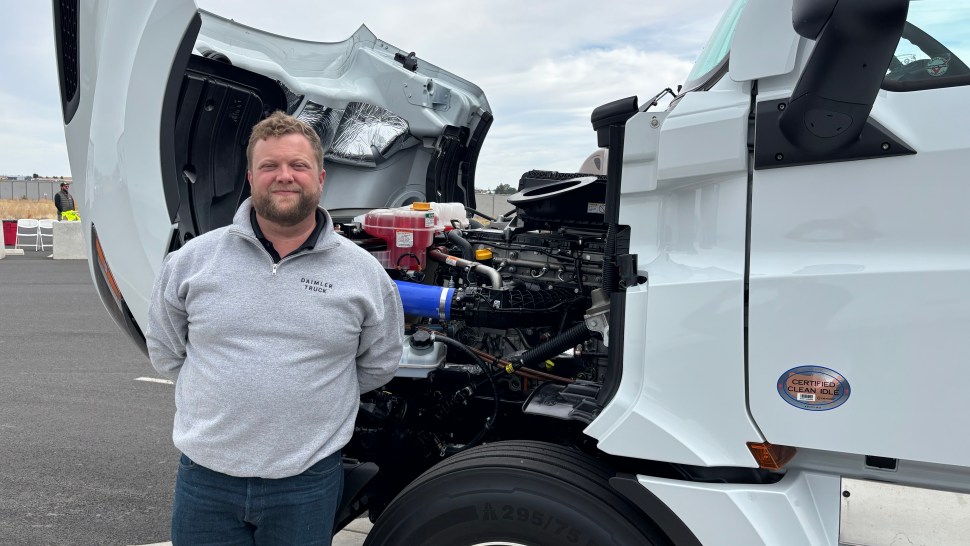
Madras, Oregon–As the truck manufacturing community awaits word on what the final rule on NoX emissions from heavy and medium duty vehicles will be, Daimler Truck North America (Frankfurt/XETRA: DTNA) is expressing concern about one possible provision aimed at easing the regulatory burden.
In a gathering of the media here at DTNA’s proving ground and test track in the region known as the High Desert of Oregon, in the state where the company has its corporate headquarters, the proposed amendments to the nitrogen oxide (NoX) rule that were released in July by the Environmental Protection Agency served as a backdrop to the primary reason for the gathering: the release of the Detroit 6 engine from Daimler that is designed to meet the specifications.
Various Daimler officials made clear in multiple statements at the press briefing that regardless of the outcome of the amendment process, the Detroit 6 engine already meets the standards.
The comment period for the amendment process closed in late August. The core part of the rule that is to go into effect next year was not part of the amendment process: the standard that will tighten NoX emissions to 0.035 brake horsepower-hour (bhp-hr) from the earlier standard of 0.2. That’s staying in place.
Warranty changes get big backing
The trucking industry for the most part embraced several of the changes. In particular, a requirement for extended warranties has been rescinded. The new proposed standard is what’s in place now: a 5-year/100,000-milie emissions warranty rather than a warranty of 10 years and 450,000 miles.
At the Oregon event, Dan Potter, manager of product compliance and regulatory affairs at Daimler, said in a presentation that the company “believes that the EPA did a good job when they wrote this rule, creating flexibility, building it into the rule, and we believe it helps support the product we are intending to bring in 2027 and further years.”
Specifically on keeping the current warranty rule in place, Potter said in a separate interview with FreightWaves that “we think in terms of impact to the customer, the proposal to get rid of the warranty extension for 2027 is going to make the biggest bottom line impact.”
Shifts in DEF policy
The proposals also call for significant changes to “deratement” of engines running low on diesel exhaust fluid (DEF), substituting various warnings for the current practice of drastically slowing a vehicle. But one thing that is not happening: DEF disappearing. The proposed rule had received online disinformation that suggested DEF was being phased out. It is not.
The proposed changes in DEF usage in the amendments would be the second major change to DEF policy this year. The elimination of DEF sensors earlier this year to help combat deratements, particularly in agricultural applications, was the first.
But the proposed amendment that Daimler is resisting is what is known as non-compliance penalties (NCPs), which would allow an engine manufacturer to pay fines with full disclosure that its engines are not in compliance with the NoX standard. (This would be different from a non-compliant engine manufacturer now, where they would be subject to potential harsher fines under the Clean Air Act after being charged by the Environmental Protection Agency.)
Potter said non-compliance penalties are permitted as a tool under the Clean Air Act. “Federal law governs how and why the EPA is supposed to use them,” Potter said. “They can or must be used when there is a manufacturer that is unable to meet standards for technological reasons.”
Not what they said earlier
Potter said all the major engine manufacturers had said at one point they could meet the 0.035 NoX standard. “I have quotes from all of them that say we’re well prepared,” Potter said.
But that has changed.
Potter did not mention any particular manufacturer. But a spokeswoman for Daimler pointed to a comment made on the second quarter earnings call for truck manufacturer PACCAR (NASDAQ: PCAR) which suggested just paying the penalties might be an acceptable business strategy, at least for now.
“Maybe the situation is very leveling now and maybe to our advantage a little bit in that the NCPs are allowing everybody to make sure we get the right products out there validated so the customers get the experience with the products, they get the experience with our products and the quality of product we’re able to introduce in a more gradual way versus it being a step change,” PACCAR CEO R. Preston Feight said on the call.
Cheaper to break the rules?
Feight added that the level of fines under the NoX rule NCPs would be around $6,000 to $7,000. But given other estimates that the cost of ensuring an engine meets the NoX standard through engineering might be as much as $15,000, those fines may look attractive.
Companies that are eyeing the NCPs as a strategy rather than a punishment are “planning to use these NCPs for reasons of economic importance rather than technological ones,” Potter said. “So we believe that there’s a risk here to the rule. We believe that this contravenes what Congress specifically sets out on what performance penalties are intended to be used for.”
Potter’s view is backed by the Engine Manufacturers Association (EMA, which is the trade group that represents companies like Daimler and Paccar.
In its comments to the amendments’ proposed rulemaking, the EMA argued the NCP program would not be fair to companies that made the investments needed to make compliant engines.
“Clean mobility suppliers have invested in developing technologies and manufacturing capacity for the past 10 years in advance of implementing these model year 2027 and later heavy-duty standards and depend on policy stability to avoid stranded investments,” the association wrote. “The option to use expanded credit allowances and NCPs puts those investments and associated jobs at risk. It is our position that the current regulation as finalized in 2022 includes sufficient lead time and compliance flexibility for heavy-duty engine OEMs.”
That view was also backed in the comments by a group of attorneys general from a group of blue-leaning states.
“The Proposal would allow manufacturers to use NCPs in lieu of meeting the emission standard for 2027 and later model year heavy-duty vehicles, despite the fact that the criteria for establishing NCPs have not been met,” the state officials said. “This is fundamentally at odds with the Clean Air Act’s mandate that EPA set standards that reflect the greatest degree of emission reduction achievable, as it creates a pathway for manufacturers to disregard that standard in the first instance.”
Potter noted several times that the proposed amendments are just that: proposals. The shape of the final rule may take months to emerge.
But regardless, the Detroit 6 engine will be available on the Freightliner Cascadia that will be available in the upcoming model year.
A gripping safety demonstration
While the reason for the press gathering was primarily the launch of the Detroit 6 and its compliance with the new NoX rules, it also gave Daimler officials a chance to show off to the media the latest features of Daimler’s Active Break Assist (ABA).
Daimler is not the only manufacturer with that feature, designed to autonomously halt a vehicle that is in danger of colliding with another vehicle that may have blown a stop sign or red light, one that turned into oncoming traffic or a vehicle that is stopped and at risk of being rear ended by a truck driver that failed to stop in time.
It’s a powerful demonstration, with a freight journalist in the passenger seat as the company driver heads straight for a small “vehicle” made of soft materials. That demonstration was undertaken numerous times until all the scribes in attendance had a shot in the passenger seat.
It’s a process made possible by GPS, with the two vehicles–the truck with ABA and the “crash test dummy” car–starting from carefully-calibrated spots on the test track in Oregon.
The idea is that the truck will be planned to barely miss the vehicle mockup. On one of the demonstrations, the truck did slightly clip the fake car, leading to a lengthy delay to re-calibrate location. But otherwise the media was treated to a series of close calls.
More articles by John Kingston
Some judicial skepticism of non-domiciled rule in Lujan arguments
Another aspect of Montgomery: it might make human brokers more valuable
Brokerage Compliance Symposium
The day before F3. Every compliance issue you face - fraud exposure, carrier liability, FMCSA rules, cargo theft, insurance gaps - navigated by attorneys and operators defining best practices in a changing industry.
F3 Awards Dinner
The night before F3. FreightTech100 companies honored. FreightTech 25 and Shipper of Choice winners revealed live. Cocktail reception into dinner and live music - 300 industry leaders in one purpose-built room.
F3: Future of Freight Festival
Industry-defining keynotes, rapid-fire technology demos, and industry leaders networking in experiences across Chattanooga - plus the inaugural F3 Awards Dinner featuring the FreightTech and Shipper of Choice reveals.
The day before F3. Every compliance issue you face - fraud exposure, carrier liability, FMCSA rules, cargo theft, insurance gaps - navigated by attorneys and operators defining best practices in a changing industry.
The Signal at Chattanooga Choo Choo • Chattanooga, TN Register NowThe night before F3. FreightTech100 companies honored. FreightTech 25 and Shipper of Choice winners revealed live. Cocktail reception into dinner and live music - 300 industry leaders in one purpose-built room.
The Signal at Chattanooga Choo Choo • Chattanooga, TN Register NowIndustry-defining keynotes, rapid-fire technology demos, and industry leaders networking in experiences across Chattanooga - plus the inaugural F3 Awards Dinner featuring the FreightTech and Shipper of Choice reveals.
The Signal at Chattanooga Choo Choo • Chattanooga, TN Register Now