




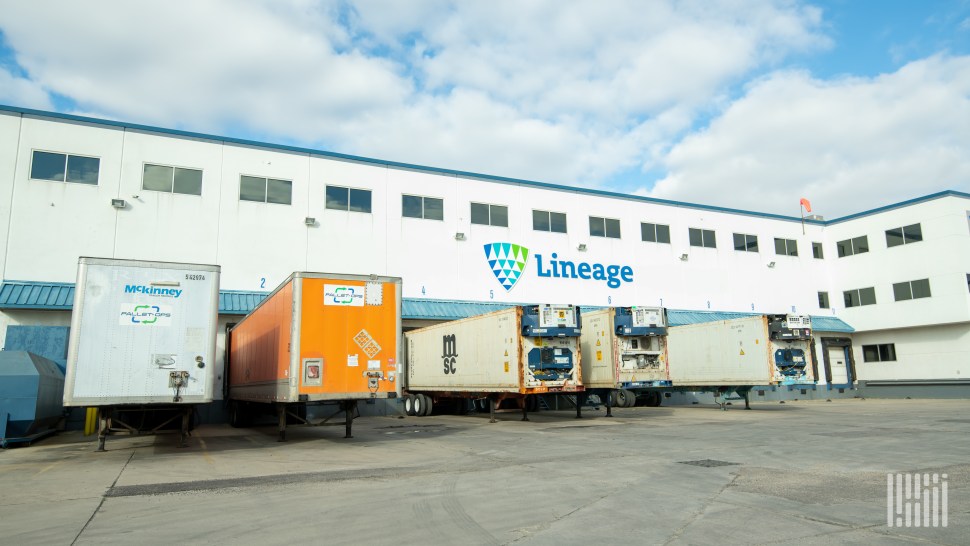
Cold storage facility operator Lineage said customer inventories have stabilized, though some accounts are holding lower stock levels. The Novi, Michigan-based company said Tuesday on its third-quarter call that it continues to shutter underutilized facilities in efforts to tighten supply and reduce debt leverage.
Lineage (NASDAQ: LINE) noted that it and Americold (NYSE: COLD), the top two operators in the space, have reduced overall capacity by 4% (9 million square feet) over the past two years. Lineage has idled 16 locations since the start of 2025, representing 2.6 million square feet and 212,000 pallet positions.
The company reported a third-quarter net loss of $173 million, or 68 cents per share. Adjusted funds from operations (AFFO) were 73 cents per share, down 12 cents year over year. (AFFO excludes depreciation, acquisition costs, restructuring expenses and other non-recurring items.)
Consolidated net revenue of $1.36 billion was down 1% y/y and just shy of the $1.37-billion consensus estimate.
An 8% y/y decline in food-related container volumes dragged revenue lower. The company pointed to weakness in the seafood sector as higher fuel costs forced fishermen to curtail their trips. Elevated diesel prices also pushed Lineage’s third-party transportation costs higher in the quarter.
However, facility occupancy is improving across the portfolio.
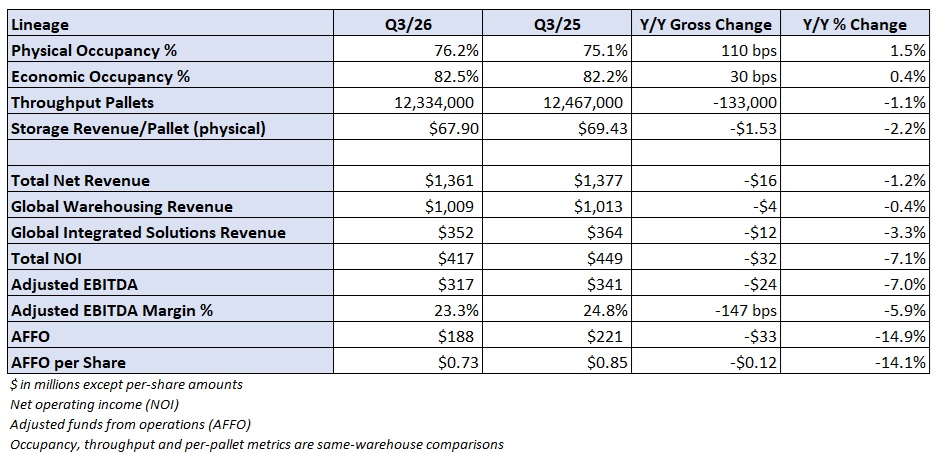
On a same-warehouse comparison, Lineage’s physical occupancy was 76.2% in the quarter, 110 basis points higher y/y, and 40 bps better than the second quarter. (Physical occupancy was 76.4% in the first quarter.)
Pallet throughput declined 1% y/y, with storage revenue per pallet down 2%. Both metrics were up less than 1% sequentially.
“Our core business trends continued to stabilize in the third quarter, with same-store occupancy growing year-over-year for the second consecutive quarter, further confirmation that customer inventory levels have normalized,” said Lineage President and CEO Greg Lehmkuhl in a news release.
Adjusted EBITDA of $317 million was 7% lower y/y, with the adjusted EBITDA margin falling 150 bps to 23.3%.
The company lowered its full-year adjusted EBITDA guidance by 1% at the midpoint of the new range of $1.25 billion to $1.27 billion. A fire at a California facility is expected to be a $20-million headwind. (Lineage reported $1.3 billion in adjusted EBITDA in 2025.)
The AFFO guidance range was tightened to $2.86 to $2.98 per share.
It has 17 facilities currently under construction, which will add $141 million in net operating income, $11 million of which has already been achieved.
Lineage ended the third quarter with net debt at 6.4 times last 12 months’ adjusted EBITDA. It said that proceeds from asset dispositions and insurance recoveries should lower its leverage to a target range of 5 to 5.5x, with meaningful progress occurring in the 2027 first half.
Lineage manages 497 facilities with 3.1 billion cubic feet of space across North America, Europe and the Asia-Pacific region. It also provides freight forwarding, customs brokerage, drayage and truck transportation.
Shares of LINE were down 9.6% in early trading on Tuesday compared to the S&P 500, which was off 0.6%.
Why it matters? Lineage is one of only two publicly traded cold storage providers. Its quarterly results provide a look at macro trends across the temperature-controlled warehousing and transportation markets.
