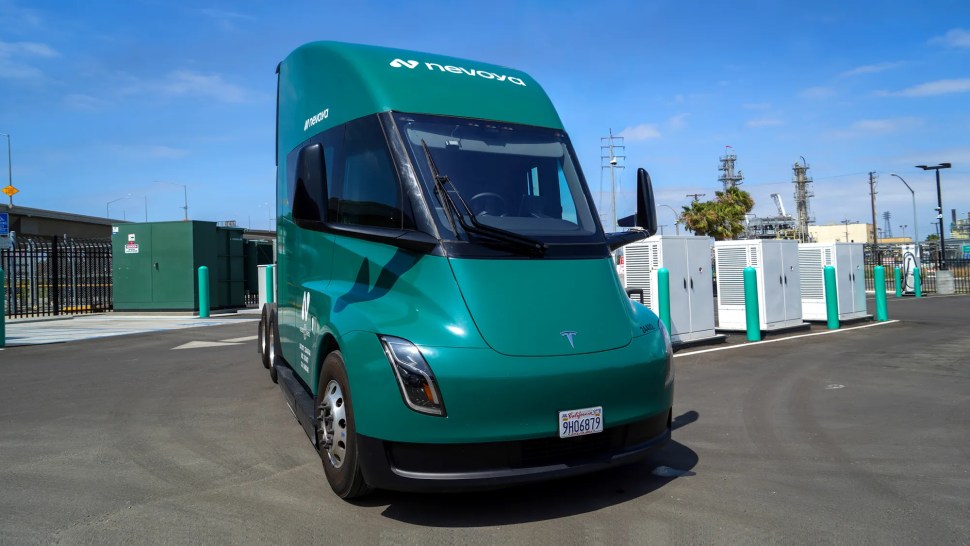
Meta will buy environmental attribute certificates tied to 25 Nevoya battery-electric trucks on Interstate 10, a multi-year deal that gives the electric truckload carrier committed demand on a second freight lane. Nevoya, which announced the agreement Thursday, expects the Class 8 trucks to start running between San Bernardino, California, and Phoenix in 2027 and to cover about 4 million freight miles a year.
The deal is Meta’s second with Nevoya and the first it has signed on its own. In Texas, Meta was one of several buyers in the Center for Green Market Activation’s alliance, whose pooled certificate purchases support Nevoya’s 63-truck deployment between Houston and Dallas. The carrier, which raised a $9.3 million seed round in July 2025, said the I-10 agreement gives Meta a framework to add corridors in the future.
Meta’s purchase is not tied to hauling its own goods. Still, the release describes I-10 as a key route for moving data center construction materials across the southern United States. A FreightWaves SONAR analysis estimates data center construction will add 18.9 million truckloads nationwide from 2026 through 2031. Value chain emissions, known as scope 3, made up 99% of Meta’s 8.2 million metric tons of carbon dioxide equivalent in 2024, according to its 2025 Sustainability Report.
“Freight is part of the emissions footprint of building and operating our data centers, and multi-year commitments like this help address our scope 3 emissions and make electric trucking available and competitive on the routes that serve the regions where we build,” Devon Lake, Meta’s head of net zero strategy, said in the release.
Deal terms and other tech buyers
Neither company disclosed the agreement’s value or length. Meta announced it Thursday in a newsroom post alongside purchases of low-carbon cement and near-zero-emission steel, part of a push to cut emissions in its data center supply chain. Meta has also backed zero-emission freight with NFI in Virginia, according to the post.
The Texas corridor reached 63 trucks after Google agreed in September to back 25 of them, a project Google said would cover about 11 million miles a year.
How the certificate purchase works
Under the agreement, Meta pays for the environmental attributes of Nevoya’s battery-electric freight service, issued as certificates, while the trucks haul freight for other shippers. Companies buy the certificates to address emissions across their value chains, including logistics, according to the release.
The approach is known as book and claim. Smart Freight Centre, a nonprofit that co-leads the Texas program with the Center for Green Market Activation, describes it as letting a low-emission shipment’s environmental attributes be “decoupled, traced, and accounted separately from the physical delivery,” in a December 2025 white paper on road freight.
In the Texas program, an independent, accredited auditor verifies the emissions impact as Nevoya operates the lane, CCJ reported in January. The release does not say who will verify the I-10 certificates.
Charging along the I-10 corridor
The deal includes bringing charging infrastructure online along the route, with the 25 trucks’ charging matched 100% with renewable energy certificates. Nevoya expects the chargers to be available to all freight operators on the corridor, and Meta described them as permanent, open-access stations. Neither company named a charging partner or sites.
Nevoya now has certificate buyers on two lanes. It first announced plans to run electric trucks on I-10 in August 2025.
“Meta coming back for a second corridor is a strong signal that this model works. Electric trucks already win on the corridors we run; what unlocks them at scale is multi-year demand that drives financial and operational innovation. That is what this agreement does, and we intend to repeat it corridor by corridor,” John Verdon, Nevoya’s co-founder and chief commercial officer, said in the release.
Why it matters: For fleets weighing electric trucks between the Inland Empire and Phoenix, the deal adds chargers Nevoya expects to open to every operator on I-10. Whether certificate money can sustain a fleet gets its first full test in early 2027, when the 63-truck Texas project is set to run.