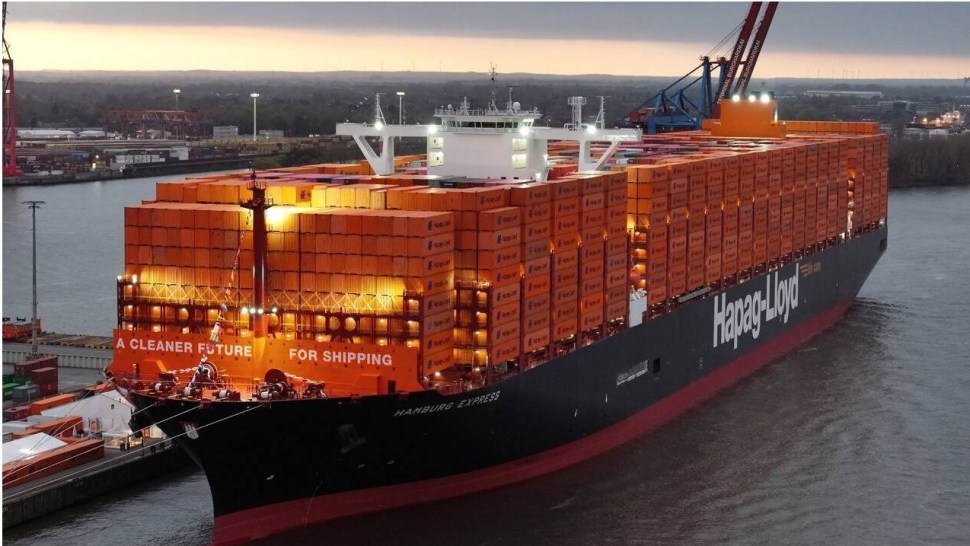
Maersk and Hapag-Lloyd announced today that their Gemini Cooperation’s AE1, AE2 and AE3 services will return to the trans-Suez route and Red Sea, replacing diverted voyages around Africa.
The changes, in a phased transition extending from December into January, affect Asia-Europe services, but their potential to free vessel capacity gives U.S. importers a reason to watch the rollout.
“They will now sail via the trans-Suez route instead of transiting via the Cape of Good Hope,” Maersk (OTC: AMKBY) said in a customer advisory.
The shift marks another step toward restoring shorter shipping routes between Asia and Europe. It could also change how much vessel capacity carriers need to maintain those services, with possible consequences for capacity deployment elsewhere in their global networks. Those effects remain uncertain, however, as congestion and network adjustments continue to absorb shipping capacity.
Maersk, Hapag-Lloyd (HLAG.DE) and other global liners since late 2023 diverted scheduled services away from the Suez-Red Sea route after Yemen’s Houthi rebels attacked merchant shipping in support of Gaza. But ocean carriers are returning as Houthi attacks waned, and longer diversions increased costs and operating complexity.
Transition begins December 4
AE2 will be the first of the three services to make the scheduled transition, with the Mary Maersk, voyage 650W, starting its rotation at Ningbo on December 4. AE3 will follow with Alette Maersk, voyage 652W, starting at Shanghai on December 20. AE1’s first listed sailing will be Damietta Express, voyage 702W, starting at Shanghai on January 14, 2027. These are dates at the first loading ports, rather than dates for passage through the canal.
The revised rotations include Suez Canal transits in both directions. Maersk said the changes would improve transit times, while cautioning that implementation depends on continued stability in the Red Sea and ongoing monitoring of regional security conditions.
The announcement also completes a broader routing shift within Gemini. According to shipping analyst Linerlytica, the return of these three services will make Maersk and Hapag-Lloyd the first alliance to restore Suez routing across all of its Asia-Europe services, following earlier changes to other Gemini loops.
U.S. impact centers on capacity, not direct routing
For the U.S. market, the impact is indirect. Shorter voyages can release vessels from longer rotations, creating opportunities for carriers to rebalance capacity across their networks, Maersk said.
That does not mean U.S. importers should expect an immediate drop in ocean freight rates. DHL Global Forwarding said the return to Suez would release capacity previously absorbed by diversions around Africa, but warned that congestion and extensive network adjustments could keep supply chains under pressure into 2027. And, recent violent incidents involving shipping in a global swath from the Black Sea to the Strait of Hormuz to the Somali coast create a tenor of uncertainty further supporting higher ocean rates.
Congestion and security remain constraints
DHL estimated that broader network adjustments could take another six to 12 months as carriers reposition vessels and rebalance services, assuming security conditions do not force further changes. It also said more than 10% of the global container fleet remained tied up in port congestion.
For cargo owners, that means increased vessel availability and dependable delivery schedules may not arrive together. Maersk’s own security caveat also leaves open the possibility that the announced rotations could change if conditions in the Red Sea deteriorate.
Why it matters: For U.S. importers, retailers and manufacturers, Gemini’s Suez return could loosen global vessel supply and influence future carrier deployment decisions, but congestion, regional demand and security risks will determine how much of that benefit reaches U.S. trade lanes.
Read more articles by Stuart Chirls here.
Read more:
Red Sea overcapacity looms as ocean container spot rates still 50% above year-ago
U.S. container imports hit record 2.67 million TEUs in October as port delays rise
Tanker strikes cruise riverboat in New Orleans
CMA CGM triples profit as Q3 freight rates and cargo volumes rise