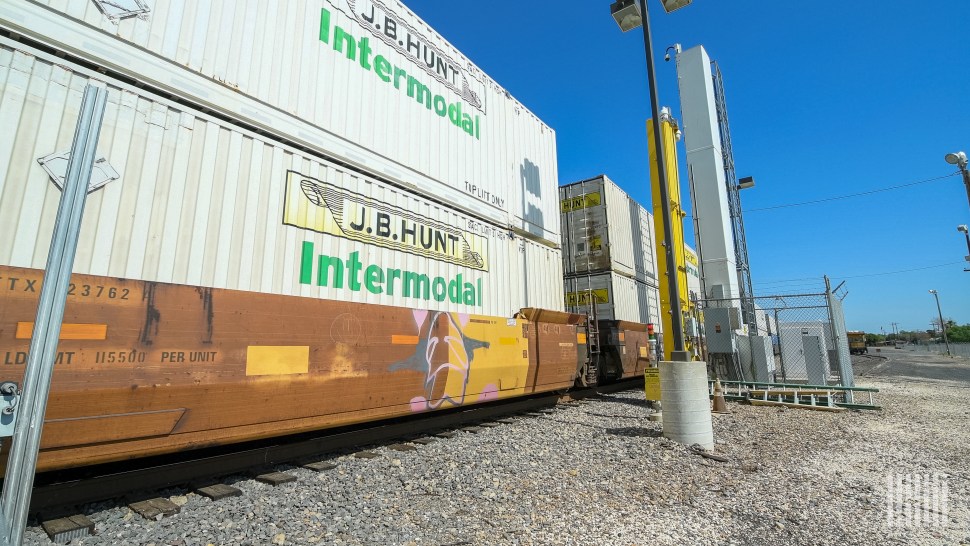
J.B. Hunt Transport is urging the Surface Transportation Board to reject Union Pacific’s (NYSE: UNP) proposed merger with Norfolk Southern (NYSE: NSC), arguing that the deal overstates potential shipper savings and truck-to-rail growth while threatening competition and service reliability.
In comments filed Nov. 18, the transportation company (NASDAQ: JBHT) said the merger, as proposed, would likely deliver “more harm than benefit” to its intermodal customers. It argued that the railroads have not provided adequate assurances that operating efficiencies would translate into lower customer costs or that intermodal shippers would have meaningful remedies for service failures.
The filing signed by Darren Field, Hunt’s executive vice president and president of intermodal, said that the company moved approximately 2.25 million intermodal loads in the preceding 12 months and is the largest intermodal customer of both BNSF Railway (NYSE: BRK-B) as part of the railroad’s Quantum service, and Norfolk Southern. It also has commercial relationships with every Class I railroad.
Hunt took particular issue with the railroads’ projection that the merger would generate approximately 1.2 million annual intermodal loads converted from highway transportation, phased in over three years. The company argued that the forecast does not reflect how customers actually choose between truck and rail service.
According to the filing, the railroads’ model uses haul length and interchange information as a proxy for reliability. Hunt said that approach overlooks other causes of service failures, including freight left behind at origin terminals, congestion, equipment shortages and delays at destinations.
“But moving the dots on a map to create different single-line origins and destinations does not, by itself, give a customer a reason to move freight from highway to intermodal,” Field said in the filing.
Field contrasted the projected growth with Hunt’s own experience. The company’s largest intermodal growth year, 2013, added 181,000 loads, he said. In 2016, a strategy using steep price discounts generated 144,000 additional loads, below a target of 200,000. Those results illustrate the challenge of achieving the railroads’ conversion forecast, he argued.
Hunt said substantial conversion opportunities already exist without consolidation. Its internal research estimates that approximately 9.8 million to 11.2 million annual loads could shift from truck to intermodal across all Class I railroads using existing routes and arrangements between carriers.
Savings claims leave cost questions
The company also challenged the railroads’ projected $3.5 billion in annual shipper savings, arguing that the application does not guarantee that merger efficiencies would reach customers through lower rates. It warned that rate increases could instead absorb some or all of the projected difference between truck and rail costs.
The filing said the cost estimates understate the expense of converting freight to intermodal, including first- and last-mile trucking, containers, chassis and terminal capacity. Field estimated that handling an additional 1.2 million annual intermodal loads would require more than 60,000 additional 53-foot containers, along with supporting equipment and capacity.
Hunt said the application does not explain who would supply that equipment, who would pay for it or how quickly it could be integrated into the network. Failure to secure sufficient capacity could undermine reliability and push freight back onto highways, the company argued.
Harrisburg routing options raise concerns
Competition concerns center partly on the possibility that a combined Union Pacific–Norfolk Southern would favor freight moving entirely over its own network over traffic exchanged with competing railroads. Hunt identified BNSF–Norfolk Southern service into Eastern Pennsylvania as a particular concern.
The company described Harrisburg, Pennsylvania, as a network-critical intermodal market and a significant opportunity for future growth. Today, freight can reach that market from either Union Pacific or BNSF through interchange with Norfolk Southern in Chicago, according to the filing. Hunt warned that the merger could weaken BNSF’s participation and reduce customers’ competitive routing alternatives.
To illustrate its concerns about gateway protections, the provider cited its experience following the Canadian Pacific (NYSE: CP)–Kansas City Southern merger. The company said unreliable service and rate increases led it to stop using the Laredo, Texas, gateway for its traffic despite protections adopted in that proceeding.
Field said an alternative Monterrey, Mexico-to-Atlanta route using Ferromex, BNSF and Norfolk Southern through Eagle Pass and Chicago was 1,570 rail miles longer than the CPKC–Norfolk Southern route through Laredo, yet moved freight faster and more consistently. Hunt argued that the experience shows why keeping an interchange formally open is not enough to preserve a commercially viable option.
Conditions sought if merger is approved
Although rejection is its preferred outcome, J.B. Hunt outlined four categories of protections it wants imposed if the STB approves the transaction:
Preserve existing gateways, interchanges and service lanes, with prior STB approval required before they are eliminated, downgraded, restricted or otherwise disadvantaged;
Grant competing railroads trackage rights into Harrisburg—BNSF from Chicago, CSX (NASDAQ: CSX) from Chambersburg, Pennsylvania, or both;
Establish enforceable intermodal service standards, accessible dispute-resolution procedures and financial penalties or damages for noncompliance;
Require rigorous STB oversight for at least 10 years.
Hunt also argued that the proposed service protections leave intermodal customers without adequate recourse. Its filing said intermodal traffic is excluded from the railroads’ proposed damages arbitration and Targeted Access programs, and that those programs would remain too restrictive even if eligibility were expanded.
Why It Matters: J.B. Hunt’s filing challenges the merger from the perspective of a major customer of both Norfolk Southern and its competitors, and not simply a rival railroad. Its central argument is that a larger network does not automatically produce a better door-to-door transportation service: customers also need competitive prices, dependable equipment and capacity, reliable delivery and viable alternative routes.
Subscribe to FreightWaves’ Rail e-newsletter and get the latest insights on rail freight right in your inbox.
Read more articles by Stuart Chirls here.
Read more:
Union Pacific–Norfolk Southern merger draws labor support, shipper concerns
US rail traffic rises 7.3% as intermodal gains 10.7% in latest week
Transcontinental merger of Union Pacific and Norfolk Southern divides rail leaders
Union Pacific police in shootout after alleged train robbery on southern California freight line