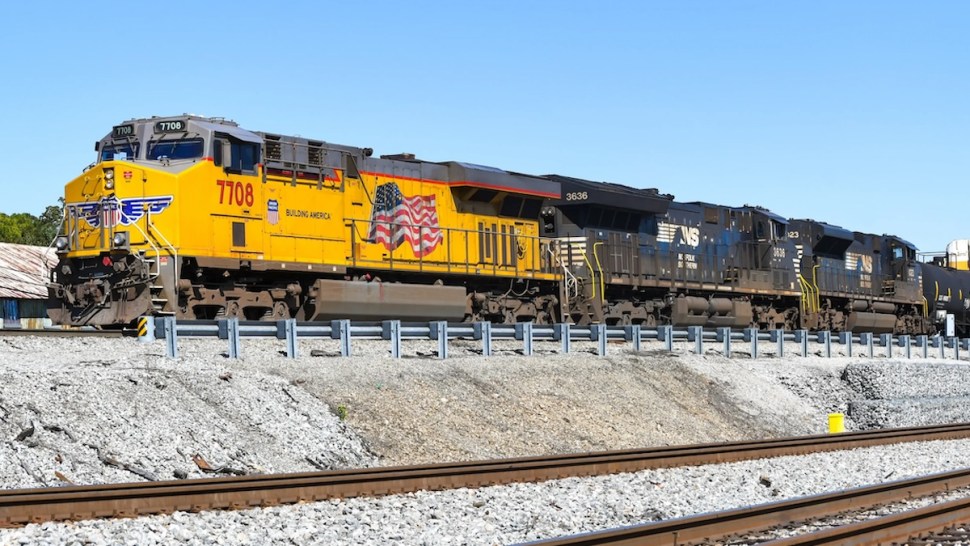
Ahead of a Wednesday filing deadline for public comments, Union Pacific and Norfolk Southern used their third-quarter 2026 earnings calls to argue that their controversial proposed merger would lower supply-chain costs and help railroads win freight from trucks.
Their competitors offered different responses. CPKC (NYSE: CP) demanded rejection by the Surface Transportation Board; CSX (NASDAQ: CSX) emphasized partnerships, and CN (NYSE: CNI) highlighted an agreement intended to protect its business while opening new markets.
BNSF, which as a unit of Berkshire Hathaway (NYSE: BRK-B) doesn’t hold an earnings call, earlier offered a public statement from its chief executive opposing the merger.
The STB is expected to render a decision in 2027.
Union Pacific: Lower costs, faster service and confidence in approval
On Union Pacific’s October 22 earnings call (NYSE: UNP), Chief Executive Jim Vena argued that combining the two networks would reduce the friction involved in moving freight between railroads.
“Our merger … will deliver substantial measurable benefits by strengthening the supply chain,” Vena said. “It will lower transportation costs and provide faster, more seamless rail service options that enable our customers to compete and help keep goods affordable for American … consumers.”
Vena characterized the transaction as an end-to-end combination with limited overlap, rather than a consolidation of substantially parallel networks. He also pushed back against competitors seeking concessions, saying requests needed to be grounded in the merger’s actual competitive effects. Chief Financial Officer Jennifer Hamann said UP (NYSE: UNP) was building cash reserves in anticipation of closing on the deal in the second half of 2027.
Norfolk Southern: Make truck-to-rail gains permanent
Norfolk Southern (NYSE: NSC) CEO Mark George framed the merger as a structural answer to an industry problem. Freight can shift to rail when trucking becomes expensive, then return to highways when market conditions change.
“When shippers are given a rail product that offers better value than the highway, they move freight to rail quickly, and the Union Pacific-Norfolk Southern combination is designed to create those conditions permanently,” George said on the company’s October 22 earnings call.
George acknowledged that competing railroads were already responding with new services and closer cooperation.
“We have definitely seen a more enhanced competitive environment,” he said, adding that railroads working together was good for the industry even when it made competition tougher for Norfolk Southern. His argument was that a unified network could help preserve market-share gains that otherwise might disappear as fuel prices and trucking capacity normalize.
CPKC: Reject the merger, rather than bargain over concessions
CPKC CEO Keith Creel delivered the most forceful earnings-call opposition, arguing that the proposed railroad’s scale and market power would create risks that were unnecessary.
“We don’t want a condition. We don’t want a concession. We don’t think it’s needed,” Creel said during CPKC’s October 28 earnings call, reported by Trains. “To create something that represents that much risk, that much market power forever is completely unneeded.”
Creel rejected comparisons with CPKC’s own merger, stressing that Canadian Pacific and Kansas City Southern had been the two smallest Class I systems and remained the smallest combined network. CPKC’s preferred outcome was rejection; if regulators nevertheless approved the transaction, it would seek protections including competitive access and meaningful safeguards at interchange gateways.
CSX: Partnerships can improve service without common ownership
On CSX’s October 21 earnings call, in response to a question regarding how the railroad’s partnerships with other carriers served as a counterweight to the proposed Union Pacific–Norfolk Southern combination, Chief Commercial Officer Maryclare Kenney emphasized that cooperation across railroad boundaries was established practice, not a new response invented for the merger fight.
“It’s been common practice for CSX to work closely with our interline partners to try to find new and in some cases better solutions for our customers,” Kenney said. “We’re always looking for ways across our lines of business—but I would say in particular when you think about intermodal—trying to find solutions that improve transit and improve reliability for our customers.”
Her answer focused on the commercial alternative to consolidation by connecting separate networks through service agreements. “We’ve been happy with the results we’ve seen with the partnerships we formed over the last several years, and we’ll continue to work on those going forward,” she said.
Canadian National: Protect the network and pursue Mexico growth
Canadian National CEO Tracy Robinson described its prospective agreement with Union Pacific as both a defensive measure and a growth opportunity.
“It mitigates the risk of the merger to our network and our business, but it also creates opportunities,” Robinson said on CN’s October 30 earnings call.
In her prepared remarks, Robinson said the “soon-to-be-finalized agreement” would extend CN’s reach into Mexico and position it to compete for a larger share of approximately $45 billion in annual Canada–Mexico trade. The agreement barters access in exchange for CN dropping its opposition to the merger.
BNSF: A warning about rates and reduced competition
BNSF President and CEO Katie Farmer opposed the transaction in a July 28 public statement responding to supplemental merger information submitted to regulators.
“The additional data submitted by UP does not change the fact that this would be an anti-competitive transaction between two financially healthy companies, that will raise rates on rail customers and result in higher prices for consumers,” Farmer said.
Why it matters: The outcome of the proposed merger is likely to reshape freight routings, interchange access and competitive leverage well beyond the two merging railroads.
Subscribe to FreightWaves’ Rail e-newsletter and get the latest insights on rail freight right in your inbox.
Read more articles by Stuart Chirls here.
Read more:
Union Pacific police in shootout after alleged train robbery on southern California freight line
BLET ends Wheeling & Lake Erie strike
Genesee & Wyoming prepares to split into three rail holding companies
US rail traffic hits intermodal record as October freight gains signal economic resilience, says AAR
Rising Q3 transportation costs squeeze manufacturers, reward railroads and reshape trade