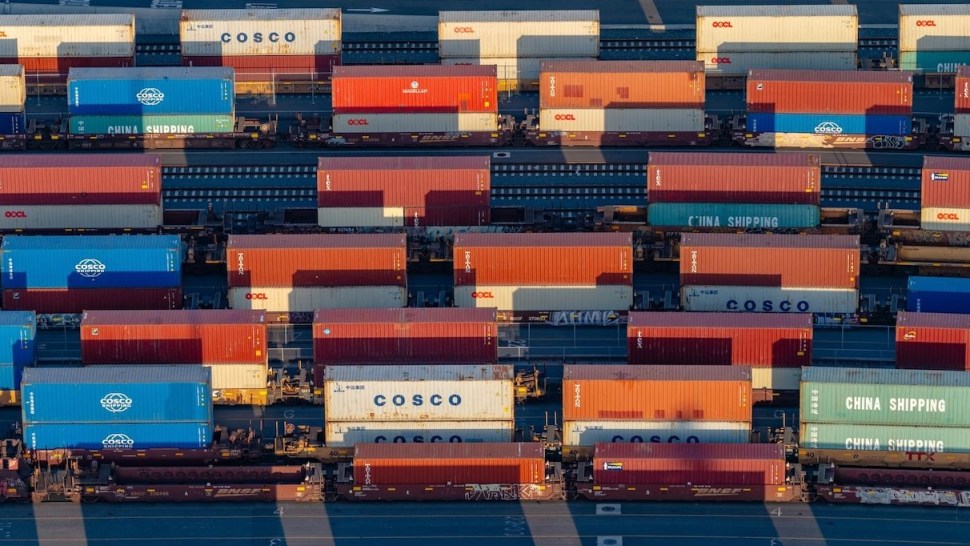
Nearly 35,700 import containers were waiting for on-dock trains at the ports of Los Angeles and Long Beach this week, as record cargo volumes and reported railcar shortages slowed the movement of freight inland.
Of the 35,688 containers awaiting rail service on Oct. 26, 10,562 had been on the terminals for at least nine days, according to The Dwell’s compilation of the ports’ daily rail reports. The figures count individual containers, rather than twenty-foot-equivalent units, or TEUs, the standard measure of port cargo volume.
The backlog was more severe at Los Angeles, where 8,133 of the 19,626 containers awaiting trains had waited nine days or longer. At Long Beach, 2,429 of 16,062 rail-bound containers had reached that threshold. That put the share of longer-waiting containers at 41.4% in Los Angeles, compared with 15.1% in Long Beach.
The daily inventory figures follow a broader increase in the time containers spend on marine terminals. Average rail-container dwell across the port complex rose to 7.19 days in September from 6.75 days in August, according to Pacific Merchant Shipping Association data. Average dwell for containers leaving by local truck increased to 3.18 days from 2.95 days.
Both ports handled record monthly cargo volumes in September. Los Angeles processed approximately 1.04 million TEUs, while Long Beach handled 997,177 TEUs. PMSA linked the increase in container dwell to the extended peak shipping season and heavy cargo flows.
Freight broker C.H. Robinson identified Southern California intermodal railcar shortages as a constraint in its October market update, saying limited equipment availability was extending import dwell and slowing inland movement. Empty-container repositioning was also complicating equipment flows, while truck-destined containers were moving relatively normally by comparison.
The figures point to particular pressure on the rail side of the ports’ operations. The Oct. 26 counts measure containers awaiting on-dock trains at a particular moment; they are not an average waiting time and do not establish that every container in the inventory is overdue.
Class I railroads BNSF (NYSE: BRK-B) and Union Pacific (NYSE: UNP) serve the southern California port complex.
The buildup of containers on terminals has not been accompanied by evidence of a comparable offshore vessel queue. The Dwell’s separate congestion tracker reported one ship awaiting a berth during the week of Oct. 26, based on Maritime Administration and Marine Exchange data.
A possible labor disruption could add pressure in the coming days. The Pacific Maritime Association warned Oct. 27 that a potential Nov. 1 strike involving approximately 250 port watchmen could affect eight container terminals. Members of International Longshore and Warehouse Union (ILWU) Local 26 voted to approve a walkout as soon as Sunday.
According to the employer association, the terminals handle roughly 85% of Long Beach cargo and 33% of Los Angeles cargo.
FreightWaves has reached out for comment from the ports and railroads.
Subscribe to FreightWaves’ Rail e-newsletter and get the latest insights on rail freight right in your inbox.
Read more articles by Stuart Chirls here.
Read more:
Wabtec earnings rise on higher freight and transit sales
Union Pacific posts record third-quarter revenue and profits
Norfolk Southern profits rise on higher volume and revenue
F3: Future of Freight Festival
Industry-defining keynotes, rapid-fire technology demos, and industry leaders networking in experiences across Chattanooga - plus the inaugural F3 Awards Dinner featuring the FreightTech and Shipper of Choice reveals.
Industry-defining keynotes, rapid-fire technology demos, and industry leaders networking in experiences across Chattanooga - plus the inaugural F3 Awards Dinner featuring the FreightTech and Shipper of Choice reveals.
The Signal at Chattanooga Choo Choo • Chattanooga, TN Register Now