




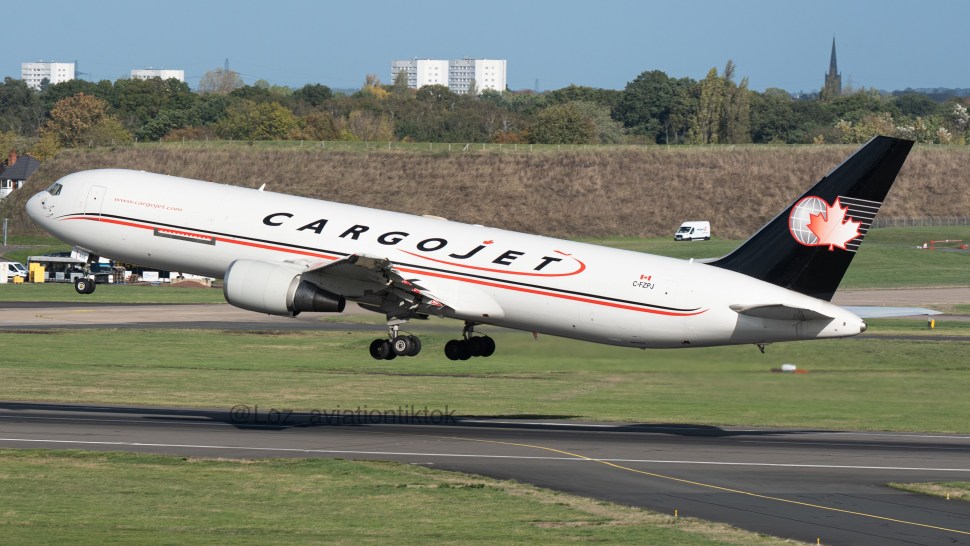
Cargojet credited new strategic initiatives involving the integration of the Canadian overnight network with international operations and introduction of more scheduled charter services, which improved asset utilization, for propelling the company to record third-quarter revenue and operating profit.
The streamlined operation has allowed the company to better connect global markets through its Ontario hub, resulting in increased demand from shippers attracted to more route options. In addition to more flights, non-domestic activity benefitted from favorable market conditions that have raised yields across the air cargo industry, where capacity has not kept up with the 6% volume growth year-to-date.
The all-cargo carrier late Wednesday reported revenue of US$201.4 million, a 30.3% increase year over year. Adjusted earnings before interest, taxes, depreciation and amortization grew 28% to $63.4 million, as stronger charter and long-term contracted flying activity more than offset higher maintenance, ground and pilot costs. Both figures were the highest ever during the July-to-September period.
Management said improved aircraft utilization, reflected by a 13.3% increase in block hours per aircraft, played an important role in profit margins increasing 31.5% over the prior-year quarter.
Cargojet (TSX: CJT) this year implemented a revamped business model called One Fleet, One Network aimed at improving efficiency and expanding its global reach by centrally managing aircraft, network capacity and commercial sales for domestic express, long-term dedicated contract flying, and charter operations rather than treating them as independent business lines.
“This integrated approach allows us to match capacity more effectively with customer demand, improve aircraft productivity, and pursue opportunities that generate the greatest value across our networks. Our focus is on generating higher-quality revenue, maximizing the productivity of our existing assets, and translating that performance into stronger earnings and free cash flow,” said CEO Pauline Dhillon during an earnings conference call with analysts.
“By connecting our domestic network with key international markets, we can create new cargo flows, increase network density, and generate incremental revenue from our existing infrastructure and aircraft,” she added. A big focus is on repurposing aircraft when they are not operating in the domestic overnight network or on dedicated customer routes.
The network restructuring shares commonalities with FedEx, which is in the process of melding separate ground and express networks into a more cohesive, and less expensive to run, whole.
More charter options
Cargojet’s strategy took another step forward with the announcement that it will expand scheduled freighter service to three times per week between its base in Hamilton, Ontario — about 40 miles southwest of Toronto — and Miami, effective Dec. 2. The extra frequency provides greater connectivity between Europe, Asia, Canada and key destinations in South America, giving freight forwarders more shipping options and flexibility, according to the company.
Dhillon said the carrier has already secured volume commitments from existing customers ahead of the Miami launch.
Changes to the charter business are also paying dividends, she said, as the carrier evolves from primarily offering ad hoc flying toward a more balanced mix of scheduled service and customer-specific rentals. Revenue for all-in charters, under which a customer pays a fixed amount per flight that covers all costs, was up 88%.
“This evolution provides greater revenue visibility, creates opportunities to build consistent cargo volumes, and allows us to deploy available aircraft capacity more productively,” the CEO said.
The charter business benefitted from the mid-September addition of a second weekly frequency between Hamilton and Liège, Belgium, because of increased demand. The service is operated by a Boeing 767 converted freighter, which continues onward to Tel Aviv, Israel. And it began flying weekend charter flights to China.
Cargojet operates a mix of 42 leased and owned Boeing 767 medium widebody converted freighters and Boeing 757 large narrowbody freighters, one more than last year.
The carrier has been flying several freighters on behalf of UPS, which retired its fleet of 27 large MD-11 cargo jets following the deadly crash of one of its planes last November. As UPS continues to take delivery of factory-built 767 freighters from Boeing the need for outside capacity goes down and Dhillon said most UPS work will end this quarter.
The loss in UPS business will largely be offset by new contractual flying to South America, which has already begun, as well as additional flying opportunities to China and the Far East that are currently being negotiated.
Management stated that it is increasingly focused on revenue quality and is willing to reprice contracts when they become eligible for adjustment, saying the company’s high on-time performance and overall service justify premium pricing.
October domestic volumes were strong and customer shipping forecasts suggest that the current peak season should compare favorably with last year. International flying this year for customers like DHL Express has also been strong as geopolitical disruptions have led businesses to divert some cargo to air transport.
Cargojet’s new pilot contract, which calls for a 53% increase in pay over four years, took effect during the third quarter. The company previously said it would pass those cost increases onto customers.
Click here for more FreightWaves/American Shipper stories by Eric Kulisch.
