




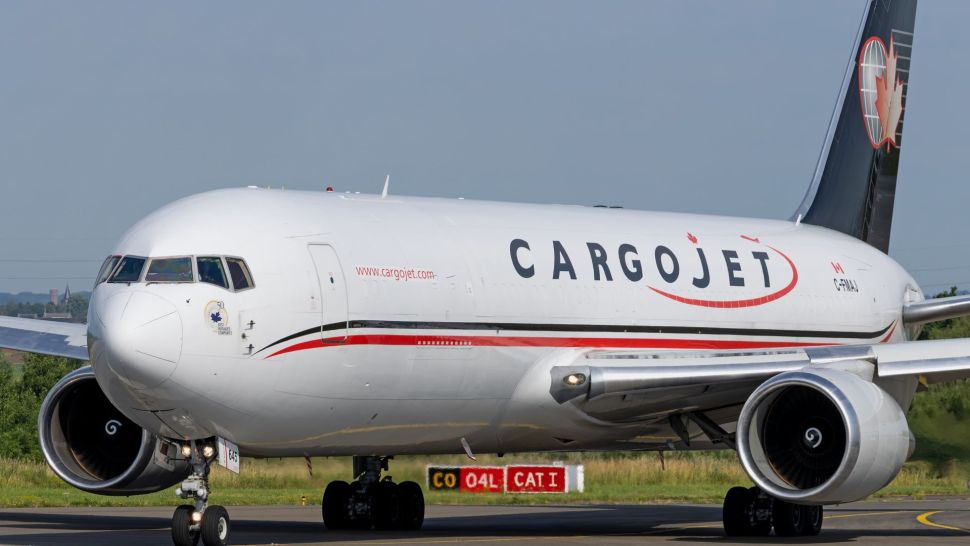
Canadian freighter operator Cargojet plans to recover the substantial increase in costs stemming from a new five-year contract with pilots through productivity gains and by raising rates on customers that ship goods on its domestic overnight network and rent planes for international transportation.
The collective bargaining agreement, which was finalized by an arbitration award late last month, calls for a 53% increase in wages over the contract’s term, including an immediate 26% bump retroactive to July 1, followed by annual increases of 5% over the following four years.
It’s a huge raise in wages, but one that Cargojet (TSX: CJT) management acknowledged was necessary to bring its pilots up to industry standards, while providing operational stability for the company and its customers through continuation of a no-strike, no-lockout provision.
“As customer agreements come due, we will look to pass these costs through. Many of these conversations have begun,” said CEO Pauline Dhillon last week on a conference call with analysts to discuss the company’s second-quarter earnings. The goal is to absorb the costs without impacting long-term margins. Customers with shorter-term contracts will be first to feel the rate increases, she added.
Cargojet did achieve some productivity benefits from the new labor agreement,
The new labor helps Cargojet on the productivity front by making the number of days worked per month more comparable to the baseline at other airlines. Pilots will now be expected to work 16 days per month, instead of 15 days, or have their pay proportionally adjusted downward if they only wish to work 15 days, Chief Financial Officer Aaron McKay said. The extra multiplied across the entire crew base will create about 6,000 additional crew days of work. Cargojet also benefits as fewer training days will count as working days, driving additional productivity.
“The pilot group will be flying a bit more per person, and so it will probably take a little bit of time to fully realize the benefits of that as we grow into it,” he explained.
Wages typically represent 60% to 65% of total crew costs at Cargojet.
BMO Equity Research estimates quarterly crew costs in the first year of the labor deal will increase by $2.2 million, with a net impact of about $1.44 million.
Q2 growth
For the quarter, revenue was US$199 million, up 15.8%, year over year behind growth in the domestic network, a 37.4% increase in all-inclusive charter business and fuel surcharges, offset by a 12.6% decline in long-term capacity purchase agreements with other airlines. Adjusted core earnings grew 8.9% to $63 million, ahead of expectations.
Cargojet had net income of $5 million versus a $2.3 million loss in the prior-year period.
Actual flying revenue — excluding profit padding on fuel surcharges — was $158.5 million, a 7.5% improvement.
Higher fuel costs during the quarter nudged down Cargojet’s adjusted profit margin to 31.7%. The airline’s ability to maintain equivalent aircraft utilization with two fewer planes than last year helped minimize margin compression.
The results were achieved despite an unstable global trade environment, exacerbated by the Iran war.
Cargojet operates 41 Boeing 757 narrowbody and 767 medium widebody freighter aircraft. The company in July purchased a converted 767-300, which is scheduled to join the fleet this quarter, according to the earnings report.
In Canada, Cargojet operates an overnight cargo service on which most customers, including express delivery and e-commerce retailers, pre-pay for guaranteed space and weight allocations. E-commerce business remains strong, partly because retailers aren’t opening more stores in secondary markets following the closure of the Hudson’s Bay department store chain, preferring instead a direct-to-consumer model shipping directly from warehouses, Dhillon said.
The company attributed the decline in dedicated contract carriage to the redeployment of aircraft from long distance routes serving Asia and Europe for DHL Express, to South America — where routes are shorter and less lucrative. Quarterly comparisons in the future should be more consistent and as a DHL partner carrier Cargojet expects to pick up additional flying as overall market demand picks up in the second half.
Short-term charter business jumped more than 37% due to new opportunities and continued outsourcing from UPS following the November crash of an MD-11 freighter, and subsequent retirement of its MD-11 fleet. The November launch of weekly scheduled cargo service between Canada and Liège airport in Belgium, followed by the recent service extension from Liège to Tel Aviv, Israel, using an aircraft that was idle on weekends also allowed the company to pick up incremental charter business.
Positive results were partially offset by the reduction in scheduled charter service between China and Canada that occurred when a Chinese e-commerce intermediary last year ended its contract in response to new U.S. regulatory barriers on low-value parcel imports.
Click here for more FreightWaves/American Shipper stories by Eric Kulisch.
Write to Eric Kulisch at ekulisch@freightwaves.com.
RELATED STORIES:
Canada’s Cargojet plays role in CEO exit at Amazon partner 21 Air
New UPS revenue helps Cargojet overcome loss of China e-commerce volume
Brokerage Compliance Symposium
The day before F3. Every compliance issue you face - fraud exposure, carrier liability, FMCSA rules, cargo theft, insurance gaps - navigated by attorneys and operators defining best practices in a changing industry.
F3 Awards Dinner
The night before F3. FreightTech100 companies honored. FreightTech 25 and Shipper of Choice winners revealed live. Cocktail reception into dinner and live music - 300 industry leaders in one purpose-built room.
F3: Future of Freight Festival
Industry-defining keynotes, rapid-fire technology demos, and industry leaders networking in experiences across Chattanooga - plus the inaugural F3 Awards Dinner featuring the FreightTech and Shipper of Choice reveals.
The day before F3. Every compliance issue you face - fraud exposure, carrier liability, FMCSA rules, cargo theft, insurance gaps - navigated by attorneys and operators defining best practices in a changing industry.
The Signal at Chattanooga Choo Choo • Chattanooga, TN Register NowThe night before F3. FreightTech100 companies honored. FreightTech 25 and Shipper of Choice winners revealed live. Cocktail reception into dinner and live music - 300 industry leaders in one purpose-built room.
The Signal at Chattanooga Choo Choo • Chattanooga, TN Register NowIndustry-defining keynotes, rapid-fire technology demos, and industry leaders networking in experiences across Chattanooga - plus the inaugural F3 Awards Dinner featuring the FreightTech and Shipper of Choice reveals.
The Signal at Chattanooga Choo Choo • Chattanooga, TN Register Now