




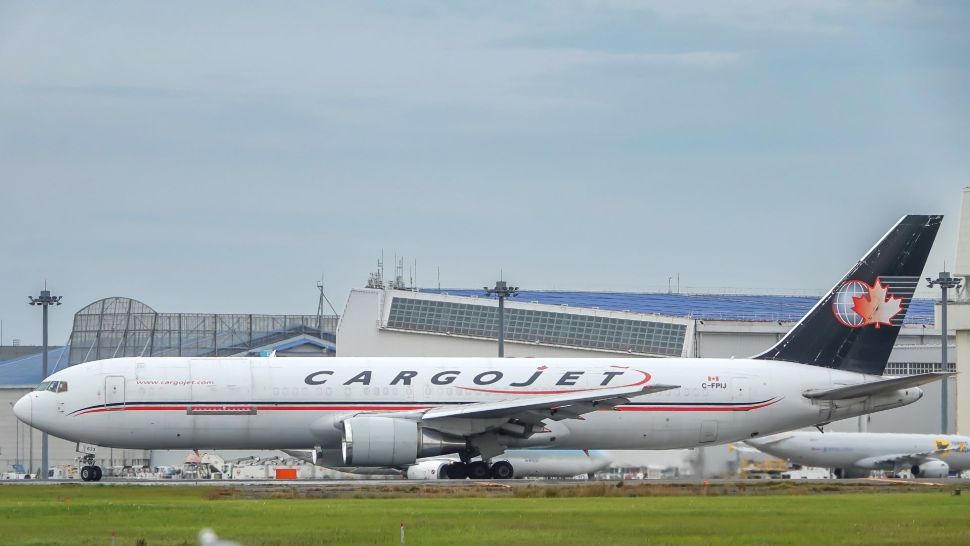
Flying for UPS and redeploying the fleet to areas like South America where demand is strong helped Canadian all-cargo airline Cargojet mitigate the loss of a large transport contract related to plunging e-commerce trade from China to North America, caused by U.S. tariffs, and a 32% decrease in fourth-quarter charter revenue.
UPS (NYSE: UPS), and FedEx to a lesser degree, engaged Cargojet (TSX: CJT) in November to provide crewed charters in their package delivery networks after a fiery UPS crash during takeoff in Louisville, Kentucky, led authorities to indefinitely ground all MD-11 aircraft. UPS and FedEx (NYSE: FDX) together have 56 MD-11s on the sidelines that are undergoing mandatory inspections while the accident investigation continues.
In mid-November, data from flight tracking platforms showed Cargojet was operating four Boeing 757-200 narrowbody jets between UPS’s global air hub in Louisville, Kentucky, and its base at the Hamilton International Airport near Toronto. Work for UPS has significantly increased since then, with multiple flights per day operating between Louisville, Hamilton and Toronto, according to Flightradar24. Cargojet has operated 14 Boeing 757-200 narrowbody freighters between the Toronto area and Louisville during the past three months. UPS’s total lease commitment is difficult to ascertain because aircraft are used interchangeably, with some units providing irregular service and others shuttling back-and-forth daily for stretches of time.
Cargojet also has operated seven Boeing 767-300 medium widebody freighters on behalf of UPS, mostly between Vancouver, British Columbia, and Louisville. Again, UPS’s total commitment is difficult to ascertain because Cargojet often uses different planes to support an assigned route. Neither company would provide specific details about the arrangement. Meanwhile, Cargojet in December and January operated flights for FedEx from its hub in Memphis, Tennessee, to Vancouver, Hamilton and Toronto with two 767 freighter aircraft.
UPS said last month it will retire its 27 MD-11s rather than return them to service when they are cleared to fly by the Federal Aviation Administration. CFO Brian Dykes said the ability to meet current demand with alternative capacity convinced management to let go of the MD-11s, which the express carrier plans to replace with Boeing 767-300s already on order from Boeing. Cargojet is one of three airlines UPS is using to backfill its lost MD-11 capacity.
Cargojet expects to continue providing replacement capacity to UPS through the third quarter, and possibly into the busy fourth quarter because regulators have not yet indicated when the MD-11s will be certified to fly again. Revenue from UPS will more than make up for lost transpacific sales this year, Chairman Ajay Virmani said on Wednesday’s earnings briefing.
The UPS transport services agreement is renewed on a quarterly basis, “but we expect it to last at least until quarter three or quarter four because [of peak season since] we haven’t seen anything from FAA or Boeing about when the MD-11s are going back, or even if they are going back to service,” he said. “It’s quite a fluid situation. But it makes up for more than what we had in China and some of the other charters,” aided by better than average margins.
Dykes, however, said most of UPS’s budget for third-party airlift will be spent in the first half of the year. The need to outsource flying will be reduced with the expected arrival of five B767s from the factory by the summer.
‘Tale of two cities’
Cargojet’s 17% gain in revenue from its domestic express network was not enough to offset the decline in contracted charter flying or per-flight aircraft rentals, which fell 22.6% and 9.6% respectively as businesses curtailed imports to reduce tariff impacts, the company said in its earnings report on Wednesday. Total revenue of $208.1 million was down 2.9% year over year.
“We are thinking of our 2025 as the tale of two cities that exist within our business. While the domestic network remained robust, long haul transatlantic and transpacific lanes continue to be impacted by geopolitical uncertainty,” said Pauline Dhillon in her first presentation to analysts as the sole CEO after sharing the position for two years.
Domestic volumes were supported by strong consumer demand for online purchases, management said. Co-load customers that contract for blocks of space in the domestic network include Amazon, FedEx, UPS and Canada Post. Commercial airlines also tender shipments in Toronto and Vancouver to reach customers in the interior of the country.
Vigorous cost-control initiatives enabled Cargojet to increase operating profit 3.6% to $69.4 million despite the slowdown in business, with the adjusted operating margin up 2.1% from the prior year. The company, which operates 41 aircraft, cut quarterly capital expenditures for maintenance and new capacity by 73%, to $27.4 million and will only invest in new capacity in 2026 if new customers make long-term lease commitments. It could face higher labor costs when it renegotiates its pilot contract, which is due to expire in June.
Cargojet was a victim of U.S. trade wars with China since Canada is a conduit for many goods bound for U.S. consignees. Westbound transpacific trade began to sink last year for the first time since 2022.
E-commerce volumes from Chinese sellers such as Shein, Temu, Alibaba and TikTok to the United States fell 50% y/y for the third consecutive month in December and were down 30% for the entire year in 2025, according to recent figures from China Customs. The downturn in direct-to-consumer shipments began in May when the Trump administration ended an exemption that allowed small-dollar shipments to enter the country duty-free and with minimal paperwork. Merchandise immediately became subject to the existing tariff rate for Chinese imports, which the U.S. sharply raised multiple times and averaged 47.5% in November.
Dhillon announced that Cargojet and Great Vision HK Express, an e-commerce logistics provider, mutually agreed to suspend their contract with more than a year remaining because of weak demand. The airline generated nearly $160 million from the contract so far. At the onset, Cargojet operated three flights per week from Hangzhou to Vancouver, British Columbia, utilizing Boeing 767-300 aircraft.
Great Vision is assessing forecasts from electronic retailers and what export incentives the Chinese government might still provide as it reassesses its shipping requirements. Virmani said the transportation contract could be reactivated quickly if the U.S. and China reach a trade agreement and lower their reciprocal tariffs.
The fourth quarter represented the trough for the long-term dedicated contract business, under which Cargojet provides aircraft, crew and maintenance to customers who are responsible for selling the space, assuming global political tensions and economic uncertainty ease, the CEO said.
Cargojet expects to more than make up the minimum revenue guaranteed under the Great Vision contract by developing new opportunities closer to home, including in South America and Europe. Redirecting a portion of its fleet from the China-U.S. corridor to Europe was a tactic FedEx also took last year when President Trump ended the de minimis rule and levied tariffs on low-value parcel shipments.
“We will deploy our assets to increasingly align with opportunities best suited to the composition of our fleet on lanes that are less impacted by political and trade related tensions while we wait for broader shipping conditions to improve,” Dhillon said.
The company recently began scheduled charter operations to Central and South America, and the Caribbean, for a new customer, with flights five times per week.
During the fourth quarter, Cargojet also introduced a weekend service between its main hub in Hamilton to Liege, Belgium, using a Boeing 767 when it isn’t busy supporting the domestic network on weekdays. Cargojet is taking the risk of selling capacity to shippers interested in reserving sections of space or simply booking small loads as needed, much like a traditional cargo airline. The service captured strong seasonal demand in Europe for premium seafood and other Canadian goods, while the company’s sales agent in Europe was able to generate consistent volumes on the westbound leg, Dhillon said. In many cases, imports feed into Cargojet’s domestic overnight network for onward transport to other Canadian cities.
The Canadian carrier also seized new business in North America that provides “better utilization of our aircraft, better rotation, better revenue, better margins and better shareholder value,” said Dhillon.
Revenue declined in the quarter despite Cargojet’s ability to replace lost transpacific business because shorter stage lengths in the Americas and Europe mean the airline is flying fewer billable hours for charter customers. On the plus side, having aircraft staged in North America makes fleet utilization, maintenance and crew scheduling easier, management said.
Click here for more FreightWaves/American Shipper stories by Eric Kulisch.
Write to Eric Kulisch at ekulisch@freightwaves.com.
RELATED STORIES:
UPS won’t resurrect MD-11 fleet after deadly crash, takes $137M charge
Cargojet, Latam add new freighter routes, capacity to Europe
Brokerage Compliance Symposium
The day before F3. Every compliance issue you face - fraud exposure, carrier liability, FMCSA rules, cargo theft, insurance gaps - navigated by attorneys and operators defining best practices in a changing industry.
F3 Awards Dinner
The night before F3. FreightTech100 companies honored. FreightTech 25 and Shipper of Choice winners revealed live. Cocktail reception into dinner and live music - 300 industry leaders in one purpose-built room.
F3: Future of Freight Festival
Industry-defining keynotes, rapid-fire technology demos, and industry leaders networking in experiences across Chattanooga - plus the inaugural F3 Awards Dinner featuring the FreightTech and Shipper of Choice reveals.
The day before F3. Every compliance issue you face - fraud exposure, carrier liability, FMCSA rules, cargo theft, insurance gaps - navigated by attorneys and operators defining best practices in a changing industry.
The Signal at Chattanooga Choo Choo • Chattanooga, TN Register NowThe night before F3. FreightTech100 companies honored. FreightTech 25 and Shipper of Choice winners revealed live. Cocktail reception into dinner and live music - 300 industry leaders in one purpose-built room.
The Signal at Chattanooga Choo Choo • Chattanooga, TN Register NowIndustry-defining keynotes, rapid-fire technology demos, and industry leaders networking in experiences across Chattanooga - plus the inaugural F3 Awards Dinner featuring the FreightTech and Shipper of Choice reveals.
The Signal at Chattanooga Choo Choo • Chattanooga, TN Register Now