




FedEx Corp. said it has completed projects that improve freight flows through its European road and air networks as the integrated logistics giant implements broader plans to improve profitability in its European division.
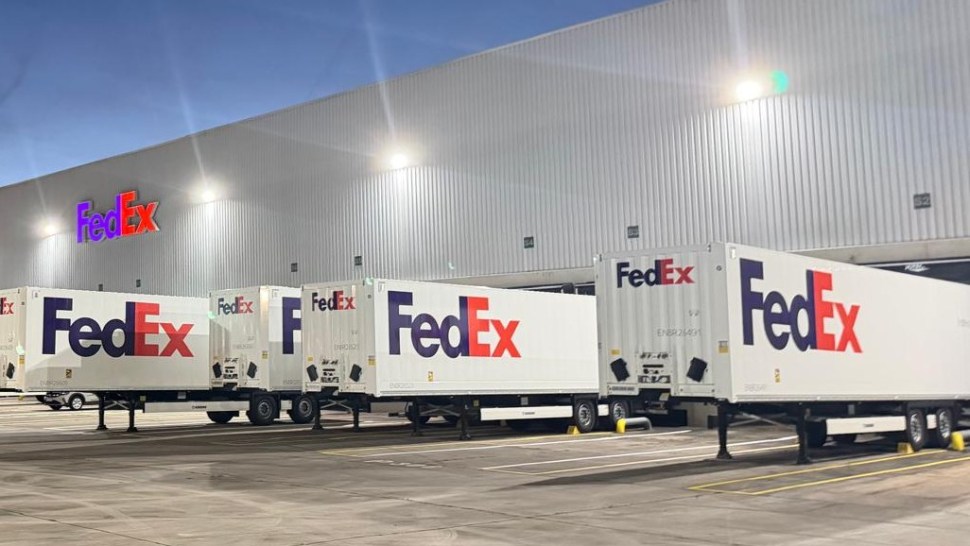
The company on Monday announced the opening of a new road hub in Alzenau, Germany, to support the movement of freight and bulk shipments across the country and Europe, just in time for the busy peak shipping season. The 166,840-square foot facility features 32 loading bays, trailer parking for 50 vehicles and will create about 85 jobs.
The FedEx (NYSE: FDX) terminal is located in an existing building and is equipped with state-of-the-art sorting and handling technology for processing freight, oversize boxes and parcels that are routed on a conveyor system.
“By enhancing our road network, we are creating greater connectivity, flexibility, and reliability for businesses. This investment strengthens our ability to help customers access new opportunities and grow their businesses, said Boris Stoffer, managing director network operations Germany at FedEx, in a news release on Monday.
Situated in the Rhine-Main region east of Frankfurt am Main airport, Alzenau benefits from easy access to Germany’s major transport corridors. Its proximity to existing FedEx facilities and direct connections to the A3 and A45 motorways position the site as an important gateway for domestic and international freight flows.
With the addition of Alzenau, FedEx now operates four road hubs in Germany, alongside facilities in Hanover, Nuremberg and Wiesbaden. The FedEx road network links 700 locations and gateways across 45 countries.
In June, FedEx completed the expansion of a large truck terminal in The Netherlands that streamlined freight flows.
Madrid airport upgrade
FedEx also has modernized its second airside facility at Madrid-Barajas International Airport in Spain, giving shippers access to more capacity and streamlined customs clearance.
The refurbished facility complements the existing FedEx installation at Madrid Airport, bringing the company’s total operating footprint to more than 48,400 square feet and strengthening its ability to respond to peak-season demand spikes and ensure consistent, fast delivery service, FedEx said in a news release last week.
The upgrade added 16,680 square feet of warehouse space, four dedicated trailer docks, a castor deck roller platform capable of handling and maneuvering up to 14 unit load devices, and a high-density storage area with secure space for 5,700 pieces.
The facility is also equipped with automated sorting systems, dimensioning and weighing equipment, and X-ray screening systems for shipment inspection. In addition, it features a temporary bonded warehouse, an authorized customs area designed to secure and manage international goods while corresponding customs clearance procedures are completed.
FedEx said the terminal modernization helps centralize express and economy shipping flows to and from the Canary Islands, simplifies customs formalities and shortens transit times. It also expands consolidation capacity for European Union economy shipments bound for key destinations across Latin America and the United States.
The facility also streamlines handling of international priority cargo and heavyweight goods, which fits with FedEx’s strategic focus on attracting more high-value, non-parcel cargo.
European consolidation
During an Oct. 28 briefing on third-quarter results, FedEx management described how it is consolidating fragmented country operations in Europe to make it easier for customers to manage shipments across an integrated cross-border network.
In France, the company has closed 17 stations, modernized two hubs and 16 stations by installing advanced, automated sorting systems, and equipped 32 stations with new tracking and monitoring technology.
FedEx is similarly simplifying operations to prioritize higher-value international B2B and export services in Italy. As part of this process, FedEx is transitioning from an eight-hub footprint to a highly streamlined three-hub footprint and actively reducing station count. In June, the company reached an important milestone when it consolidated two Milan area stations into a newly upgraded facility that allows more efficient pickup and delivery within one of the most densely populated areas of the country.
FedEx plans to reduce domestic capacity by 20% in Italy by 20%, 30% in the United Kingdom and 40% in France. CEO Raj Subramaniam said the company is now encouraging sales teams to pursue more intercontinental and intra-European volume and reduce lower-yielding intra-country business.
The integrator is on track to reach its target of $650 million in adjusted operating income in Europe by the end of 2029, he added.
Click here for more FreightWaves/American Shipper stories by Eric Kulisch.
RELATED STORIES:
DHL earmarks $450M for Eastern Europe logistics expansion
FedEx cashes in on premium logistics services, fuel surcharges
