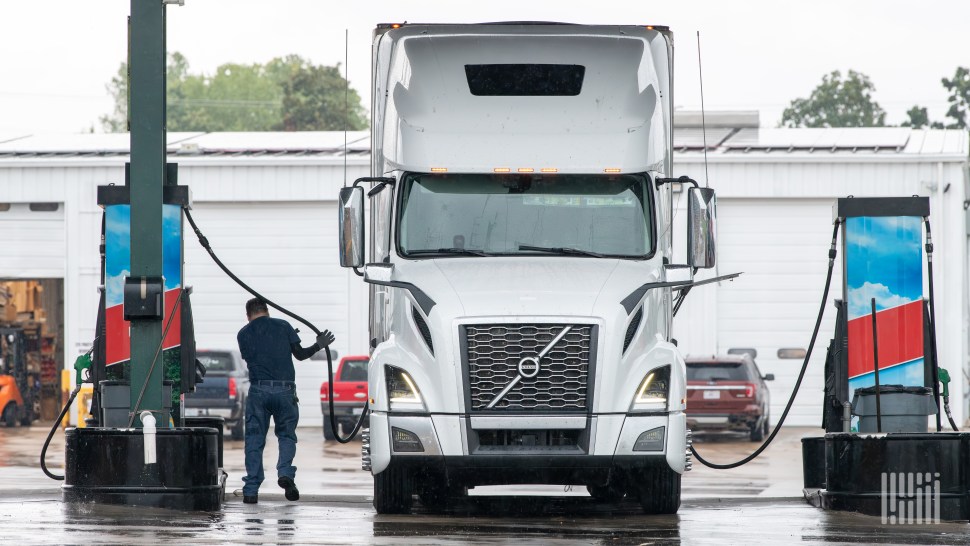
The executive order (EO) from President Donald Trump on implementing the red dye diesel tax break has been formally published, but it is thin on fixing a fundamental problem with the policy: state and federal rules are not in sync.
The executive order was published in the Federal Register Friday. It is just four pages in length.
After citing unspecified “historic efforts to ensure fuel affordability for our citizens,” the executive order says “it is clear that further temporary relief is necessary.”
The EO directs Secretary of the Treasury Scott Bessent to “use his authority to defer certain diesel fuel tax payment obligations.” Bessent also is to look at waiving penalties that might other be incurred for the use of red dye diesel in over the road applications.
Red dye diesel gets its name through the fact that it is red in appearance because a dye has been blended into it. The dye has no impact on its performance.
The dye is blended so that certain end uses, primarily agricultural, can consume red dye diesel and avoid paying the federal excise taxes of 24.3 cts/g. Federal excise taxes on diesel also include a 0.1 cts/g fee for the Leaking Underground Storage Tank Trust Fund Fee.
Break goes through December 31
The deferral period, if it is declared following a five-day review period, would be for October 5 through the end of the year.
But the goal is that the deferral be made permanent, so that the tax break for the remainder of the year ultimately would not need to be paid.
“The Secretary shall explore avenues, including legislation, to eliminate the obligation to pay the amounts deferred pursuant to the Secretary’s exercise of authority described in section 2 of this order,” the EO said.
But states have laws that prevent the consumption of red dye diesel on their respective roads. Wholesale and retail outlets are set up to provide a supply chain for non-dyed diesel which remains liable for the federal excise taxes, and that means they in only rare cases would have segregated tanks and pipelines that are targeted at red dye diesel.
The EO calls on the Treasury Secretary to “engage with State governments, relevant industry leadership as determined by the Administrator, and relevant labor organizations as determined by the Administrator to encourage safe and expedient coordination between the Federal Government and these various stakeholders in furtherance of the policies of this order.”
Some states already have acted
A wide range of states have changed their policies in recent weeks to allow red dye diesel on their roads. Texas, Indiana, Illinois, Nebraska, North Dakota, Ohio, Oklahoma, North Carolina, Arkansas and Alabama are all states that have made some sort of concession in their state rules to promote the use of red dye diesel and its lower cost.
But as has been noted by several critics of the red dye diesel policy, crossing from a state with a waiver into one that doesn’t have it is going to create a tax-paying nightmare for trucking companies. The extra bookkeeping effort may not be worth the tax break.
As Breakthrough Fuel said in a summary of the proposed change, after rating the impact from the tax shifts to be “low” at the retail level, it noted that “Highway lanes rarely carry dyed fuel, interstate routes cross non-relief states, and clear diesel pricing is unchanged by the order.”
The order also targets greater distribution by ordering the Treasury Secretary to “(coordinate) with agricultural cooperatives, rural fuel distributors, farm supply organizations, and other agricultural stakeholders, as determined by the Secretary of Agriculture, to ensure adequate distribution of dyed diesel for their use in high-demand areas.”
More articles by John Kingston
FMCSA’s Elison: ‘weeks’ away from fixing Motus user experience
Wall Street analysts positive on C.H. Robinson deal; S&P more cautious
FMCSA split sleeper berth pilot program moves closer to launch