The Port of Los Angeles’ sales pitch to importers in recent months has been: We have plenty of capacity now. No more ship queues. The port labor contract expired July 1, 2022, but there has been no major disruption to imports during negotiations on the new contract. No need to ship your goods all the way through the Panama Canal to the East or Gulf coasts. Come back to LA!
That sales pitch, to the extent it ever worked, died on Friday.
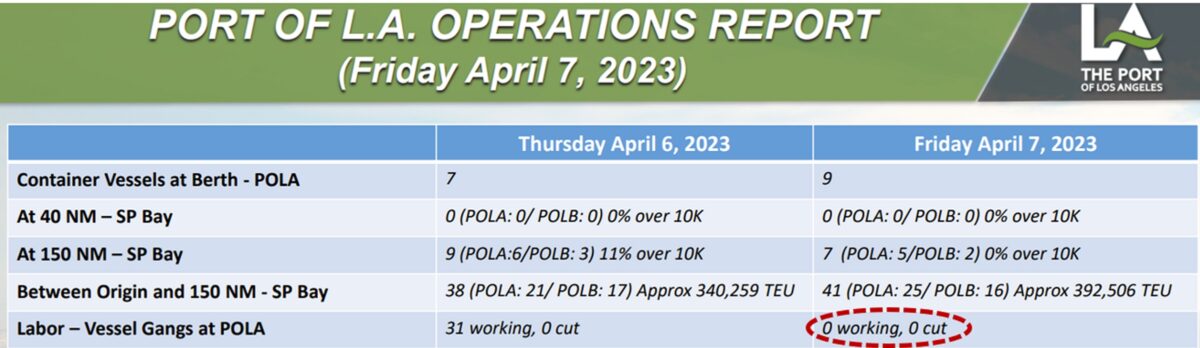
LA/LB closed for 24 hours
Terminal operations at the ports of Los Angeles and Long Beach were closed for Thursday’s night shift and Friday’s day shift. Work resumed with Friday’s night shift.
The Pacific Maritime Association (PMA), representing the terminals, said port facilities were closed due to the “concerted action to withhold labor” by the International Longshore and Warehouse Union (ILWU) Local 13.
The ILWU Local 13 said members didn’t show up Thursday night because they happened to be busy at a monthly membership meeting, where a new president was appointed. It said workers’ absence Friday was due to union members spending time with families for the religious holiday. (Labor action at West Coast ports does not have a history of being explicitly confirmed; rather, it takes the form of passive-aggressive behavior that escalates with increasingly implausible deniability.)
The National Retail Federation (NRF) communicated with the White House on Friday to voice its concerns about the situation. The NRF urged the Biden administration “to prevent any further disruptions.”
Exporters of agricultural goods that depend on Los Angeles and Long Beach took a hit from the shutdown.
Peter Friedmann, executive director of the Agriculture Transportation Coalition (AgTC), said Friday that “there have been periodic disruptions” since the last ILWU-PMA contract expired, but the impacts were more “subtle … until the current sudden shutdown of the ports of Los Angeles and Long Beach.”
One AgTC member had 10 trucks turned away from the Port of Long Beach on Thursday night, with containers of goods having to be stored at a yard near the port. This exporter incurred an added cost of $20,000, leading to a substantial loss on the international sale.
“This highly damaging experience is being repeated for thousands of containers,” said Friedmann.
Shift to East/Gulf Coast ports
U.S. import volumes are being sharply curtailed due to an inventory “bullwhip effect.” Importers brought in too much volume in the first half of last year. They’ve been working through bloated inventories ever since.
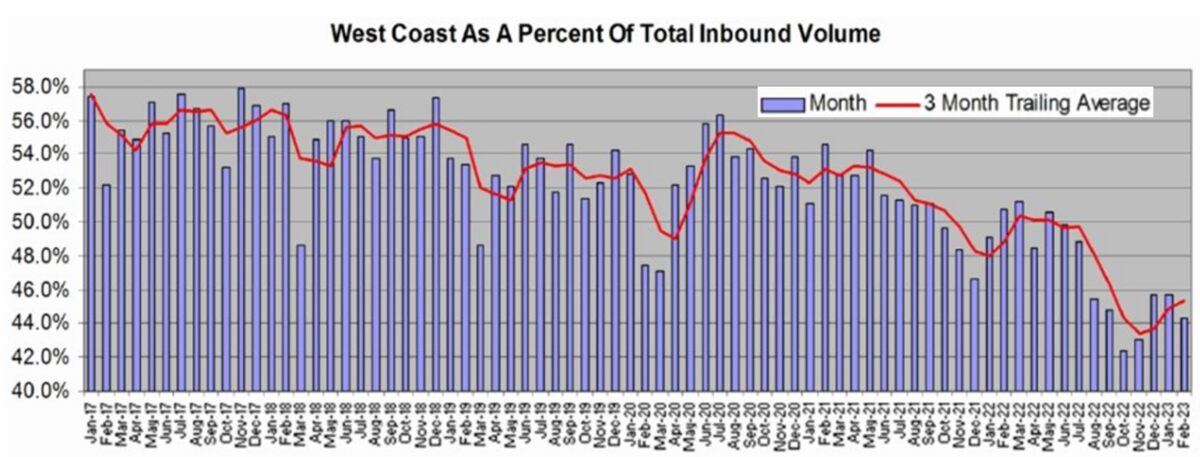
Meanwhile, now-validated concerns over West Coast labor disruptions due to the expired contract compelled U.S. importers to shift supply chains more toward East and Gulf Coast ports starting in mid-2022. As a result of these two trends, import volumes to all U.S. ports are falling, but much more precipitously at West Coast ports.
“February was the 21st straight month when the percentage change at East/Gulf Coast ports outperformed West Coast ports,” reported independent shipping analyst John McCown. The West Coast’s share of the country’s imports fell to 44%.
Importers planning the coming peak season’s import strategy have just been given a very clear reminder on the dangers of bringing some of their volumes back to the West Coast this year. Friday’s incident was a visceral confirmation that importers made the right decision to shift their cargo destinations.
Impact of past labor dispute — and what’s different
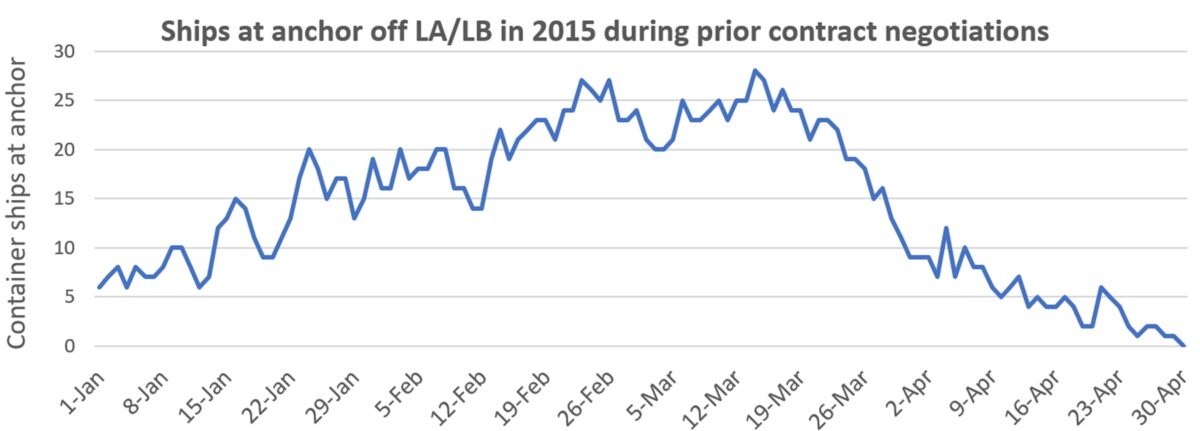
The previous ILWU-PMA labor contract negotiations, in 2014-2015, led to work slowdowns and significant congestion in Los Angeles and Long Beach. Container ships piled up at anchorages, similar to what occurred during the COVID import boom (albeit to a much lesser degree).
The landscape for Asia-U.S. supply chains is much different today, courtesy of what happened after the last ILWU-PMA contract negotiations: the debut of the larger Panama Canal locks in 2016 and the concurrent expansion and dredging of East and Gulf Coast ports to accommodate the larger vessels that can traverse the newer locks.
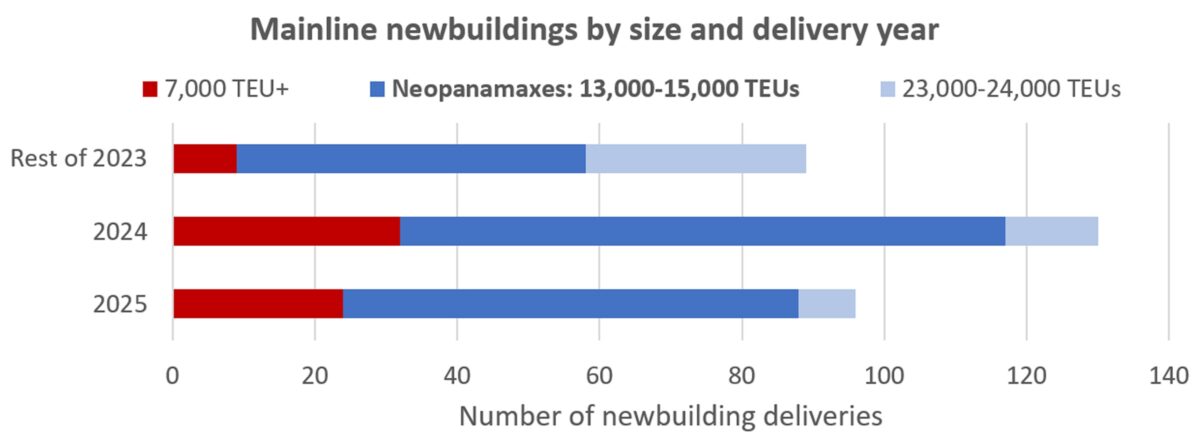
The container shipping industry is building a massive amount of new tonnage that is specifically designed for this route: so-called Neopanamaxes. According to Alphaliner, 60% of mainline newbuildings due for delivery in 2023-2025 are Neopanamaxes.
Permanent shift?
Even before Friday’s headline-grabbing shutdown, there was growing sentiment that the more recent gains of East and Gulf Coast ports were permanent.
Nerijus Poskus, vice president of ocean strategy at Flexport, told FreightWaves last month: “You have more shipping services to the East Coast than you’ve ever had before. You’ve built new supply chains. [Importers] can move back, but why would they?
“People have gotten used to this new reality. I don’t think this has that much to do with the risk of a strike on the West Coast anymore. I don’t see the West Coast gaining all its share back,” said Poskus.
That’s bad news for U.S. exporters. According to Friedmann, “Ocean carriers put vessels in service to carry the higher-value import consumer goods. They carry the relatively lower-value agriculture exports on the backhaul. As ships that carried imports that would have called on West Coast ports are now serving Gulf and East Coast ports, agriculture exports are jeopardized.”
Click for more articles by Greg Miller
Related articles:
- Crunch time for trans-Pacific container shipping contract talks
- West Coast wipeout: Los Angeles, Long Beach imports still sinking
- Imports sink again as wholesale inventories remain bloated
- ‘Colossal’ tidal wave of new container ships about to strike
- The Fed’s supply chain pressure gauge just went negative
- Container shipping market yet to bottom as spot rates keep slipping
- Container trade’s next turn: Price wars, cheap contracts, new ships
Brokerage Compliance Symposium
The day before F3. Every compliance issue you face - fraud exposure, carrier liability, FMCSA rules, cargo theft, insurance gaps - navigated by attorneys and operators defining best practices in a changing industry.
F3 Awards Dinner
The night before F3. FreightTech100 companies honored. FreightTech 25 and Shipper of Choice winners revealed live. Cocktail reception into dinner and live music - 300 industry leaders in one purpose-built room.
F3: Future of Freight Festival
Industry-defining keynotes, rapid-fire technology demos, and industry leaders networking in experiences across Chattanooga - plus the inaugural F3 Awards Dinner featuring the FreightTech and Shipper of Choice reveals.
The day before F3. Every compliance issue you face - fraud exposure, carrier liability, FMCSA rules, cargo theft, insurance gaps - navigated by attorneys and operators defining best practices in a changing industry.
The Signal at Chattanooga Choo Choo • Chattanooga, TN Register NowThe night before F3. FreightTech100 companies honored. FreightTech 25 and Shipper of Choice winners revealed live. Cocktail reception into dinner and live music - 300 industry leaders in one purpose-built room.
The Signal at Chattanooga Choo Choo • Chattanooga, TN Register NowIndustry-defining keynotes, rapid-fire technology demos, and industry leaders networking in experiences across Chattanooga - plus the inaugural F3 Awards Dinner featuring the FreightTech and Shipper of Choice reveals.
The Signal at Chattanooga Choo Choo • Chattanooga, TN Register Now